

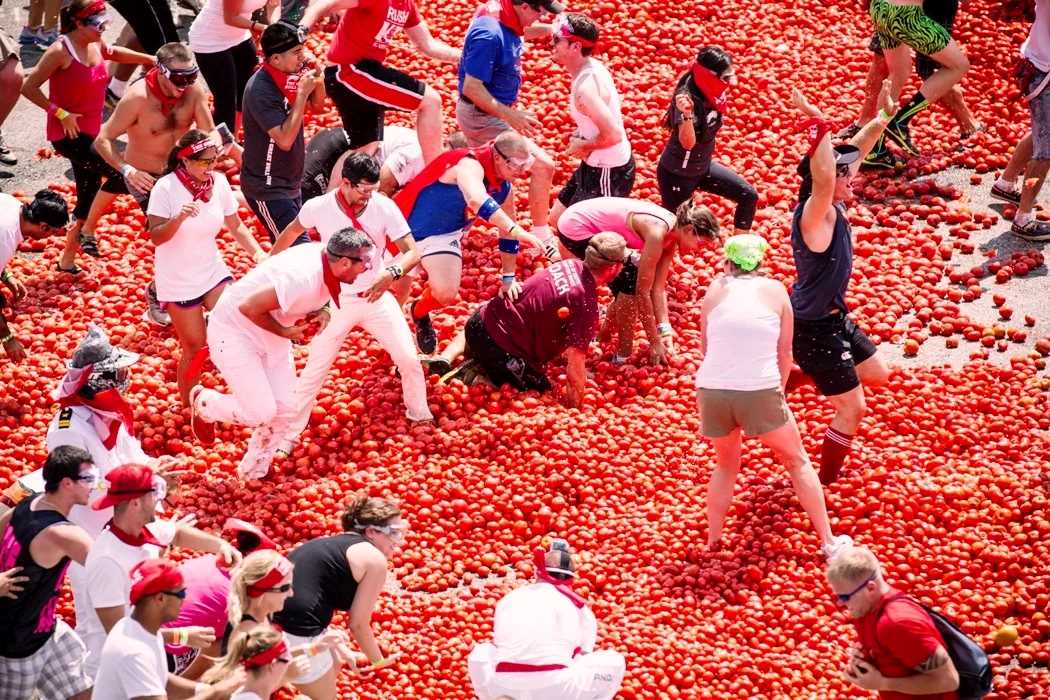
La Tomatina is one of the world’s most unusual, colorful and entertaining festivals. Every year, thousands of people gather in the small Spanish town of Buñol, near Valencia, to take part in an enormous, good-natured tomato-throwing battle.
Held traditionally on the last Wednesday of August, La Tomatina turns the streets of Buñol into a sea of red. The festival has its origins in an incident involving young people in 1945 and has developed from a local celebration into an internationally famous event. Spain’s official tourism portal classifies it as a Festival of International Tourist Interest. (Spain.info)


🇪🇸 What Is La Tomatina?
La Tomatina is a festival in which participants throw tomatoes at one another in a huge, organized, good-natured food fight.
The event takes place in Buñol, a town in the province of Valencia in eastern Spain. Buñol is approximately 39 kilometres from the city of Valencia. The town is also known for its medieval castle, historic centre and surrounding natural attractions. (Spain.info)
The tomato battle itself is relatively short, but it forms the spectacular centrepiece of a much larger day of celebration.
For a short period, streets, buildings, participants and even the surrounding ground become covered in tomato pulp.
📅 When Is La Tomatina Celebrated?
La Tomatina is traditionally held on the last Wednesday of August.
🍅 La Tomatina 2026
In 2026, La Tomatina takes place on Wednesday, August 26. (Spain.info)
The festival therefore coincides with August 26, making it an especially interesting international observance to include in an August 26 history and world-festivals resource.
📜 History of La Tomatina
The origins of La Tomatina date back to 1945.
According to the official festival history, a group of young people were attending festivities in Buñol, including a parade involving giant figures and other celebrations. During the event, a disturbance broke out, and people encountered a nearby vegetable stall.
Tomatoes became part of the ensuing chaotic food fight.
What began spontaneously was repeated the following year, with young people deliberately bringing tomatoes to recreate the event. The tradition continued despite attempts by authorities to stop it. (La Tomatina de Buñol 2026)
Thus, one of the world’s most famous festivals grew from a seemingly ordinary street disturbance.
🚫 The Festival Was Once Banned
La Tomatina’s history was not always smooth.
During the early 1950s, authorities prohibited the celebration. Participants nevertheless continued trying to organize the tomato battle.
In 1957, the festival was cancelled, but local residents responded with a symbolic demonstration known as the “Burial of the Tomato.”
A procession carried a coffin containing a tomato while musicians played funeral marches.
The protest became popular, and eventually the authorities allowed the celebration to return. (La Tomatina de Buñol 2026)
This episode became an important part of La Tomatina’s story.
🌍 From Local Tradition to International Festival
For many years, La Tomatina remained primarily a local celebration.
Its popularity gradually expanded, particularly as newspapers, television and later the internet and social media brought images of the spectacular red-covered streets to audiences around the world.
Today, people travel to Buñol from many countries specifically to experience the festival.
The official festival organization describes La Tomatina as a living tradition that has developed considerably since its beginnings in 1945 while retaining its original spirit. (La Tomatina de Buñol 2026)
Spain’s tourism authority recognizes the event as a Festival of International Tourist Interest. (Spain.info)
🍅 How Does La Tomatina Work?
The main tomato battle follows a recognizable sequence.
🌅 Morning — Participants Gather
The festivities begin in the morning, with participants gathering in the town.
According to Spain’s official tourism information, the day begins around 9:00 a.m. in the town square. (Spain.info)
🥖 Breakfast and Festivities
The town hall traditionally distributes bread or pastries to participants.
As more people arrive, the atmosphere becomes increasingly lively.
🥓 The Ham on the Greasy Pole
One of the traditional preliminary events involves a tall pole covered with soap or grease.
A ham is placed at the top.
Participants attempt to climb the slippery pole and reach the prize.
The challenge is difficult because the pole is deliberately made extremely slippery.
The crowd watches and cheers as participants attempt to reach the top.


💦 Water and the Crowd
Before the tomato battle begins, participants gather along the streets.
Water may be thrown from balconies, adding to the excitement and helping people prepare for the heat.
The streets gradually fill with participants.
🚚 The Arrival of the Tomato Trucks
The most eagerly anticipated moment arrives when trucks loaded with tomatoes enter the designated area.
The trucks carry enormous quantities of tomatoes that will become the festival’s “ammunition.”
When the tomatoes are unloaded, participants rush toward them.
🔔 The First Signal — The Battle Begins
At approximately 11:00 a.m., a signal announces the beginning of the tomato battle.
Tomatoes begin flying through the air.
People grab tomatoes from the trucks and throw them at other participants.
Within minutes, the streets become covered in tomato pulp and juice.
Spain’s official tourism description notes that successive trucks arrive with tomatoes until a second signal marks the end of the battle. (Spain.info)
🍅 The Golden Rule: Squash the Tomatoes
One of the most commonly cited safety practices is to crush or squash tomatoes before throwing them.
A whole tomato thrown with force can hurt someone.
Squashing it makes it softer and reduces the likelihood of injury.
The festival is intended to be a playful celebration rather than a genuinely aggressive fight.
🔔 The Second Signal — Stop!
After roughly an hour, a second signal announces that the tomato battle is over.
Participants are expected to stop throwing tomatoes.
The transformation is remarkable.
A street that was previously normal can suddenly resemble a river of tomato pulp.
Spain’s official tourism material describes the battle as lasting about an hour, while the broader festivities continue throughout the day. (Spain.info)
🚿 The Great Cleanup
After the battle comes one of the most practical parts of La Tomatina: cleaning up.
Participants and streets are washed down with water.
Firefighters, municipal workers and other personnel help clean the town.
Participants themselves also find ways to wash away the tomato pulp.
Many people emerge from the festival looking almost completely red.


👕 What Do People Wear?
The classic La Tomatina image is a crowd wearing white clothing covered in bright red tomato pulp.
Many participants wear:
- White T-shirts
- Shorts
- Old trousers
- Swimming clothing
- Closed shoes
- Goggles
- Waterproof pouches for valuables
Spain’s tourism material specifically recommends goggles and a white T-shirt as useful items for participants. (Spain.info)
Why white?
White clothing makes the red tomato stains dramatically visible and has become part of the visual identity of the festival.
🥽 Why Are Goggles Useful?
Goggles can help protect the eyes from:
- Tomato juice
- Tomato pulp
- Accidental impacts
- Water
- Crowded conditions
They are particularly useful because the battle involves tomatoes flying from many directions.
🎒 What Should Visitors Bring?
Someone attending La Tomatina should think carefully about what to bring.
Recommended:
- Old clothes
- Closed footwear
- Swimming goggles
- Waterproof phone pouch
- Minimal valuables
- Towel
- Change of clothes
- Drinking water
- Sun protection
Avoid:
- Expensive jewelry
- Valuable watches
- Important documents
- Fragile electronic equipment
- Clothing you want to keep clean
A smartphone can easily become covered in tomato pulp and water, so waterproof protection is sensible.
🎟️ Is La Tomatina Free?
The festival has evolved considerably over the years.
Modern La Tomatina uses a controlled access system because of the enormous number of visitors.
For 2026, Spain’s official tourism portal lists a general admission price of €10, while the official festival website provides current ticketing and access information. (Spain.info)
The official website also explains that a digital ticket must be exchanged at designated control points for an official wristband; the wristband is required for entry to the route. (La Tomatina de Buñol 2026)
For anyone actually planning to attend, current official instructions should always be checked before travelling.
👧 La Tomatina Infantil
La Tomatina also has a special version for children.
The Tomatina Infantil is organized for children approximately 4–14 years old.
It is held separately from the main festival, traditionally on the Saturday before the adult event, and is designed to provide children with a more controlled and family-oriented experience. (La Tomatina de Buñol 2026)
This allows children to experience the fun of the tomato tradition without being exposed to the same massive crowds as the main event.
🌱 What Happens to the Tomatoes?
The enormous quantity of tomatoes used in La Tomatina naturally raises questions about food waste.
The festival’s organizers and authorities have developed logistical and cleanup measures around the event.
It is important, however, to distinguish La Tomatina from ordinary tomato consumption: the tomatoes used for the battle are selected and handled for the event rather than simply representing food taken directly from people’s kitchens.
The environmental dimensions of large festivals—including water use, transportation, waste management and food use—remain reasonable subjects for discussion.
🧹 The Environmental Challenge
A festival involving thousands of people and large quantities of tomatoes inevitably creates environmental and logistical challenges.
Authorities have to deal with:
- Tomato waste
- Water consumption
- Plastic waste
- Transportation
- Crowd management
- Street cleaning
- Public sanitation
The cleanup operation is therefore an important part of making the event possible.
The tomato pulp itself can be washed away from the streets, leaving Buñol ready to return to normal life.
🏘️ Buñol — The Home of La Tomatina
Buñol is much more than La Tomatina.
The town lies in the Valencia region of Spain, surrounded by hills and natural landscapes.
Among its attractions are:
- 🏰 Buñol Castle
- ⛪ Historic churches
- 🌳 Parks and gardens
- 🏞️ Natural landscapes
- 💧 Turche Cave and waterfall
- 🏺 Archaeological attractions
Spain’s tourism authority highlights the town’s 13th-century castle, historic old quarter and surrounding natural sites. (Spain.info)


🎶 La Tomatina Is More Than a Tomato Battle
Although the tomato fight receives the world’s attention, La Tomatina is part of a broader festive atmosphere.
Music, dancing, food, social gatherings and other activities contribute to the celebration.
The tomato battle itself lasts only around an hour, but the festival atmosphere continues through the day and into the night. (Spain.info)
🌎 Why Is La Tomatina So Popular?
Several characteristics make La Tomatina internationally attractive.
🍅 It is unusual
Few festivals involve thousands of people throwing tomatoes at one another.
📸 It is visually spectacular
The combination of white clothing and red tomato pulp creates unforgettable photographs.
😄 It is playful
The event is intended as a celebration rather than a serious competition.
🌍 It attracts international visitors
People from different countries gather together in Buñol.
🏘️ It has a fascinating local history
Its origins lie in an apparently spontaneous local tradition that survived attempts to suppress it.
🧑🤝🧑 La Tomatina and Community Spirit
At its heart, La Tomatina is a community festival.
The tradition began locally and remained connected with the people of Buñol even as international tourism transformed it.
This combination of local identity and global participation is one reason the festival has remained so distinctive.
Visitors come from around the world, but the event remains rooted in a small Spanish town.
🧠 Interesting Facts About La Tomatina
1. 🍅 It began in 1945
The festival traces its origins to a disturbance involving young people.
2. 🇪🇸 It takes place in Buñol
Buñol is in Spain’s Valencia region.
3. 📅 It is held on the last Wednesday of August
This is the traditional date.
4. 🔴 The streets turn red
Tomato pulp covers participants and streets during the battle.
5. ⏰ The battle lasts about an hour
The wider festival lasts much longer. (Spain.info)
6. 🥓 A ham is traditionally placed on a slippery pole
Participants attempt to climb the pole before the tomato battle. (Spain.info)
7. 🚿 Cleaning is a major operation
Once the battle ends, participants and streets are washed down.
8. 👧 There is a children’s version
Tomatina Infantil offers children a separate experience. (La Tomatina de Buñol 2026)
9. 🌍 It has international recognition
La Tomatina has been designated a Festival of International Tourist Interest. (Spain.info)
10. 📸 It has become a global cultural icon
Images of the tomato-covered streets have helped make the festival famous worldwide.
⚠️ Safety at La Tomatina
Despite its playful nature, the festival requires common sense.
Participants should:
- Follow instructions from organizers.
- Avoid pushing or aggressive behavior.
- Squash tomatoes before throwing them.
- Protect their eyes.
- Wear suitable footwear.
- Keep valuables protected.
- Stay aware of vehicles and crowds.
- Stop immediately when the official signal is given.
- Follow instructions regarding entry and exit.
The objective is fun, not injury.
🍅 La Tomatina as a Symbol of Celebration
What makes La Tomatina especially fascinating is its transformation from a spontaneous local incident into a globally recognized cultural tradition.
It demonstrates how communities can turn an unusual event into a distinctive identity.
Today, the festival represents:
Fun + Community + Tradition + Tourism + Spanish Culture
Its famous red streets have become one of the most recognizable images associated with Spain’s summer festivals.
📊 La Tomatina — Quick Facts
| Category | Information |
|---|---|
| Name | La Tomatina |
| Meaning | The Tomato Festival |
| Location | Buñol, Valencia, Spain |
| Usual date | Last Wednesday of August |
| 2026 date | August 26, 2026 |
| Origin | 1945 |
| Main activity | Tomato-throwing battle |
| Battle duration | About one hour |
| International status | Festival of International Tourist Interest |
| Traditional preliminary event | Climbing a slippery pole for a ham |
| Children’s event | Tomatina Infantil |
| Main visual color | Red |
| Official website | La Tomatina de Buñol |
🌟 La Tomatina and Spanish Culture
Spain is famous for festivals that combine history, community, music, food and spectacle.
La Tomatina fits this tradition while remaining completely unique.
It is not a religious festival, national independence celebration or historical reenactment. Instead, it is essentially a joyful community tradition that developed into an international cultural event.
That unusual origin is part of its charm.
🍅 Conclusion
La Tomatina is one of the world’s most extraordinary festivals.
What began in Buñol in 1945 as a youthful disturbance involving tomatoes eventually became a famous international celebration. After periods of restriction and cancellation, the tradition survived and grew into an event attracting visitors from around the world. (La Tomatina de Buñol 2026)
Every August, Buñol becomes the centre of an unforgettable spectacle: trucks arrive loaded with tomatoes, participants gather in the streets, a signal announces the beginning, and for about an hour the town becomes a giant, good-natured tomato battlefield.
But La Tomatina is about more than throwing tomatoes. It represents community spirit, tradition, laughter, tourism and the ability of a small town to transform an unusual local custom into a globally recognized cultural celebration.
🍅 La Tomatina in one sentence:
A small-town Spanish tradition that turned a tomato fight into one of the world’s most famous festivals.
¡Viva La Tomatina! 🍅🇪🇸
Leave a Reply