

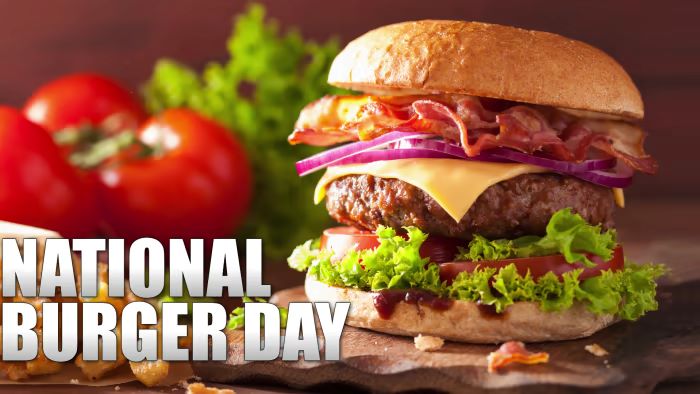
Celebrating One of the World’s Most Beloved Foods
National Burger Day is a food-themed observance celebrating the hamburger, one of the most recognizable and widely enjoyed foods in the world.
Burgers have evolved from a relatively simple combination of meat and bread into an enormous culinary category. Today, burgers can be found in fast-food restaurants, diners, food trucks, gourmet restaurants and home kitchens, with countless variations ranging from classic beef burgers to chicken, fish, vegetarian and plant-based burgers.
Important date note: The name National Burger Day is used for different observances in different countries, and the date is not universally fixed. August 27 is commonly listed by some calendars as National Burger Day in the United States, while the United Kingdom has traditionally celebrated its own National Burger Day on a different date. So it is best treated as an informal food observance rather than an official international day.
🍔 What Is a Burger?
A burger generally consists of a patty served inside a sliced bun, usually accompanied by toppings and sauces.
A classic hamburger may contain:
- 🍞 Bun
- 🥩 Beef patty
- 🧀 Cheese
- 🥬 Lettuce
- 🍅 Tomato
- 🧅 Onion
- 🥒 Pickles
- 🍅 Ketchup
- 🟡 Mustard
- Mayonnaise
But there are virtually unlimited combinations.
A burger can be simple or elaborate, inexpensive or gourmet, traditional or highly creative.
📜 The History of the Hamburger
The exact origin of the modern hamburger is debated.
The story is more complicated than the popular claim that a single person “invented” the hamburger.
The modern burger developed from several culinary traditions involving ground meat, meat patties and bread.
🇩🇪 The Hamburg Connection
The name hamburger is associated with Hamburg, Germany.
In 19th-century Germany, Hamburg steak referred to a preparation of chopped or minced beef.
German immigrants brought various meat preparations to the United States.
Over time, the meat patty became associated with being served between slices of bread or inside a bun.
🇺🇸 The American Hamburger
The hamburger as we know it today developed in the United States during the late 19th and early 20th centuries.
Several American restaurants and vendors have been credited with popularizing the hamburger.
Among the frequently mentioned claims are:
- Louis’ Lunch in New Haven, Connecticut
- White Castle
- Various diners, fairs and food stands
- Early American hamburger restaurants
Because several similar developments occurred around the same period, historians generally do not identify one universally accepted inventor.
🏰 White Castle and the Rise of the Burger
Founded in 1921, White Castle became one of America’s earliest major hamburger chains.
It helped establish the burger as an affordable, standardized restaurant food.
Its small square hamburgers became particularly famous.
The company’s approach influenced the development of the modern fast-food industry.
🍟 The Burger and Fast Food
During the 20th century, burgers became closely associated with fast food.
Large restaurant chains helped transform the hamburger into a global food.
Burgers became popular because they were:
- Fast to prepare
- Portable
- Relatively inexpensive
- Easy to customize
- Suitable for mass production
The growth of automobile culture and roadside restaurants also contributed to the burger’s popularity.
🌎 The Burger Goes Global
Today, burgers are eaten in countries across the world.
But they are rarely identical from one place to another.
Local cultures have adapted the burger to their own tastes.
You may find burgers incorporating:
- Spicy sauces
- Local cheeses
- Regional vegetables
- Fried eggs
- Pickled vegetables
- Seafood
- Local spices
- Traditional breads
This makes the burger an excellent example of global food culture adapting to local traditions.
🇮🇳 Burgers in India
India has developed its own vibrant burger culture.
Indian burger menus often include:
🥔 Aloo Tikki Burger
A potato-based patty inspired by Indian flavors.
🌶️ Masala Burger
A burger incorporating spicy Indian seasonings.
🧀 Paneer Burger
A popular vegetarian option using paneer.
🍗 Chicken Burger
Often seasoned with Indian spices.
🌱 Vegetarian and Plant-Based Burgers
A wide variety of meat-free burgers are available in India.
Indian burgers may feature ingredients such as:
- Coriander
- Green chili
- Cumin
- Garam masala
- Chaat masala
- Paneer
- Potato
- Mint chutney
🌴 Burgers in Kerala
Kerala’s food culture has also embraced the burger.
Modern cafés, bakeries and restaurants across Kerala offer numerous burger varieties.
Local flavors can appear through:
- Spicy chicken
- Kerala-style sauces
- Pepper seasoning
- Fried onions
- Cheese
- Green chili
- Coconut-based flavors
- Local vegetable fillings
The result is an interesting meeting point between global fast food and Kerala’s distinctive culinary traditions.
🍔 Different Types of Burgers
🥩 Classic Beef Burger
The traditional American-style hamburger usually features a beef patty.
🍗 Chicken Burger
Uses a chicken patty, which may be grilled, fried or crispy.
🐟 Fish Burger
Uses fish as the main protein.
🥬 Vegetable Burger
Made using ingredients such as:
- Beans
- Lentils
- Vegetables
- Grains
- Mushrooms
🌱 Plant-Based Burger
Designed to replicate some characteristics of meat while being made primarily from plant ingredients.
🧀 Cheeseburger
A burger topped with cheese.
Popular cheeses include:
- Cheddar
- American cheese
- Swiss cheese
- Mozzarella
- Blue cheese
🍄 Mushroom Burger
Can feature grilled or sautéed mushrooms as a topping or as part of the patty.
🧀 What Makes a Great Burger?
There is no single formula, but several elements contribute to a satisfying burger.
1. The Bun
The bun should complement the filling without overwhelming it.
Popular choices include:
- Brioche
- Sesame bun
- Potato bun
- Pretzel bun
- Whole-wheat bun
2. The Patty
The patty is the heart of the burger.
Its:
- Texture
- Seasoning
- Moisture
- Thickness
- Cooking method
all affect the final result.
3. The Toppings
Toppings add contrasting textures and flavors.
For example:
Crunchy lettuce + juicy tomato + creamy cheese + tangy pickles
creates a more interesting eating experience.
4. The Sauce
Sauces bring the components together.
Common choices include:
- Ketchup
- Mustard
- Mayonnaise
- Barbecue sauce
- Chili sauce
- Garlic sauce
- Special burger sauce
🧠 The Science of a Delicious Burger
A good burger often works because of contrast.
Think about:
Soft bun
Juicy patty
Crispy lettuce
Creamy cheese
Tangy pickles
Sweet or spicy sauce
The combination creates multiple flavors and textures in a single bite.
🔥 Popular Burger Cooking Methods
Burgers can be prepared in several ways.
Grilled
Cooked over direct heat, often producing a smoky flavor.
Pan-Fried
Cooked on a skillet or frying pan.
Griddled
Cooked on a flat hot surface.
Smash Burger
A ball of ground meat is pressed thinly onto a hot cooking surface, creating a browned, crispy exterior.
Baked
Some burger patties, particularly vegetarian varieties, can be baked.
🍔 Smash Burgers
The smash burger has become particularly popular in recent years.
Instead of forming a thick patty, the meat is placed on a very hot cooking surface and pressed flat.
This creates:
- A thin patty
- Crispy edges
- Strong browning
- A juicy center when properly cooked
The technique demonstrates the importance of the Maillard reaction, the chemical process responsible for many of the appealing browned flavors produced during cooking.
🥗 Are Burgers Healthy?
A burger can be part of a balanced diet, but nutritional value varies enormously.
A burger’s health profile depends on:
- Patty ingredients
- Portion size
- Cooking method
- Cheese
- Sauces
- Bun
- Added salt
- Side dishes
A burger loaded with multiple cheese slices, creamy sauces and fried toppings can be substantially higher in calories, saturated fat and sodium than a simpler burger.
On the other hand, burgers can be made with:
- Leaner proteins
- Whole-grain buns
- Beans
- Vegetables
- Lentils
- Plant-based patties
- Fresh toppings
The key is balance and moderation.
🍔 Burger and Food Culture
The hamburger represents much more than fast food.
It has become part of:
- American popular culture
- Road-trip culture
- Diner culture
- Sports events
- Barbecues
- Family meals
- Casual dining
- Global food culture
Few foods have achieved such widespread international recognition.
🌎 Famous Burger Styles
Different regions have developed distinctive burger traditions.
🇺🇸 American Classic
Beef patty, cheese, lettuce, tomato, onion, pickles and sauces.
🇯🇵 Japanese-Inspired Burgers
May incorporate teriyaki, Japanese sauces or other local ingredients.
🇮🇳 Indian Burger
Often includes potato, paneer or spiced vegetable patties.
🇲🇽 Mexican-Inspired Burger
May feature chili, avocado, salsa or jalapeños.
🇦🇺 Australian Burger
Australian-style burgers are sometimes associated with toppings such as beetroot and fried egg.
These variations show how a global food can acquire local identities.
👨🍳 How to Celebrate National Burger Day
🍔 1. Make Your Own Burger
Create a homemade burger and experiment with toppings.
Try:
Classic
Beef + cheddar + lettuce + tomato + pickles
Indian-inspired
Paneer or potato patty + mint chutney + onion + tomato
Vegetarian
Bean patty + lettuce + avocado + tomato
👨👩👧 2. Have a Family Burger Night
Let each family member design their own burger.
Set out:
- Buns
- Patties
- Cheese
- Vegetables
- Pickles
- Sauces
Everyone can create a personal combination.
🧑🍳 3. Organize a Burger Challenge
Friends can compete to create the most creative burger.
Possible categories:
🏆 Best Taste
🏆 Most Creative
🏆 Best Vegetarian Burger
🏆 Best Presentation
🏆 Best Local-Flavour Burger
🌱 4. Try a Meat-Free Burger
Celebrate the day with a:
- Bean burger
- Lentil burger
- Mushroom burger
- Paneer burger
- Vegetable burger
- Plant-based burger
🎓 Burger Day Activities for Students
Schools can turn the observance into a fun learning opportunity.
🌎 Geography
Identify major burger-producing and consuming regions.
📜 History
Research the evolution of the hamburger.
🧪 Science
Study the Maillard reaction and food chemistry.
📊 Mathematics
Calculate the cost of producing a homemade burger.
🥗 Nutrition
Compare the nutritional composition of different burger styles.
🎨 Art
Design an imaginary burger restaurant and create its logo and menu.
🧠 Fun Burger Facts
🍔 Fact 1
The hamburger’s name is connected to Hamburg, Germany, not the word “ham.”
🍔 Fact 2
There is no universally accepted single inventor of the modern hamburger.
🍔 Fact 3
Hamburgers became especially popular in the United States during the late 19th and early 20th centuries.
🍔 Fact 4
The hamburger has become a global food with countless regional variations.
🍔 Fact 5
A hamburger does not necessarily have to contain beef. Chicken, fish, vegetables, beans, lentils and plant-based ingredients can all be used.
🍔 Fact 6
The smash burger relies heavily on browning and the Maillard reaction for its characteristic flavor.
🍔 Fact 7
The burger is one of the world’s most recognizable symbols of American fast-food culture.
🍔 Fact 8
India has developed many vegetarian and spice-forward burger varieties.
🍔 Fact 9
The bun is not merely a container—it contributes flavor, texture and structural balance.
🍔 Fact 10
Burger toppings can reflect local food traditions, making the burger a fascinating example of culinary globalization.
🌟 Burger Day Message
“A great burger brings together simple ingredients, creative flavors and the joy of sharing good food.”
National Burger Day is a chance to appreciate the humble burger in all its forms—from the classic cheeseburger to creative vegetarian creations and regional versions inspired by cuisines around the world.
🍔 National Burger Day — Quick Facts
| Category | Information |
|---|---|
| Observance | National Burger Day |
| Common date listed in some calendars | August 27 |
| Type | Informal food observance |
| Main food | Hamburger |
| Historical association | Hamburg, Germany |
| Modern development | United States |
| Popular varieties | Beef, chicken, fish, vegetable, paneer and plant-based |
| Common toppings | Lettuce, tomato, onion, pickles and cheese |
| Popular cooking styles | Grilled, griddled, pan-fried and smashed |
| Global significance | Major symbol of modern casual and fast-food culture |
🍔 Conclusion
From roadside diners to gourmet restaurants and home kitchens, the hamburger has traveled an extraordinary culinary journey.
What began with traditions involving minced or chopped meat eventually evolved into one of the world’s most recognizable foods. Today, the burger is constantly being reinvented with new ingredients, cooking techniques and cultural influences.
Whether you prefer a classic cheeseburger, spicy chicken burger, crispy fish burger, paneer burger, vegetable burger or plant-based creation, National Burger Day is a delicious excuse to appreciate this remarkable food.
So gather your favorite toppings, try a new combination, share a meal with friends or family—and enjoy one of the world’s most famous comfort foods.
🍔 Happy National Burger Day!
Build it. Bite it. Enjoy it! 🍔✨
Leave a Reply