

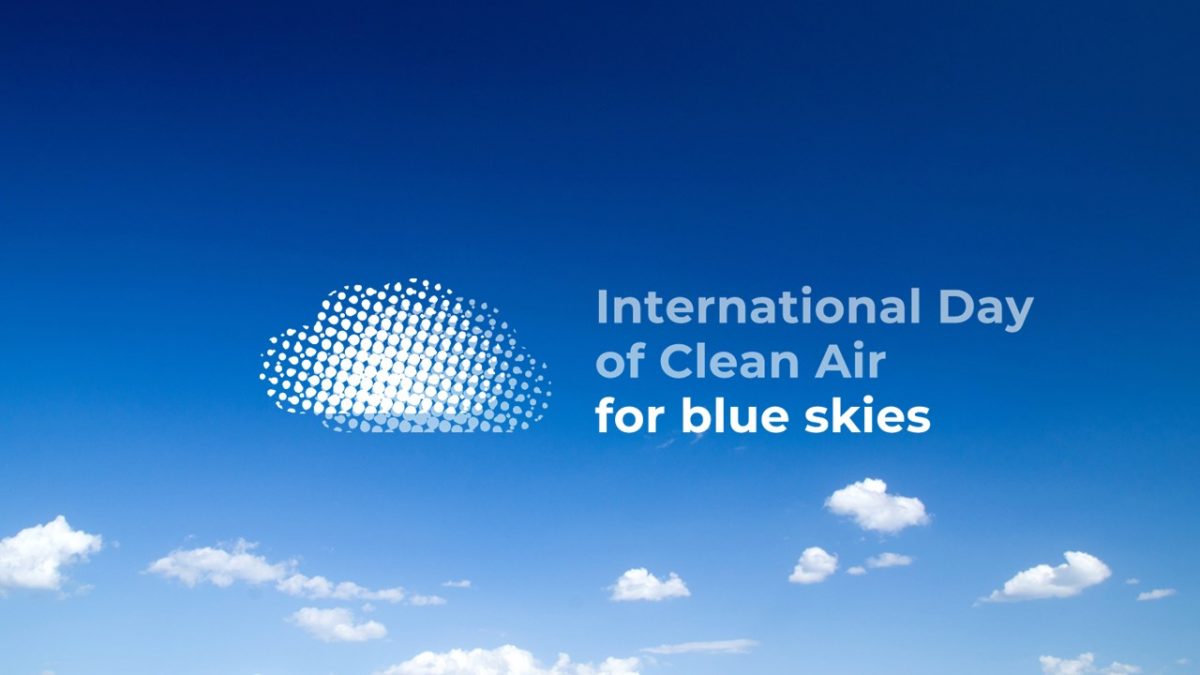
September 7 | Breathing Clean Air for a Healthier People and a Healthier Planet
Every human being takes thousands of breaths each day, yet the quality of the air we breathe is often taken for granted. International Day of Clean Air for Blue Skies, observed annually on September 7, reminds the world that clean air is fundamental to human health, environmental sustainability and a better quality of life.
Established by the United Nations General Assembly in 2019, the International Day was first observed on September 7, 2020. The United Nations Environment Programme (UNEP) facilitates the observance. The Day seeks to raise awareness about air pollution and encourage governments, businesses, communities and individuals to take action for cleaner air. (UNEP – UN Environment Programme)


🌎 What Is International Day of Clean Air for Blue Skies?
International Day of Clean Air for Blue Skies is a global observance dedicated to improving air quality and protecting people and the planet from the harmful effects of air pollution.
The UN established the Day because air pollution is not confined by national borders. Pollutants released in one location can travel long distances and affect people, ecosystems and the climate elsewhere. Consequently, cleaner air requires cooperation among countries, cities, industries, communities and individuals. (UNEP – UN Environment Programme)
The observance also emphasizes an important idea: clean air is not a luxury; it is essential for healthy living.
📜 History of the Day
The UN General Assembly adopted Resolution 74/212 in 2019, designating September 7 as the International Day of Clean Air for Blue Skies. The resolution called for greater public awareness and stronger action to improve air quality. (UNEP – UN Environment Programme)
The first observance took place on September 7, 2020, under the theme “Clean Air for All.” The initiative was strongly supported by the Republic of Korea and is facilitated by UNEP. (UNEP – UN Environment Programme)
Since then, the annual observance has provided an international platform for governments, scientists, environmental organizations, businesses and citizens to discuss air pollution and promote practical solutions.
🌫️ What Is Air Pollution?
Air pollution occurs when harmful substances enter the atmosphere in concentrations that can damage human health, ecosystems, buildings or the climate.
Major air pollutants include:
- Particulate matter (PM2.5 and PM10)
- Nitrogen dioxide (NO₂)
- Sulfur dioxide (SO₂)
- Carbon monoxide (CO)
- Ozone at ground level
- Volatile organic compounds
- Black carbon and other pollutants
Some pollutants are visible as smoke or smog, but many dangerous pollutants are invisible. This makes air pollution particularly difficult to recognize without monitoring equipment.
UNEP notes that air pollution remains one of the greatest environmental threats to human health and that it is closely connected with climate change. (UNEP – UN Environment Programme)
🏭 Major Causes of Air Pollution
Air pollution comes from both human activities and natural sources.
1. Transportation
Cars, buses, trucks, ships and aircraft can release pollutants through the combustion of fossil fuels.
The transition to electric mobility, public transportation, cycling and walking can help reduce emissions.
2. Industries
Factories and industrial facilities can release particulate matter, sulfur compounds, nitrogen oxides and other pollutants.
Cleaner technologies, better emission controls and renewable energy can significantly reduce industrial pollution.
3. Burning Fossil Fuels
Coal, oil and gas used for electricity, heating and transportation are major sources of air pollution and greenhouse-gas emissions.
Moving toward renewable sources such as solar and wind power offers benefits for both air quality and climate protection. (United Nations)
4. Household Pollution
Cooking and heating with polluting fuels and inefficient technologies can create dangerous indoor air pollution.
5. Open Burning and Waste
Burning garbage, agricultural residues and other materials releases smoke and toxic substances into the atmosphere.
Better waste management and recycling can reduce this problem.
6. Agriculture
Agricultural activities can contribute to air pollution through burning, livestock emissions and the use of certain fertilizers.
7. Wildfires and Natural Sources
Wildfires, dust storms and volcanic activity can also contribute to poor air quality. Climate change can worsen some conditions that increase the risk or intensity of wildfire smoke.
❤️ Health Effects of Air Pollution
Air pollution can affect almost every part of the human body.
Long-term exposure is associated with diseases and conditions including:
- Heart disease
- Stroke
- Lung cancer
- Chronic respiratory diseases
- Asthma
- Respiratory infections
- Reduced lung development in children
- Premature death
Children, older people and individuals with existing health vulnerabilities can be particularly affected.
UNEP has reported that air pollution is responsible for millions of premature deaths each year. Estimates vary according to methodology and year, but recent assessments have placed the annual burden at more than eight million premature deaths. (UNEP – UN Environment Programme)
🌱 Air Pollution and Climate Change
Air pollution and climate change are closely interconnected.
Many activities that produce greenhouse gases also produce air pollutants. For example, burning coal, oil and gas can simultaneously contribute to climate change and deteriorating air quality.
Therefore, measures such as:
- renewable energy,
- energy efficiency,
- cleaner transportation,
- improved waste management,
- reduced fossil-fuel consumption,
can provide a double benefit: reducing air pollution while helping to address climate change. (United Nations)
💙 Why Are Blue Skies Important?
The phrase “Blue Skies” represents more than beautiful scenery.
A clear blue sky is a powerful symbol of:
- Clean and breathable air
- Healthy communities
- Environmental responsibility
- A sustainable future
- Cooperation between nations
- The right of people to live in a healthy environment
The goal is not merely to make cities look cleaner. It is to create environments where people can live, work, study and breathe safely.
🌍 Air Pollution Knows No Borders
One of the most important messages of the Day is that air pollution is a transboundary problem.
Smoke, fine particles and other pollutants can travel across cities, states and national borders. Consequently, one country cannot solve every aspect of air pollution by acting alone.
International cooperation is therefore essential.
Governments can share:
- Air-quality data
- Scientific research
- Clean technologies
- Monitoring systems
- Best practices
- Pollution-control strategies
The UN has repeatedly emphasized the need for coordinated action because air pollution affects human health, ecosystems and economies across borders. (UNEP – UN Environment Programme)
🇮🇳 Clean Air and India
Air quality is also a major environmental and public-health concern in India.
Rapid urbanization, transportation, industrial activity, construction, waste burning and other sources can contribute to air pollution in different parts of the country.
India has developed national and city-level initiatives to improve air quality, including the National Clean Air Programme (NCAP) and efforts to strengthen air-quality monitoring and public awareness.
The UN Environment Programme has also worked with Indian institutions and organizations to strengthen air-quality management capacity. (The United Nations in India)
For India, clean-air action is especially important because improving air quality can simultaneously contribute to better public health, more livable cities and climate action.
🏙️ How Can Cities Achieve Cleaner Air?
Cities can take many practical steps.
🚍 Promote public transportation
Efficient buses, metro systems and other forms of public transportation can reduce the number of private vehicles on roads.
🚲 Encourage cycling and walking
Safe pedestrian and cycling infrastructure can reduce vehicle dependence while encouraging healthier lifestyles.
🌳 Increase green spaces
Urban trees and vegetation can contribute to healthier and more pleasant urban environments, although greenery should complement—not replace—direct emissions reduction.
⚡ Expand clean energy
Renewable energy can reduce dependence on fossil fuels and associated pollution.
🏭 Strengthen industrial controls
Industries should use cleaner production technologies and comply with emission standards.
♻️ Improve waste management
Proper collection, recycling, composting and disposal can reduce open burning.
📡 Strengthen air-quality monitoring
Reliable monitoring allows authorities and citizens to understand pollution patterns and respond effectively.
👨👩👧 What Can Individuals Do?
Clean air is a shared responsibility. Individual choices cannot replace strong government and industrial action, but millions of responsible choices can contribute to broader change.
Individuals can:
- Use public transportation whenever practical.
- Walk or cycle for short journeys.
- Avoid unnecessary vehicle idling.
- Maintain vehicles properly.
- Save electricity.
- Choose energy-efficient appliances.
- Avoid burning leaves and household waste.
- Reduce, reuse and recycle materials.
- Plant and protect appropriate trees and vegetation.
- Support policies and community initiatives that promote clean air.
- Stay informed about local air-quality conditions.
- Encourage schools and workplaces to adopt clean-air practices.
UNEP similarly recommends energy conservation, efficient technologies, cleaner transport, responsible waste practices and community participation. (UNEP – UN Environment Programme)
🎯 Themes of the International Day
The observance has featured different themes over the years:
| Year | Theme |
|---|---|
| 2020 | Clean Air for All |
| 2021 | Healthy Air, Healthy Planet |
| 2022 | The Air We Share |
| 2023 | Together for Clean Air |
| 2024 | Invest in #CleanAirNow |
| 2025 | Racing for Air |
| 2026 | Focus on the economic case for integrated climate and clean-air action |
The 2026 observance highlights findings from a global economic assessment by UNEP and the Climate and Clean Air Coalition, emphasizing that coordinated clean-air and climate action can improve public health, strengthen economies and advance climate goals. (UNEP – UN Environment Programme)
💡 10 Interesting Facts About Clean Air
1. Air pollution can be invisible
Some of the most dangerous pollutants cannot be seen with the naked eye.
2. PM2.5 is extremely small
Fine particulate matter can penetrate deep into the respiratory system and is a major health concern.
3. Air pollution and climate change are connected
Many sources contribute simultaneously to both problems.
4. Pollution can travel long distances
Air pollution does not necessarily remain where it was produced.
5. Children are particularly vulnerable
Their developing bodies and lungs can be affected by polluted air.
6. Indoor air can also be polluted
Household cooking and heating practices can produce significant pollution.
7. Clean energy can provide multiple benefits
Replacing fossil fuels can help reduce both air pollutants and greenhouse gases.
8. Urban transport matters
Vehicle emissions can be an important contributor to air pollution in cities.
9. Waste burning is harmful
Open burning can release particulate matter and toxic substances.
10. Everyone has a role
Governments, industries, scientists, communities and individuals all have responsibilities in creating cleaner air.
🌏 The Message of September 7
International Day of Clean Air for Blue Skies reminds us that the air we share connects us all.
A polluted atmosphere does not respect political boundaries, economic differences or geographical borders. The solution therefore requires cooperation at every level—from international agreements and national policies to cleaner cities and responsible individual choices.
Clean air means more than a beautiful blue sky. It means healthier children, stronger communities, more resilient ecosystems and a safer future.
The United Nations describes air pollution as a major environmental health risk while emphasizing that solutions are available and can also benefit climate action and economic resilience. (United Nations)
💙 A Call to Action
On September 7, let us remember a simple truth:
Clean air is everyone’s right, and protecting it is everyone’s responsibility.
Governments must strengthen policies. Industries must reduce emissions. Cities must invest in sustainable transportation and infrastructure. Communities must protect their environment. And individuals can make cleaner choices every day.
A blue sky should not be a rare sight.
It should be the normal sky of a healthy planet.
International Day of Clean Air for Blue Skies
September 7
Breathe Clean. Live Healthy. Protect the Planet.
Leave a Reply