

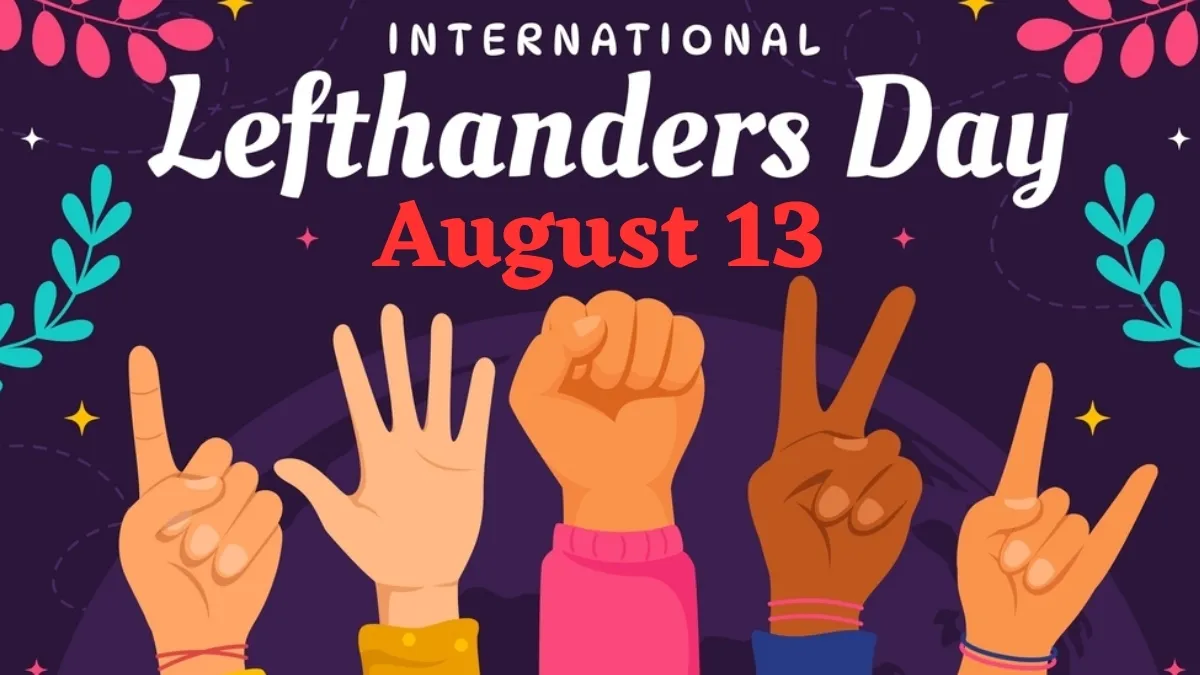
International Left-Handers Day is observed every year on August 13 to celebrate left-handed people around the world and to raise awareness of the advantages and challenges associated with being left-handed.


What Is International Left-Handers Day?
International Left-Handers Day is an annual observance dedicated to the estimated 10 percent of the world’s population who are left-handed. The day celebrates left-handedness as a natural variation in human behavior and encourages greater understanding of the experiences of left-handed people.
Left-handed people often use their left hand for activities such as writing, drawing, eating, throwing and operating tools. However, being left-handed does not mean that every activity is necessarily performed with the left hand. Many left-handed people develop a mixture of left- and right-handed preferences depending on the activity.
History of International Left-Handers Day
International Left-Handers Day was established in 1992 by the Left-Handers Club, an organization founded in the United Kingdom to promote awareness of the needs and experiences of left-handed people.
The first International Left-Handers Day was observed on August 13, 1992.
The choice of August 13 was intended to draw attention to left-handedness and challenge the negative attitudes that left-handed people have sometimes encountered throughout history.
Since then, August 13 has become an opportunity for left-handed people and their families, schools, workplaces and communities to recognize left-handedness and discuss the practical difficulties that can arise in environments designed primarily for right-handed users.
How Common Is Left-Handedness?
Left-handedness is relatively uncommon but certainly not rare. Research generally places the proportion of left-handed people at around 10 percent of the global population, although the exact percentage varies according to the population studied and how handedness is measured.
The preference for one hand develops through a complex interaction of genetic, developmental and environmental factors. Scientists have found associations between handedness and brain organization, but there is no single “left-handed gene” that determines whether someone will be left- or right-handed.
Left-Handedness and the Brain
One of the fascinating aspects of handedness is its relationship with the brain.
The human brain is divided into two hemispheres, and the two sides work together while performing most activities. Motor control is generally organized in a way that means the left side of the body is primarily controlled by the right hemisphere of the brain, while the right side is primarily controlled by the left hemisphere.
However, the relationship between handedness and brain organization is not as simple as saying that left-handed people “use the right side of their brain.” Both hemispheres participate in many complex activities, and individual patterns of brain organization vary considerably.
Challenges Faced by Left-Handed People
Modern society is largely designed around the needs of right-handed people. This can create small but sometimes frustrating difficulties for left-handed individuals.
Examples include:
- Desks designed primarily for right-handed students
- Scissors that work more comfortably in the right hand
- Computer mice positioned on the right side
- Certain sports equipment designed for right-handed players
- Writing in notebooks or binders where the hand may collide with rings or bindings
- Tools and machinery designed primarily for right-handed operation
- Writing systems in which the left hand can smear freshly written text
For many people these difficulties are minor, but they can become significant when suitable alternatives are unavailable.
Left-Handedness in Schools
Schools have historically been an important setting for discussions about left-handedness.
In some cultures and historical periods, children were discouraged—or even forced—to write with their right hands. Such practices were often based on cultural beliefs rather than scientific evidence.
Today, educators generally recognize that left-handedness is a natural human variation. Children should not normally be forced to change their natural hand preference simply because it differs from that of most classmates.
Providing suitable seating, writing materials and desks can make classroom life more comfortable for left-handed students.
Famous Left-Handed People
History and contemporary culture include many prominent left-handed people.
Among those frequently identified as left-handed or having strong left-handed preferences are:
- Leonardo da Vinci – Renaissance artist, scientist and inventor
- Michelangelo – Renaissance artist
- Napoleon Bonaparte – French military and political leader
- Helen Keller – American author and activist
- Mahatma Gandhi – Indian independence leader, commonly reported as left-handed in some sources, although accounts of his handedness vary
- Marie Curie – pioneering physicist and chemist, sometimes included in lists of left-handed historical figures, although evidence is not definitive
- Jimi Hendrix – legendary American guitarist
- Paul McCartney – musician and member of The Beatles
- Bill Gates – American technology entrepreneur
- Barack Obama – former President of the United States
Some historical claims about famous people’s handedness are uncertain, so individual examples should be treated carefully.
Left-Handedness and Creativity
Left-handed people are sometimes popularly described as being more creative, artistic or intelligent. Famous left-handed artists, musicians, scientists and leaders have contributed to this perception.
However, being left-handed does not automatically make a person more creative or intelligent. Scientific research has not established a simple rule that left-handed people are inherently more creative than right-handed people.
What is clear is that left-handed people have made important contributions across virtually every field of human activity.
Left-Handedness in Sports
Left-handed athletes can sometimes have an interesting advantage because right-handed opponents may have less experience competing against them.
This can be particularly noticeable in sports such as:
- Tennis
- Boxing
- Cricket
- Baseball
- Table tennis
- Badminton
- Fencing
In cricket, for example, left-handed batsmen and bowlers can create different angles and tactical challenges for opponents who are accustomed to right-handed players.
Celebrating International Left-Handers Day
International Left-Handers Day is not simply about celebrating a physical characteristic. It is also about acceptance, inclusion and accessibility.
Schools can recognize left-handed students by providing appropriate desks and scissors. Workplaces can consider whether tools and equipment accommodate different users. Families can encourage children to develop their natural abilities without unnecessary pressure to conform.
Individuals can also use August 13 to learn more about the fascinating science of handedness.
Interesting Facts About Left-Handedness
🖐️ About one in ten
Approximately one person in every ten is left-handed.
🧠 It is connected with brain organization
Hand preference is associated with the way the brain organizes motor functions, although the relationship is complex.
✍️ Writing can be challenging
Left-handed writers may have to adapt their hand position to avoid covering or smearing what they have just written.
⚽ Left-handed athletes can surprise opponents
Because most athletes are right-handed, opponents may have less experience dealing with left-handed playing styles.
👶 Children develop hand preferences gradually
Hand preference becomes increasingly established during childhood, although development differs from one individual to another.
🌍 Left-handedness occurs across cultures
Left-handed people are found in populations throughout the world.
A Message of Inclusion
International Left-Handers Day offers a simple but meaningful message: being different from the majority does not mean being less capable.
A world designed primarily for right-handed people can sometimes overlook the needs of left-handed individuals. Small changes—such as providing suitable equipment, allowing children to use their naturally preferred hand and designing spaces for different users—can make everyday life more inclusive.
Conclusion
International Left-Handers Day, celebrated on August 13, is a day to recognize and appreciate left-handed people around the world. It provides an opportunity to learn about handedness, challenge outdated misconceptions and encourage environments in which everyone can use their natural abilities comfortably.
From artists and musicians to athletes, scientists, leaders and ordinary people going about their daily lives, left-handed individuals have always been an important part of human society.
August 13 reminds us that the world does not have to be designed for everyone to be the same. Diversity—including the diversity of how we use our hands—is one of the fascinating characteristics of humanity.
Leave a Reply