

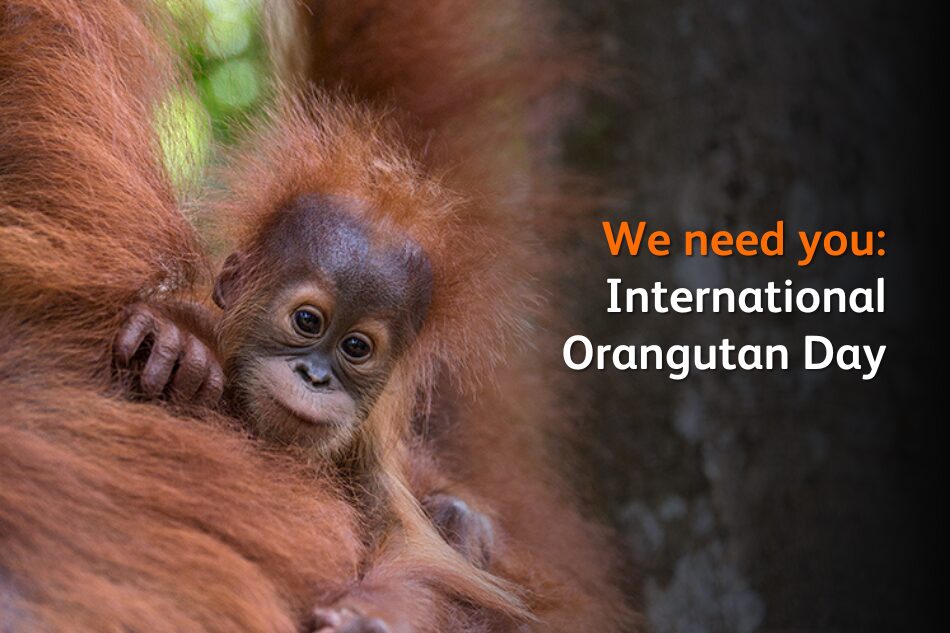
Observed annually on August 19
International Orangutan Day, observed every year on August 19, is a global awareness day dedicated to celebrating orangutans and drawing attention to the serious threats facing these remarkable great apes. The day encourages people to learn about orangutans, support their conservation, and help protect the tropical forests on which they depend.
Orangutans are among the world’s most intelligent and fascinating animals. Known for their reddish-orange hair, expressive faces, remarkable problem-solving abilities, and strong family relationships, they play an important role in the ecosystems of Southeast Asia.
Their survival, however, is closely connected to the survival of their rainforest habitat.


What Is International Orangutan Day?
International Orangutan Day provides an opportunity to raise awareness about the conservation of orangutans and the forests of Indonesia and Malaysia where they live.
The word orangutan comes from the Malay and Indonesian expression “orang hutan,” meaning “person of the forest.” The name reflects the animal’s remarkable intelligence and its close relationship with its forest environment.
The day encourages individuals, schools, conservation organizations, governments, businesses, and communities to take action to protect orangutans and their habitats.
What Is an Orangutan?
Orangutans are great apes belonging to the genus Pongo. Unlike gorillas, chimpanzees, and bonobos, which are native to Africa, orangutans are found naturally in Southeast Asia.
There are three recognized species of orangutan:
- Bornean orangutan (Pongo pygmaeus)
- Sumatran orangutan (Pongo abelii)
- Tapanuli orangutan (Pongo tapanuliensis)
The Tapanuli orangutan was scientifically recognized as a separate species in 2017. It has one of the smallest populations among the great apes and is considered critically endangered.
Where Do Orangutans Live?
Wild orangutans are found on the islands of Borneo and Sumatra in Southeast Asia.
Their habitat consists primarily of tropical forests, including:
- Lowland rainforests
- Peat-swamp forests
- Mountain forests
- Tropical forests near rivers and wetlands
Orangutans spend much of their lives in trees. Their long arms, strong hands, and flexible feet make them highly adapted to an arboreal lifestyle.
Their forests provide them with food, shelter, nesting materials, and opportunities for raising their young.
Three Species of Orangutan
Bornean Orangutan
The Bornean orangutan is found on the island of Borneo. It is generally larger and darker than the Sumatran species.
Bornean orangutans face serious threats from habitat destruction, hunting, and human-wildlife conflict.
Sumatran Orangutan
The Sumatran orangutan lives mainly in northern Sumatra. It is generally more social than the Bornean species and has distinctive physical characteristics.
Its remaining habitat has been severely reduced, making conservation efforts extremely important.
Tapanuli Orangutan
The Tapanuli orangutan is found in a relatively small region of the Batang Toru ecosystem in northern Sumatra.
It is considered one of the world’s most endangered great apes. Its restricted geographic range makes the species particularly vulnerable to habitat loss and other disturbances.
Remarkable Intelligence
Orangutans are extraordinarily intelligent animals.
Researchers have observed them using tools, solving problems, learning from one another, and remembering locations of seasonal food sources.
They can use leaves as umbrellas, create tools for obtaining food, and construct sophisticated sleeping nests high in trees.
Their intelligence provides evidence of the remarkable cognitive abilities found among great apes.
Orangutans and Their Young
One of the most beautiful aspects of orangutan life is the close relationship between mothers and their offspring.
Young orangutans depend heavily on their mothers for several years. Mothers teach their young where to find food, how to move safely through the forest, how to construct nests, and how to recognize dangers.
This extended childhood is unusual among mammals and reflects the complexity of orangutan development.
Young orangutans gradually develop the skills necessary to survive independently.
Orangutans: The Great Apes of the Forest
Orangutans spend more time in trees than most other great apes.
Their long arms allow them to move between branches, while their strong hands and feet provide an excellent grip.
They construct sleeping nests in trees using branches and leaves. Some orangutans build new nests every night.
Their arboreal lifestyle makes them especially dependent on continuous forest habitat.
The Importance of Orangutans to the Ecosystem
Orangutans are not merely inhabitants of the rainforest. They also contribute to the health of the ecosystem.
They eat a wide variety of fruits and other plant material. When they consume fruits and move through the forest, they help disperse seeds.
Some seeds can travel considerable distances from the parent plant after passing through the digestive system of an orangutan.
In this way, orangutans contribute to forest regeneration and biodiversity.
Protecting orangutans therefore means protecting an entire ecosystem.
Major Threats to Orangutans
Despite their intelligence and ecological importance, orangutans face severe threats.
1. Deforestation
The destruction of tropical forests is one of the greatest dangers.
Forests are cleared for agriculture, plantations, roads, mining, settlements, and other development.
When forests disappear, orangutans lose their food sources, nesting sites, and safe movement corridors.
2. Palm Oil Production
Palm oil is an important agricultural commodity used in thousands of products around the world.
Unsustainable expansion of oil-palm plantations has contributed to the loss and fragmentation of orangutan habitat in parts of Indonesia and Malaysia.
However, palm oil itself is not inherently the enemy. Sustainable production, responsible land-use planning, stronger enforcement, and protection of high-value forests can help reduce environmental damage.
3. Hunting and Illegal Wildlife Trade
Orangutans can be hunted illegally, while young animals may be captured for the illegal pet trade.
Because young orangutans remain dependent on their mothers for years, capturing an infant often has devastating consequences for the mother as well.
4. Human-Wildlife Conflict
When forests are destroyed or fragmented, orangutans may enter agricultural areas searching for food.
This can lead to conflict with farmers and landowners.
Conservation programmes increasingly seek solutions that protect both wildlife and local communities.
5. Climate Change
Climate change can alter tropical forest ecosystems, affect food availability, increase drought and fire risks, and place additional pressure on already threatened populations.
Orangutans and Forest Conservation
One of the most important lessons of orangutan conservation is that protecting an animal requires protecting its habitat.
A forest is not simply a collection of trees. It is a complex ecosystem involving:
- Plants
- Mammals
- Birds
- Insects
- Reptiles
- Amphibians
- Fungi
- Rivers and wetlands
- Soil microorganisms
When forests are destroyed, the consequences extend far beyond orangutans.
Protecting orangutan habitat therefore contributes to the conservation of thousands of other species.
Orangutan Conservation Efforts
Conservation organizations and governments are working in several ways to protect orangutans.
These efforts include:
- Protecting remaining forests
- Establishing wildlife reserves
- Restoring degraded habitat
- Rehabilitating rescued orangutans
- Releasing suitable animals into protected forests
- Combating illegal wildlife trafficking
- Monitoring wild populations
- Supporting local communities
- Creating wildlife corridors
- Promoting sustainable agriculture
- Educating the public
Successful conservation requires cooperation between governments, scientists, local communities, indigenous peoples, businesses, conservation organizations, and consumers.
The Role of Local Communities
People living near orangutan habitats are essential partners in conservation.
Conservation programmes are more successful when local communities have opportunities to earn sustainable livelihoods while protecting forests.
Community-based conservation may involve:
- Sustainable agriculture
- Ecotourism
- Forest restoration
- Environmental education
- Sustainable forestry
- Alternative sources of income
Conservation should seek to protect both biodiversity and human well-being.
Orangutans and Ecotourism
Responsible ecotourism can provide economic benefits to communities while encouraging protection of forests and wildlife.
Visitors who observe orangutans should follow strict guidelines. They should maintain appropriate distances, avoid feeding wildlife, never attempt to touch animals, and follow the instructions of trained guides.
Wildlife tourism must always prioritize the welfare of animals.
What Can Ordinary People Do?
People living thousands of kilometres away from orangutan habitats can still contribute to conservation.
Make Responsible Consumer Choices
Learn about the environmental impacts of products containing palm oil and support companies working toward responsible and sustainable sourcing.
Avoid Wildlife Products
Never purchase products made from endangered wildlife or participate in the illegal wildlife trade.
Support Conservation Organizations
Donations and responsible volunteering can help fund habitat protection, research, rescue programmes, and community conservation.
Spread Awareness
Share reliable information about orangutans and the importance of tropical forests.
Reduce Environmental Impact
Everyday choices that reduce waste, excessive consumption, and environmental destruction can contribute to broader conservation efforts.
Orangutans and Children
International Orangutan Day is an excellent opportunity for schools to teach children about wildlife conservation.
Students can:
- Learn about orangutan biology
- Watch educational documentaries
- Draw orangutan pictures
- Conduct rainforest projects
- Plant native trees
- Organize awareness programmes
- Prepare presentations
- Raise funds for conservation
- Learn about sustainable consumption
Teaching children to respect wildlife can create lifelong environmental responsibility.
Interesting Facts About Orangutans
- Orangutans are great apes, not monkeys.
- Their name means “person of the forest.”
- They are among the world’s most intelligent animals.
- Orangutans are excellent climbers.
- They spend much of their lives in trees.
- They build nests for sleeping.
- Mothers and young have exceptionally strong relationships.
- Orangutans eat a wide variety of fruits and plants.
- They play an important role in seed dispersal.
- There are three recognized orangutan species.
- The Tapanuli orangutan was recognized as a separate species in 2017.
- Orangutans are found naturally only in parts of Borneo and Sumatra.
- Habitat destruction is one of their greatest threats.
Why Orangutans Matter
The survival of orangutans represents much more than the survival of one group of animals.
They symbolize the extraordinary biodiversity of tropical forests and remind humanity that forests are living communities rather than empty spaces waiting for development.
When we protect orangutan habitat, we also protect countless other species, freshwater systems, carbon-rich forests, and ecological processes that benefit people.
Orangutans also remind us of our own biological connection with the natural world. As great apes, they demonstrate sophisticated intelligence, emotional complexity, learning ability, and social behaviour.
Conclusion
International Orangutan Day is a reminder that the future of orangutans depends largely on the choices human beings make today.
These remarkable “people of the forest” have survived for millions of years, but modern pressures have placed their future in serious danger.
Protecting them requires more than rescuing individual animals. It requires protecting forests, supporting local communities, preventing illegal wildlife trade, encouraging responsible agriculture, and creating a culture of respect for nature.
The story of the orangutan is ultimately a story about our relationship with the natural world.
If we protect the forests, we protect orangutans.
If we protect orangutans, we protect biodiversity.
And when we protect biodiversity, we help protect our own future as well.
🌳 International Orangutan Day – August 19
Let us protect the “people of the forest” and the magnificent rainforests they call home. 🦧🌳
Leave a Reply