

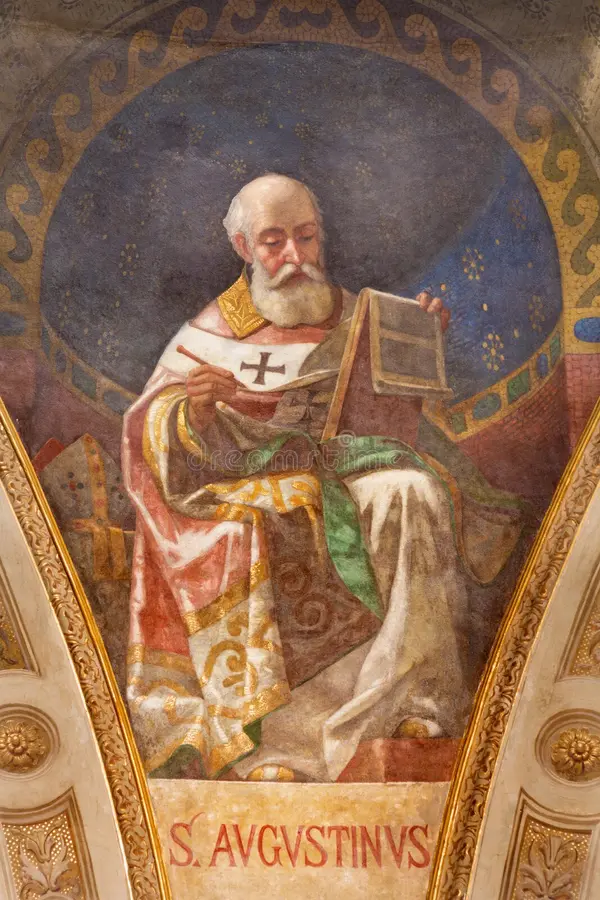
Augustine of Hippo, commonly known as St. Augustine, is one of the most influential thinkers in the history of Western Christianity and Western philosophy. His thought stands at the meeting point of Christian faith, Platonism, human psychology, ethics, politics, theology, and the search for truth.
His philosophy is not a systematic philosophical system in the modern sense. Rather, it is a lifelong intellectual journey centered on a fundamental question:
How can the human person find truth, happiness, and God?
For Augustine, these three questions are inseparable. Human beings desire happiness; genuine happiness can be found only in the truth; and ultimate truth is found in God.


1. Augustine’s Intellectual Journey
Augustine was born in 354 at Thagaste in Roman North Africa and died in 430 at Hippo Regius. His philosophical development was strongly influenced by several traditions.
Major influences
Platonism and Neoplatonism were particularly important. Augustine encountered Platonic ideas through Latin thinkers and especially through the works associated with Plotinus and Porphyry.
He was also deeply influenced by:
- Cicero – especially his emphasis on wisdom and the philosophical life
- Platonism – the distinction between the eternal and changing realities
- Neoplatonism – the movement of the soul toward the transcendent Good
- Christian Scripture – particularly St. Paul
- Catholic tradition – especially the theology of creation, grace, salvation, and the Trinity
Augustine did not simply adopt Platonism. He transformed Platonic philosophy through Christian revelation.
2. The Search for Truth
The search for truth is at the heart of Augustine’s philosophy.
He believed that human beings naturally desire to know reality. Yet our senses and ordinary experiences can sometimes deceive us. Therefore, the philosopher must move beyond appearances toward deeper and more permanent truth.
For Augustine, truth is not merely a collection of correct statements.
Truth ultimately has its foundation in God.
This leads to one of the most famous themes of Augustinian thought: the relationship between faith and reason.
3. Faith and Reason
Augustine did not see faith and reason as enemies.
Instead, he believed they cooperate.
A famous Augustinian principle is commonly expressed as:
“Believe in order to understand.”
Faith gives the human person a starting point, while reason helps the believer understand what has been believed.
At the same time, Augustine also recognized the importance of understanding before and alongside faith. His thought can therefore be summarized through the complementary movements:
Faith → Understanding → Deeper Faith
Reason can investigate reality, but human reason has limitations. Divine revelation provides truths that reason alone could not fully discover.
Thus Augustine rejects both:
- blind faith without reflection, and
- reason that refuses to acknowledge anything beyond itself.
4. The Famous “Restless Heart”
One of Augustine’s most important philosophical insights concerns human desire.
In the opening of his Confessions, Augustine famously says:
“Our heart is restless until it rests in you.”
This statement summarizes much of his philosophy.
Human beings search for happiness through:
- wealth
- pleasure
- fame
- power
- relationships
- intellectual achievement
- worldly success
But none of these can provide complete and permanent happiness.
Why?
Because the human being is ultimately oriented toward the infinite and eternal.
Therefore, finite things cannot completely satisfy an infinite desire.
For Augustine, the deepest human longing is ultimately a longing for God.
5. God as the Supreme Good
Augustine’s philosophy is fundamentally God-centered.
God is:
- eternal
- immutable
- perfect
- infinite
- omnipotent
- supremely good
- the source of all being
- the source of truth
- the ultimate end of human existence
Augustine distinguishes between God, who is the supreme Good, and created things, which are good but limited.
Everything created by God possesses some degree of goodness.
However, created goods become sources of disorder when human beings treat them as the highest good.
For example:
Money is good as a means.
Friendship is good.
Knowledge is good.
Physical pleasure can have a legitimate place.
But none of these should replace God as the ultimate object of love.
6. The Problem of Evil
One of Augustine’s most famous philosophical concerns was:
If God is perfectly good and all-powerful, why does evil exist?
Augustine eventually rejected the idea that evil is an independent substance or force opposed to God.
Instead, he developed the influential idea that evil is a privation of good (privatio boni).
In simple terms:
Evil is not a thing created by God; it is a lack, corruption, or deprivation of good.
Examples:
- Blindness is a deprivation of sight.
- Injustice is a deprivation of justice.
- Hatred can be understood as a disordering of love.
- Moral evil involves a disordering of the human will.
This allowed Augustine to maintain two important beliefs:
- God created everything that exists, and creation is fundamentally good.
- Evil does not have independent existence alongside God.
7. Moral Evil and Free Will
Augustine connected moral evil with human free will.
God created human beings with the capacity to choose.
The ability to choose is good, but the human will can choose wrongly.
Therefore, moral evil arises when the will turns away from the higher good toward lower or disordered goods.
This is an important distinction:
God creates the capacity to choose; the misuse of that capacity produces moral disorder.
Augustine therefore places enormous importance on the human will.
8. The Human Will
For Augustine, human beings are not simply intellectual creatures. They are creatures of love and will.
A person becomes morally good or bad according to what he or she loves.
The crucial question is therefore:
What do we love, and in what order do we love it?
Augustine develops the concept of ordo amoris, meaning the right ordering of loves.
A healthy moral life requires loving things according to their proper value.
For example:
God → neighbor → created things
rather than:
wealth → pleasure → power → self → God
when that order makes lesser things more important than God.
9. “Love, and Do What You Will”
Another famous Augustinian idea is:
“Love, and do what you will.”
This does not mean that Augustine believed people could simply do anything they wanted.
His meaning is deeper.
If one’s love is genuinely ordered toward God and the good, one’s actions will increasingly reflect that love.
The problem is therefore not simply that human beings have desires.
The problem is that desires can become disordered.
10. The Inner Life
Augustine made an extraordinary contribution to the philosophy of interiority.
He encouraged people to look inward:
“Do not go outside; go back into yourself. In the inward person dwells truth.”
The human interior life contains:
- memory
- understanding
- will
- desire
- imagination
- conscience
- self-awareness
Augustine believed that the search for truth requires an inward journey.
But the journey does not end with the self.
The movement is:
External world → Inner self → Truth → God
11. Augustine’s Philosophy of the Mind
Augustine’s reflections on the human mind were remarkably sophisticated.
He examined:
- consciousness
- memory
- identity
- perception
- imagination
- thought
- desire
- time
His Confessions, particularly Book X, contains an extraordinary philosophical investigation of memory.
He describes memory as an immense interior realm where experiences, images, knowledge, emotions, and intellectual contents are stored.
His reflections anticipate later philosophical discussions about consciousness and personal identity.
12. Memory, Understanding, and Will
Augustine often emphasizes three fundamental powers of the human mind:
- Memory
- Understanding
- Will
These are especially important in his reflections on the Trinity.
The human mind remembers, understands, and loves.
Augustine sees this triadic structure as a kind of image of the Trinity within human beings.
This does not mean that human beings are divine. Rather, the structure of the human mind offers Augustine an analogy through which he attempts to understand the Christian doctrine of the Trinity.
13. Augustine and the Philosophy of Time
Augustine’s reflections on time are among the most famous passages in ancient and medieval philosophy.
In Confessions Book XI, he asks what time actually is.
His famous observation can be summarized:
We know what time is until someone asks us to explain it.
He distinguishes:
- the past
- the present
- the future
But he notices a philosophical difficulty.
The past no longer exists.
The future does not yet exist.
And the present seems to disappear immediately.
So where does time exist?
Augustine suggests that time is experienced through the human mind:
- memory relates to the past
- attention relates to the present
- expectation relates to the future
This is one of the most remarkable early philosophical analyses of subjective time.
14. Creation and Time
Augustine rejected the idea that God created the universe at some moment within an already existing time.
Instead:
God created both the world and time.
Therefore, asking what God was doing “before creation” is problematic because there was no temporal “before” in the ordinary sense.
God is eternal.
Creation exists within time.
This distinction between eternity and temporality is fundamental to Augustine’s metaphysics.
15. Augustine’s Doctrine of Creation
Augustine strongly defended creation from nothing (creatio ex nihilo).
God did not create the universe from some eternal material existing independently of Him.
Rather:
God → creates → everything that exists
Creation therefore depends completely upon God.
Created things are:
- finite
- changing
- dependent
- contingent
God alone is eternal and unchanging in the absolute sense.
16. Eternal Truths
Augustine asks how human beings can possess knowledge of truths that appear universal and unchanging.
For example:
- mathematical truths
- logical principles
- moral truths
Human beings themselves are changing and imperfect.
How, then, can they know unchanging truths?
Augustine connects these truths with the divine intellect.
God is the ultimate foundation of eternal truth.
This develops into what is often called Augustine’s theory of divine illumination.
17. Divine Illumination
Augustine compares God to light.
Just as physical light allows our eyes to see physical objects, divine illumination allows the human intellect to recognize truth.
This does not mean that God literally places individual ideas into our minds.
Rather, Augustine argues that human intellectual knowledge ultimately depends upon God’s sustaining and illuminating presence.
Thus:
God is to the intellect what light is to the eyes.
This became an important theme in medieval Christian epistemology.
18. The Two Cities
One of Augustine’s greatest philosophical works is The City of God.
He wrote it partly in response to the political and cultural crisis of the Roman Empire, particularly following the sack of Rome in 410.
Augustine distinguishes between two symbolic communities:
The City of God
Characterized by:
- love of God
- humility
- self-giving
- orientation toward eternal things
The Earthly City
Characterized fundamentally by:
- self-love
- pride
- domination
- excessive attachment to temporal goods
These are not simply two geographical cities.
They represent two orientations of human love.
The decisive distinction is:
love of God versus love of self carried to the point of disregard for God.
19. Augustine’s Philosophy of Politics
Augustine had a realistic view of politics.
He did not expect earthly political institutions to create perfect human happiness.
Why?
Because human beings are affected by:
- sin
- pride
- selfishness
- conflict
- desire for power
Therefore, political institutions are necessary to maintain a degree of order, justice, and peace, but they cannot create the perfect society.
This gives Augustine’s political philosophy a distinctly realistic character.
20. Peace as a Fundamental Political Good
Although Augustine recognized human conflict, he considered peace a fundamental good.
He famously describes peace in terms of the “tranquillity of order.”
Peace is not simply the absence of war.
It means that things are properly ordered.
There can be:
- personal peace
- family peace
- social peace
- political peace
- cosmic order
Human beings desire peace because they desire an ordered and harmonious existence.
21. Justice and the State
Augustine’s political philosophy also contains a challenging argument concerning justice.
A political community that lacks justice can become little more than an organized form of domination.
He therefore refuses to equate:
power = legitimacy
Political authority should be evaluated according to justice and the moral good.
This became highly influential in later Christian political thought.
22. Augustine on History
Augustine transformed the Christian understanding of history.
Many ancient philosophies viewed history as cyclical.
Augustine emphasized a fundamentally linear understanding of history:
Creation → human history → Christ → Church → final judgment → eternal destiny
History therefore has:
- a beginning
- a meaningful development
- a purpose
- an ultimate fulfillment
This became foundational for later Christian philosophy of history.
23. Original Sin
Augustine’s understanding of humanity is closely connected with his doctrine of original sin.
Human beings were created good, but humanity’s original rebellion against God resulted in a profound disorder of human existence.
The consequences include:
- disordered desire
- weakness of will
- mortality
- suffering
- alienation from God
Augustine therefore rejects the idea that human beings can achieve perfect moral transformation through their natural abilities alone.
24. Grace
This leads to one of the central ideas of Augustine’s theology and philosophy:
Grace
Human beings need God’s grace.
Grace is not simply a reward for good behavior.
It is God’s freely given assistance that heals and transforms the human person.
Augustine therefore emphasizes:
Human effort is necessary, but divine grace is foundational.
This became particularly important in later Christian debates about:
- free will
- predestination
- salvation
- human responsibility
25. Free Will and Grace
At first glance, Augustine’s emphasis on both free will and divine grace may seem contradictory.
If God’s grace is necessary, are human beings genuinely free?
Augustine’s answer develops throughout his life.
He maintains that human beings possess genuine will, but after the Fall the human will is wounded and inclined toward sin.
Grace does not destroy freedom.
Instead, grace heals and strengthens freedom so that the person can genuinely choose the good.
Thus Augustine’s mature position can be summarized:
True freedom is not merely the ability to choose anything.
Rather:
True freedom is the ability to live according to the good for which human beings were created.
26. Happiness and the Good Life
Augustine’s ethical philosophy begins with a simple observation:
Everyone wants to be happy.
The disagreement concerns what happiness actually is.
Some people seek happiness through:
- money
- pleasure
- fame
- power
- possessions
- human approval
Augustine argues that these goods are unstable.
Authentic happiness requires participation in the eternal Good, which is God.
Therefore:
The good life = rightly ordered love + truth + virtue + relationship with God.
27. Virtue
Augustine inherited the classical philosophical tradition of virtue but transformed it through Christianity.
Traditional virtues such as:
- prudence
- justice
- temperance
- courage
remain important.
But Augustine gives love a central place.
The Christian moral life is fundamentally a life of rightly ordered love.
28. Augustine’s Philosophy of Education
Augustine believed that education should lead the learner beyond superficial knowledge toward truth and wisdom.
Knowledge has value, but knowledge alone does not guarantee goodness.
A person can be highly educated and still possess:
- pride
- selfishness
- hatred
- greed
Therefore, education should form both:
the intellect and the character.
The ultimate purpose of learning is wisdom.
29. Augustine on Language and Teaching
Augustine also wrote about language and communication, especially in his work On Christian Doctrine.
Words are signs.
They point toward meanings.
But words themselves are not the ultimate reality.
Therefore, interpretation requires attention to:
- language
- context
- intention
- symbolism
- the larger meaning of Scripture
His work became highly influential in Christian hermeneutics and theories of interpretation.
30. Augustine and Platonism
Augustine’s relationship with Plato and Neoplatonism is extremely important.
He adopted several ideas compatible with Christianity, particularly:
- the superiority of spiritual reality over material appearances
- the importance of turning inward
- the existence of eternal truth
- the hierarchy of being
- the idea of a supreme Good
But Augustine fundamentally transformed these ideas.
For Plato and Neoplatonism, the ultimate philosophical reality is approached through intellectual ascent.
For Augustine, ultimate reality is the personal God revealed in Christianity.
Thus:
Platonism + Christianity ≠ simple Platonism
Augustine created something distinctively Christian.
31. Augustine’s View of the Body and Material World
It is sometimes claimed that Augustine simply rejected the physical world.
That is too simplistic.
Augustine taught that creation is good because God created it.
The problem is not matter itself.
The problem is disordered attachment to created things.
The body is therefore not evil.
Human beings are embodied creatures, and bodily existence belongs to God’s creation.
32. Love as the Center of Philosophy
Perhaps the most comprehensive way of understanding Augustine is through love.
For Augustine, the fundamental question is:
What does the human person love above everything else?
Our loves determine:
- our moral character
- our priorities
- our relationships
- our decisions
- our understanding of happiness
- ultimately, the direction of our lives
A properly ordered love brings human beings toward God.
Disordered love turns them away from their true purpose.
33. Augustine’s Philosophy in One Framework
His philosophy can be represented as a journey:
Human Desire
↓
Search for Happiness
↓
Search for Truth
↓
Interior Examination
↓
Recognition of Eternal Truth
↓
Recognition of Human Dependence on God
↓
Love of God
↓
Rightly Ordered Love
↓
Virtue and Moral Transformation
↓
True Freedom
↓
Peace
↓
Eternal Happiness in God
This is why Augustine’s philosophy is simultaneously intellectual, moral, psychological, theological, and spiritual.
34. Major Philosophical Themes of St. Augustine
| Theme | Augustine’s Central Idea |
|---|---|
| God | Supreme and eternal Good |
| Truth | Ultimately grounded in God |
| Human person | Created for God and eternal happiness |
| Happiness | Found ultimately in God |
| Evil | Privation or corruption of good |
| Free will | Real but wounded by sin |
| Grace | Necessary for healing and salvation |
| Love | Central principle of moral life |
| Virtue | Rightly ordered love expressed in action |
| Knowledge | Dependent ultimately on divine illumination |
| Time | Experienced through memory, attention, and expectation |
| Creation | Created by God and fundamentally good |
| History | Linear and providential |
| Politics | Necessary for earthly order but unable to provide ultimate happiness |
| Peace | “Tranquillity of order” |
| Church | Community oriented toward God and eternal destiny |
35. Augustine’s Most Important Works
Confessions
His most famous work and one of the great classics of Western literature.
It combines:
- autobiography
- philosophy
- theology
- psychology
- prayer
- reflections on memory
- reflections on time
- reflections on human desire
The City of God
A monumental reflection on:
- history
- politics
- society
- Christianity
- Rome
- human nature
- providence
- the destiny of humanity
On the Trinity
A profound theological-philosophical investigation of the Christian doctrine of the Trinity and the structure of the human mind.
On Christian Doctrine
A major work on:
- biblical interpretation
- signs
- language
- rhetoric
- Christian teaching
On Free Choice of the Will
Explores:
- freedom
- moral responsibility
- evil
- reason
- God
The Enchiridion
A concise treatment of:
- faith
- hope
- love
- Christian moral life.
36. Augustine’s Greatest Philosophical Contributions
Augustine’s influence extends far beyond theology.
He contributed significantly to:
Philosophy of mind
His analysis of consciousness, memory, selfhood, and interiority anticipated questions that became central to modern philosophy.
Philosophy of time
His account of subjective time remains influential.
Epistemology
His theory of divine illumination addresses the possibility of certain knowledge.
Ethics
His theory of rightly ordered love became a major Christian ethical framework.
Political philosophy
His distinction between the earthly city and the City of God profoundly influenced Christian political thought.
Philosophy of history
His linear and providential understanding of history became enormously influential.
Metaphysics
His distinction between the eternal Creator and changing creation shaped medieval Christian metaphysics.
37. Augustine’s Relevance Today
Augustine remains remarkably relevant because the questions he asked are still human questions.
What makes us happy?
Augustine asks whether consumption, success, fame, and pleasure can really satisfy us.
What is truth?
He challenges the idea that truth is merely personal preference.
Why do we do what we know is wrong?
His reflections on the divided will remain psychologically compelling.
Why does evil exist?
His analysis of evil as a deprivation of good continues to influence philosophy of religion.
What is time?
His reflections anticipate modern discussions of subjective experience and consciousness.
What is freedom?
He asks whether freedom means simply choosing whatever we want—or becoming capable of choosing what is genuinely good.
What should we love?
This may be Augustine’s most enduring question.
38. The Core of Augustine’s Philosophy
The entire philosophical vision of Augustine can perhaps be condensed into five interconnected ideas:
1. God is Truth
Ultimate truth is not merely an abstract concept. It is grounded in God.
2. God is the Supreme Good
Everything else is good only in a limited and dependent way.
3. The Human Heart Seeks Happiness
Human beings are restless because they seek an infinite fulfillment through finite things.
4. Love Must Be Ordered Correctly
Human misery arises when lesser goods are loved more than the highest good.
5. Human Fulfillment Is Found in God
The journey inward ultimately becomes a journey upward toward God.
Conclusion
The philosophy of St. Augustine of Hippo is fundamentally a philosophy of the human journey toward God.
He begins with the human experience of desire, doubt, suffering, memory, love, sin, and the search for happiness. He then moves inward to the human mind and discovers the presence of eternal truth. From there, he moves beyond the self toward God, the source of truth, goodness, being, and happiness.
His thought can therefore be summarized through a simple movement:
Seek within → discover truth → recognize God → order your loves → receive grace → live virtuously → find true freedom and peace.
Augustine’s enduring significance lies in his ability to unite philosophy and spirituality, reason and faith, psychology and theology, personal experience and universal questions. His writings helped shape medieval philosophy and profoundly influenced thinkers such as Anselm, Thomas Aquinas, Bonaventure, Martin Luther, John Calvin, René Descartes, Pascal, and many later philosophers.
At the deepest level, Augustine’s philosophy is not merely an intellectual theory. It is an invitation to examine the human heart and ask the question that stands behind almost everything he wrote:
What is it that I truly love—and is that love leading me toward the Truth and the Good?
Leave a Reply