

Introduction
The Battle of Hastings, fought on 14 October 1066 CE, is one of the most significant battles in English and European history. It marked the decisive victory of William, Duke of Normandy, over King Harold II of England, resulting in the Norman Conquest of England. This victory reshaped England’s political system, language, culture, architecture, and legal institutions for centuries to come.
The battle was not merely a struggle for a crown—it was a turning point that transformed the course of English history. The Norman conquest introduced a new ruling class, established the feudal system, and forged stronger ties between England and continental Europe. The effects of the battle are still evident in modern British society, language, and governance.
Historical Background
England Before 1066
During the early eleventh century, England had emerged as a relatively unified kingdom after centuries of conflict among the Anglo-Saxon kingdoms.
The country was ruled by King Edward the Confessor (1042–1066), a pious monarch known for his devotion to the Church rather than military leadership.
Edward had no children, leaving England without a clear heir.
His death on 5 January 1066 triggered one of the greatest succession crises in medieval Europe.
The Claimants to the English Throne
Several powerful men believed they had the legitimate right to become king.
Harold Godwinson
Harold Godwinson was England’s most influential nobleman and Earl of Wessex.
On Edward’s deathbed, Harold claimed that the king had designated him as his successor.
The English council, known as the Witenagemot, supported Harold, and he was crowned King Harold II on 6 January 1066.
William, Duke of Normandy
William argued that Edward had previously promised him the English throne.
He also claimed that Harold had sworn an oath to support his succession while visiting Normandy several years earlier.
William considered Harold’s coronation an act of betrayal.
Harald Hardrada
The King of Norway, Harald Hardrada, also claimed England based on earlier Scandinavian agreements concerning succession.
He formed an alliance with Harold Godwinson’s estranged brother, Tostig.
The Triple Threat
England faced the extraordinary challenge of defending itself against three rival claimants in the same year.
Harold had to prepare for invasions from both Normandy and Norway.
Keeping his army mobilized for months placed enormous strain on resources and morale.
The Norwegian Invasion
In September 1066, Harald Hardrada landed in northern England with a powerful Viking army.
Harold Godwinson responded with remarkable speed.
Marching nearly 300 kilometers (190 miles) in just a few days, he surprised the Norwegians at the Battle of Stamford Bridge on 25 September 1066.
The English won a decisive victory.
Both Harald Hardrada and Tostig were killed.
However, Harold’s army suffered heavy casualties and exhaustion.
William Invades England
While Harold celebrated his victory in the north, favorable winds finally allowed William to cross the English Channel.
On 28 September 1066, William landed at Pevensey in Sussex.
His invasion force included approximately:
- 7,000 soldiers
- Knights
- Infantry
- Skilled archers
- Cavalry
William established a fortified base and began raiding the surrounding countryside.
Harold’s Forced March
Upon learning of William’s landing, Harold immediately marched his weary army south.
His soldiers had just completed one exhausting campaign before being required to fight another.
The rapid movement left little time for rest or reinforcements.
The Opposing Armies
Anglo-Saxon Army
Estimated strength:
- Around 7,000–8,000 men
The army consisted mainly of:
- Housecarls (professional elite warriors)
- Fyrd (local militia)
- Heavy infantry
Strengths:
- Experienced soldiers
- Strong defensive formations
- Excellent discipline
Weaknesses:
- No cavalry
- Few archers
- Fatigue after the northern campaign
Norman Army
Estimated strength:
- Around 7,000–8,000 men
William’s forces included:
- Heavy cavalry
- Infantry
- Archers
- Crossbowmen
- Mercenaries from across France
Strengths:
- Combined-arms tactics
- Highly trained cavalry
- Effective missile troops
- Flexible battlefield strategy
The Battlefield
The armies met near the village of Battle, about 11 kilometers (7 miles) northwest of Hastings.
Harold occupied the high ground atop Senlac Hill, providing an excellent defensive position.
His troops formed the famous shield wall, a dense line of overlapping shields designed to repel enemy attacks.
The Battle Begins
The battle commenced on the morning of 14 October 1066.
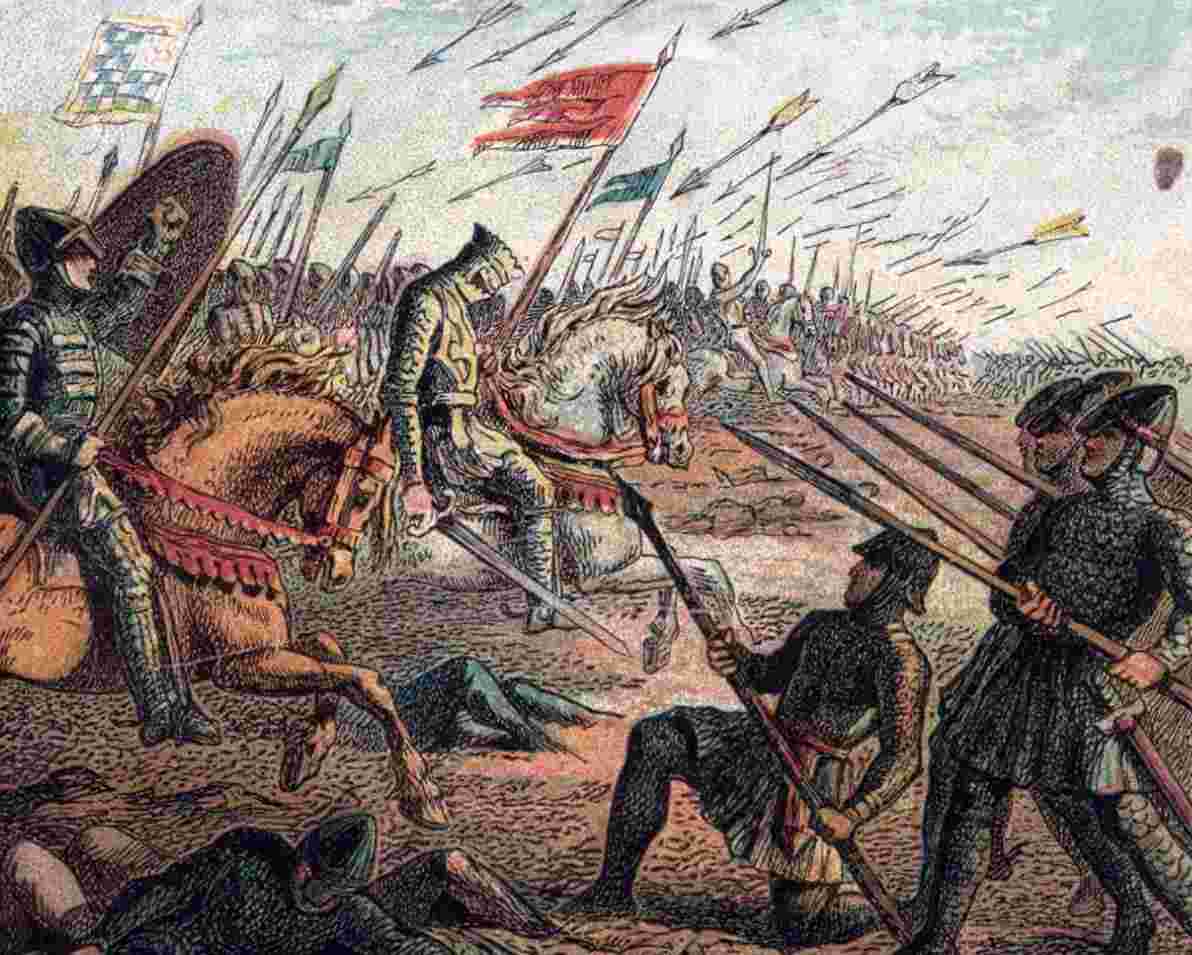
William opened with volleys from his archers.
However, the arrows had little effect because the English position on higher ground caused many missiles to strike the shield wall or pass overhead.
Norman infantry then advanced but failed to break the English defenses.
Cavalry Charges
William next ordered repeated cavalry assaults.
The English shield wall remained remarkably resilient.
The steep slope reduced the effectiveness of mounted attacks.
Norman knights suffered considerable losses.
The Feigned Retreat
One of the battle’s most famous episodes involved a feigned retreat.
During part of the fighting, some Norman troops withdrew.
Believing the enemy was fleeing, sections of the English army abandoned the safety of the shield wall to pursue them.
William’s cavalry suddenly turned back and attacked the pursuing English.
Whether this retreat was planned from the outset or evolved from battlefield confusion remains debated, but the tactic proved highly effective.
Repeated use of this maneuver gradually weakened the English line.
The Death of Harold
As the battle wore on into the afternoon, the English army became increasingly vulnerable.
According to later tradition, Harold was struck in the eye by an arrow before being killed by Norman knights.
The famous Bayeux Tapestry appears to depict this scene, though historians continue to debate exactly how Harold died.
Regardless of the precise circumstances, the king’s death shattered English morale.
Without their leader, organized resistance collapsed.
William’s Victory
By evening, the Norman army had achieved a complete victory.
Thousands of English soldiers lay dead, including much of the Anglo-Saxon nobility.
William had secured his claim to the English throne.
Why William Won
Several factors contributed to Norman success.
Superior Military Flexibility
William effectively coordinated infantry, cavalry, and archers.
Harold’s Exhausted Army
The English had recently fought and won the Battle of Stamford Bridge before marching hundreds of kilometers south.
Fatigue reduced their effectiveness.
Effective Cavalry
Norman mounted knights repeatedly exploited weaknesses in the English formation.
Feigned Retreats
These tactics persuaded English soldiers to abandon their defensive positions.
Harold’s Death
The loss of the king destroyed unity and morale.
William Becomes King
Following the victory, William marched toward London.
Although resistance continued in some regions, the English nobility gradually submitted.
On Christmas Day 1066, William was crowned King of England at Westminster Abbey.
He became known to history as William the Conqueror.
Consequences of the Battle
Norman Conquest
England came under Norman rule.
The Anglo-Saxon aristocracy was largely replaced by Norman nobles.
Feudal System
William reorganized England according to Norman feudal principles.
Land ownership became tied to military service and loyalty to the king.
Domesday Book
In 1086, William ordered the compilation of the Domesday Book, one of the most comprehensive surveys of landownership and resources in medieval Europe.
It improved taxation, governance, and royal administration.
Changes in Language
Norman French became the language of the royal court, government, and law.
Over time, Old English absorbed thousands of French words.
This fusion eventually evolved into Middle English, profoundly shaping the modern English language.
Architectural Transformation
The Normans introduced impressive stone castles and Romanesque cathedrals across England.
Famous examples include:
- The White Tower in the Tower of London
- Durham Cathedral
- Rochester Castle
These structures symbolized Norman authority and transformed England’s landscape.
Church Reform
William reorganized the English Church, appointing Norman bishops and strengthening ties with continental Europe and the papacy.
The Bayeux Tapestry
One of the most remarkable surviving sources for the Norman Conquest is the Bayeux Tapestry.
Nearly 70 meters (230 feet) long, it depicts events leading up to the Battle of Hastings and the battle itself through detailed embroidered scenes.
Although created from the Norman perspective, it remains an invaluable historical source.
Legacy
The Battle of Hastings permanently altered English history.
Its influence can be seen in:
- Government institutions
- The legal system
- Language
- Architecture
- Military organization
- Land ownership
- Relations between England and continental Europe
Few battles have produced such wide-ranging and enduring consequences.
Interesting Facts
- The Battle of Hastings was fought on 14 October 1066.
- William’s army crossed the English Channel using hundreds of transport ships.
- Harold’s army marched roughly 300 kilometers (190 miles) after defeating the Norwegians at Stamford Bridge.
- The Bayeux Tapestry remains one of the most famous visual records of medieval history.
- William was crowned king on 25 December 1066.
- The Norman Conquest introduced thousands of French words into the English language.
- The battle effectively ended Anglo-Saxon rule in England.
Military Lessons from the Battle
Military historians continue to study Hastings for several enduring lessons:
- Combined-arms warfare: Coordinating infantry, cavalry, and archers creates tactical flexibility.
- Exploit enemy fatigue: Harold’s exhausted army was at a significant disadvantage despite its strong defensive position.
- Maintain formation: The English shield wall proved formidable until discipline broke down.
- Leadership is decisive: Harold’s death caused the collapse of organized resistance.
- Adapt during battle: William repeatedly adjusted his tactics, demonstrating the importance of flexibility under pressure.
Conclusion
The Battle of Hastings (1066 CE) was far more than a contest for the English crown—it was a transformative event that reshaped the destiny of England. William the Conqueror’s victory ended Anglo-Saxon rule, established Norman dominance, and ushered in sweeping political, social, linguistic, and cultural changes. From the introduction of the feudal system and the construction of stone castles to the evolution of the English language and the strengthening of royal authority, the consequences of Hastings have echoed through nearly a millennium of history. As one of the most influential battles ever fought, it remains a defining milestone in the story of medieval Europe and the making of modern England.
Leave a Reply