

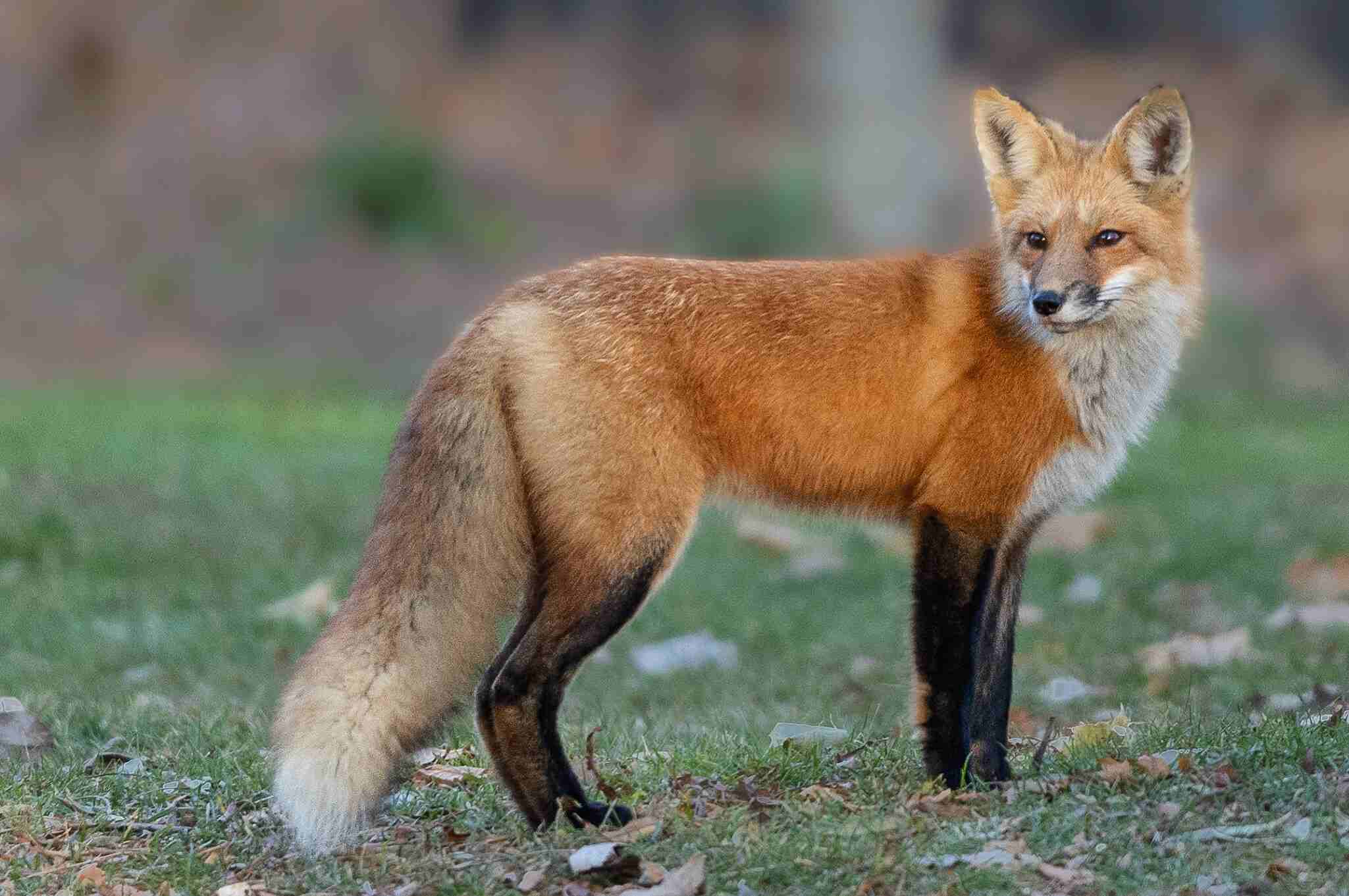
The Red Fox (Vulpes vulpes) is one of the world’s most familiar and adaptable wild mammals. Famous for its reddish coat, pointed ears, slender body and magnificent bushy tail, it occurs across a remarkably broad range of environments—from Arctic and alpine regions to deserts, farmland and major cities.
It is the largest of the true foxes and one of the most widely distributed terrestrial carnivores. Despite belonging to the order Carnivora, the red fox is actually an omnivore, eating everything from mice and rabbits to insects, fruits and carrion. (Animal Diversity Web)


📌 Red Fox at a Glance
| Feature | Information |
|---|---|
| Common name | Red Fox |
| Scientific name | Vulpes vulpes |
| Kingdom | Animalia |
| Phylum | Chordata |
| Class | Mammalia |
| Order | Carnivora |
| Family | Canidae |
| Genus | Vulpes |
| Species | Vulpes vulpes |
| Type | Mammal |
| Diet | Omnivorous |
| Conservation status | Least Concern |
| Distribution | Europe, Asia, North America, North Africa and introduced regions including Australia |
| Typical activity | Nocturnal and crepuscular |
| Social behavior | Usually solitary or living in small family groups |
| Shelter | Dens/earths |
| Young | Kits or cubs |
| Female | Vixen |
| Male | Dog fox, tod or reynard |
| Tail | Brush |
| Scientific authority | Carl Linnaeus, 1758 |
The species is currently classified as Least Concern, and its populations are considered broadly stable. (Animal Diversity Web)
🌍 Where Do Red Foxes Live?
The red fox has one of the largest geographical ranges of any terrestrial carnivore.
It occurs naturally across much of:
- Europe
- Asia
- North America
- North Africa
- Arctic regions
- Subarctic regions
- Mountain regions
It has also been introduced to Australia, where it has become an invasive predator affecting native wildlife. (Wikipedia)
Red foxes are remarkably flexible about habitat. They can live in:
🌲 Forests
🌾 Farmland
🌿 Grasslands
🏔️ Mountains
🏜️ Deserts
❄️ Tundra
🏖️ Dunes
🌳 Scrubland
🏘️ Suburbs
🏙️ Cities
They particularly benefit from landscapes containing a mixture of different habitat types. (USFS Research & Development)
🦊 What Does a Red Fox Look Like?
The classic red fox has:
- Reddish-orange or reddish-brown fur
- White or cream-colored underside
- Black lower legs and feet
- Black-tipped ears
- Long pointed muzzle
- Slender legs
- Vertical pupils
- Long bushy tail
- Often a white tail tip
But not every red fox is actually bright red.
Coat variations include:
- Red
- Orange
- Brown
- Grey
- Black
- Silver
- Mixed colors
These variations are known by names such as silver fox and cross fox.
📏 Size and Weight
Red foxes vary considerably in size depending on geography and climate.
Typical adults are approximately:
- Head and body: about 46–86 cm
- Tail: about 30–55 cm
- Weight: commonly around 3–7 kg, although larger individuals can occur
Some northern populations are substantially larger than southern populations.
For comparison, the red fox is considerably smaller than a typical adult wolf or large domestic dog.
🦶 Why Does the Fox Have Such a Large Tail?
The fox’s tail is called a brush.
It serves several purposes.
Balance
The tail helps the fox maintain balance while running and changing direction.
Warmth
In cold weather, the fox can curl up and use its bushy tail as insulation.
Communication
Tail position and movement can communicate information to other foxes.
Camouflage
The tail can help break up the animal’s outline in vegetation.
National Geographic notes that the tail functions both as a balance aid and as a warm covering in cold weather. (National Geographic)
👂 Extraordinary Hearing
Red foxes have excellent hearing.
They can detect small animals moving beneath vegetation and, in suitable conditions, even locate prey moving underground or beneath snow.
Their large ears can be rotated to help identify the direction of sounds.
This makes hearing extremely important when hunting rodents.
👃 A Powerful Sense of Smell
Like many members of the dog family, red foxes have a highly developed sense of smell.
They use scent to:
- Locate food
- Identify other foxes
- Mark territories
- Find cached food
- Communicate reproductive status
- Navigate familiar areas
Foxes commonly mark territories with urine and feces. They also possess scent glands that contribute to their characteristic odor. (IUCN UK Peatland Programme)
👀 Excellent Vision
Foxes have good vision, particularly in low-light conditions.
Their eyes are adapted for hunting during:
- Dawn
- Dusk
- Night
Their eyes reflect light in darkness, producing the familiar glowing appearance when illuminated by headlights or a flashlight.
🧠 Are Red Foxes Intelligent?
Red foxes are widely regarded as highly adaptable and behaviorally flexible animals.
Their success comes partly from their ability to:
- Learn from experience
- Remember food locations
- Adapt their diet
- Exploit new environments
- Avoid danger
- Modify activity patterns
- Take advantage of human-created food sources
Their reputation for being “cunning” appears in folklore throughout Europe, Asia and North America.
However, the popular image of the fox as a uniquely deceptive animal is partly cultural rather than a scientific measurement of intelligence.
🍽️ What Does a Red Fox Eat?
Red foxes are omnivores and opportunistic feeders.
Their diet changes according to season and location.
Animal foods
They may eat:
- Mice
- Voles
- Rats
- Rabbits
- Hares
- Squirrels
- Birds
- Eggs
- Frogs
- Lizards
- Small reptiles
- Fish
- Insects
- Earthworms
- Other invertebrates
- Carrion
Plant foods
They also consume:
- Berries
- Apples
- Grapes
- Cherries
- Other fruits
- Seeds
- Grasses
- Other plant material
The U.S. Forest Service describes their diet as highly variable and notes that small mammals, birds, fruits and insects make up major components. (USFS Research & Development)
🐭 The Famous Fox “Mouse Pounce”
One of the most fascinating hunting techniques of the red fox is its characteristic pounce.
A fox may:
- Stop moving.
- Listen carefully.
- Locate a mouse beneath grass or snow.
- Raise its head.
- Leap upward.
- Dive nose-first or forefeet-first into the ground.
- Pin the prey.
This technique is particularly spectacular when a fox hunts beneath snow.
🦊 Do Foxes Store Food?
Yes.
Red foxes may cache surplus food.
A fox can bury food in shallow holes and later return to retrieve it.
This is useful when food is temporarily abundant.
Their excellent memory and sense of smell help them locate cached food.
🌙 Are Red Foxes Nocturnal?
Red foxes are generally nocturnal or crepuscular, meaning they are particularly active at night, dawn and dusk.
However, seeing a fox during daylight does not automatically mean that it is sick.
Healthy foxes can be active during the day, especially when:
- They are raising young.
- Food is scarce.
- They live in relatively undisturbed areas.
- They have become accustomed to human activity.
The IUCN UK Peatland Programme notes that red foxes are mainly nocturnal but may also be seen during daylight. (IUCN UK Peatland Programme)
🏙️ Red Foxes in Cities
One of the most remarkable characteristics of the red fox is its ability to live alongside humans.
Urban foxes can use:
- Parks
- Gardens
- Cemeteries
- Railway corridors
- Industrial areas
- Vacant land
- Golf courses
- Building foundations
- Overgrown gardens
The U.S. Forest Service specifically notes their use of suburban environments such as parks, golf courses, cemeteries and large gardens. (USFS Research & Development)
🏠 Where Does a Fox Sleep?
Foxes use shelters called dens, often referred to as earths.
A den may be:
- Dug by the fox
- An abandoned rabbit burrow
- An abandoned badger sett
- Beneath tree roots
- Under rocks
- In banks
- Beneath buildings
- Under sheds
- In other protected locations
Foxes may maintain several potential shelters within their home range. (Animal Diversity Web)
👨👩👧 Fox Family Life
Red fox social behavior is more complicated than the common image of a completely solitary animal.
Outside the breeding season, many foxes spend substantial time alone.
During the breeding season and while raising young, however, adults may form family groups.
A typical family may include:
- A breeding male
- A breeding female
- Several kits
- Occasionally additional young adults
In some populations, older offspring may help care for younger siblings. (People’s Trust for Endangered Species)
❤️ Mating Season
In much of the Northern Hemisphere, red foxes generally mate during winter.
This is when the famous nighttime fox vocalizations may become particularly noticeable.
The female is called a vixen.
The male may be called a:
- Dog fox
- Tod
- Reynard
🐣 Pregnancy
Gestation lasts approximately seven to eight weeks.
The female usually gives birth in a den.
A litter commonly contains around four to six kits, although litter size can vary substantially. (Wikipedia)
🐾 Red Fox Kits
Newborn kits are very different from adult foxes.
They are:
- Small
- Blind
- Deaf
- Toothless
- Covered in dark, soft fur
Their eyes and ears develop during the first weeks of life.
As they grow, their coat gradually begins to resemble that of an adult fox. (Wikipedia)
🍼 How Are Kits Fed?
During the early weeks, the mother remains closely associated with the den while the male and sometimes other family members provide food.
As the kits become older, they begin leaving the den and experimenting with solid food.
Eventually they learn to hunt and forage independently.
⏳ How Long Do Red Foxes Live?
Lifespan varies dramatically between captivity and the wild.
In the wild, many red foxes live only a few years on average, although some survive considerably longer.
Captive foxes can live 10–15 years or more under suitable conditions. (Animal Diversity Web)
The short average lifespan in many wild populations is influenced by:
- Traffic
- Disease
- Hunting
- Predation
- Competition
- Food shortages
- Accidents
- Human persecution
🐺 Natural Predators
Adult red foxes have relatively few natural predators in many regions.
Potential predators include:
- Wolves
- Coyotes
- Lynx
- Large birds of prey
- Bears
- Mountain lions
Young foxes are much more vulnerable than adults.
Humans can be a major source of mortality through hunting, trapping, road accidents and persecution. (Animal Diversity Web)
🦠 Diseases
Like other wild mammals, red foxes can carry diseases and parasites.
Potential diseases include:
- Rabies
- Mange
- Canine distemper
- Parasitic infections
A fox showing unusual behavior, severe weakness, paralysis or extreme lack of fear should not be approached.
Wild foxes should always be treated as wild animals.
🌍 Red Foxes and the Environment
The red fox is an important predator and scavenger.
By consuming large numbers of rodents and other small animals, foxes can influence prey populations.
They also consume fruits and may contribute to seed dispersal.
At the same time, in places where they have been introduced—especially Australia—their predatory impact on native wildlife is a serious conservation concern. (Wikipedia)
🇮🇳 Red Fox in India
Red foxes also occur in parts of India.
They are associated with a variety of northern and high-altitude landscapes as well as some arid and semi-arid areas.
The Great Himalayan National Park’s official information describes red foxes in Himalayan and Trans-Himalayan regions and also records them from arid and semi-arid areas of Rajasthan and Kutch, Gujarat. (Great Himalayan National Park)
Indian populations show considerable variation in body size and coloration.
🎨 Red Fox Color Forms
The name “red fox” can be misleading because individuals can have very different coats.
Red phase
The familiar orange-red coloration.
Silver phase
Dark grey to almost black fur, often with silver-tipped hairs.
Cross fox
A darker form with a cross-like dark pattern across the shoulders and back.
Other variations
Individual foxes can show intermediate shades and patterns.
🌡️ How Does the Red Fox Survive Winter?
Red foxes have several adaptations for cold weather.
Their:
- Dense fur
- Bushy tail
- Small heat-sensitive extremities
- Flexible diet
- Ability to use sheltered dens
help them survive extremely cold conditions.
The tail can be wrapped around the body like a blanket while resting.
🏜️ Can Red Foxes Live in Deserts?
Yes.
One of the most impressive things about the species is its ecological flexibility.
Red foxes can survive in relatively dry environments by:
- Exploiting available prey
- Eating fruits and other foods
- Using sheltered resting sites
- Becoming active during cooler periods
They are not restricted to forests.
🏔️ Can Red Foxes Live in Mountains?
Yes.
Red foxes can occur from near sea level to high elevations. Animal Diversity Web records them from sea level to approximately 4,500 metres. (Animal Diversity Web)
Mountain populations can face severe winters, deep snow and limited food availability.
🗣️ Red Fox Sounds
Red foxes are surprisingly vocal.
They can produce:
- Barks
- Whines
- Whimpers
- Growls
- Howls
- Screams
- Yelps
- Short contact calls
The famous fox scream is particularly startling.
Vixens may produce intense, high-pitched vocalizations during the breeding season. (IUCN UK Peatland Programme)
👣 Fox Tracks
A red fox’s footprints typically show:
- Four toes
- Visible claw marks
- A narrow, relatively oval footprint
Foxes often walk in a fairly straight line, making their tracks distinctive in snow or soft soil.
💩 Fox Droppings
Fox droppings, called scat, can be used to identify fox presence.
They are often:
- Dark
- Elongated
- Tapered at one end
- Deposited in prominent locations
Foxes use scat and urine as territorial signals.
🗺️ Territory
Red foxes maintain territories or home ranges whose size depends strongly on food availability and habitat quality.
Where food is abundant, ranges may be relatively small.
Where resources are scarce, foxes may occupy much larger areas. Animal Diversity Web reports home ranges commonly around 5–12 km² in good habitats, with substantially larger ranges possible in poorer habitats. (Animal Diversity Web)
🧭 Fox Dispersal
Young foxes eventually leave their birthplace to establish their own territories.
Dispersal distances can vary enormously.
Some young foxes remain relatively close to their natal territory, while others travel very long distances.
This movement helps explain how red fox populations can colonize new landscapes.
🧬 Scientific Classification
Kingdom: Animalia
Phylum: Chordata
Class: Mammalia
Order: Carnivora
Family: Canidae
Genus: Vulpes
Species: Vulpes vulpes
The scientific name was established by Carl Linnaeus in 1758. (EUNIS)
🦊 Red Fox vs. Other Foxes
The red fox is not the only fox species.
Other true foxes include:
- Arctic fox
- Fennec fox
- Swift fox
- Kit fox
- Corsac fox
- Bengal fox
- Rüppell’s fox
- Cape fox
- Pale fox
- Tibetan sand fox
The red fox is particularly notable because of its large geographical range and remarkable adaptability.
⭐ 30 Amazing Red Fox Facts
- 🦊 Its scientific name is Vulpes vulpes.
- 🌍 It is one of the world’s most widely distributed terrestrial carnivores.
- 🐕 It belongs to the dog family, Canidae.
- 🥩 It is an omnivore.
- 🌙 It is mainly nocturnal or crepuscular.
- 👂 It has excellent hearing.
- 👃 It has a highly developed sense of smell.
- 👀 It has excellent low-light vision.
- 🐭 Rodents are important prey.
- 🍎 It also eats fruit.
- 🐟 It may eat fish.
- 🪱 It eats insects and worms.
- 🦴 It can consume carrion.
- 🕳️ It uses dens called earths.
- 🐾 Its babies are called kits or cubs.
- 👩 The female is called a vixen.
- 👨 The male is often called a dog fox or tod.
- 🧣 Its tail is called a brush.
- ❄️ Its brush helps keep it warm.
- 🏙️ It can live successfully in cities.
- 🏜️ It can inhabit deserts.
- 🏔️ It can live at high elevations.
- 🌾 It thrives in diverse landscapes.
- 🥚 It may eat bird eggs.
- 🐇 Rabbits are among its potential prey.
- 🧠 It can cache food for later.
- 🔊 It has a surprisingly large vocal repertoire.
- 🐣 Kits are born blind and helpless.
- 🦊 It is currently classified as Least Concern.
- 🌏 In Australia, introduced red foxes are a major threat to native wildlife. (Animal Diversity Web)
🔤 Red Fox A–Z Facts
A — Adaptability
Few wild mammals are as adaptable as the red fox.
B — Brush
Its magnificent bushy tail is called a brush.
C — Carnivore
It belongs to the order Carnivora, although it is actually an omnivore.
D — Den
Foxes use dens, commonly called earths.
E — Ears
Large pointed ears help the fox locate prey.
F — Food
Its diet is extremely diverse.
G — Geographic range
It has one of the largest distributions of any terrestrial carnivore.
H — Hearing
Its exceptional hearing helps it detect small prey.
I — Intelligence
Its behavioral flexibility contributes to its success.
J — Jumping
Foxes can leap impressively when hunting and negotiating obstacles.
K — Kits
Baby foxes are commonly called kits.
L — Least Concern
The species is currently classified as Least Concern.
M — Mice
Small rodents are among its favorite prey.
N — Nocturnal
It is particularly active at night.
O — Omnivore
It eats both animal and plant foods.
P — Pounce
Its famous hunting pounce helps it catch rodents.
Q — Quiet
Foxes can move remarkably quietly when stalking prey.
R — Red
Its classic reddish coat gives it its common name.
S — Scent
Scent marking is an important form of communication.
T — Territory
Foxes defend or maintain home ranges.
U — Urban
They can thrive in towns and cities.
V — Vixen
The adult female is called a vixen.
W — Winter
Dense fur and the bushy tail help it survive cold conditions.
X — Xenarthran?
No! The red fox is not a xenarthran. Xenarthrans are an unrelated group containing animals such as sloths and armadillos.
Y — Young
Fox kits become progressively more independent as they grow.
Z — Zoology
The red fox is an excellent example of behavioral and ecological adaptation studied in zoology.
📷 Red Fox Images


For high-quality photographs and species media, useful sources include National Geographic’s Photo Ark, wildlife organizations, government wildlife agencies and reputable biodiversity databases. National Geographic has an extensive Red Fox photographic feature. (National Geographic)
Important: Before downloading and republishing photographs on a website such as Nelsapy, check the copyright/license conditions of the individual image.
🎥 Red Fox Videos
The following are useful starting points for videos and wildlife footage:
- BBC Earth – Fox facts and wildlife media
- IUCN UK Peatland Programme – Red Fox video
- National Geographic – Red Fox
- Red Fox – Wikimedia Commons media collection
🌿 Conservation Status
The red fox is currently listed as Least Concern globally. Its broad distribution, adaptability and generally stable populations mean that it is not currently considered globally threatened. (Animal Diversity Web)
However, “Least Concern” does not mean that every red fox population is safe.
Local populations can face:
- Habitat destruction
- Road mortality
- Hunting
- Trapping
- Persecution
- Disease
- Pollution
- Competition
- Human-wildlife conflict
And in Australia, the introduced red fox represents a major ecological problem because of predation on native species. (Wikipedia)
❤️ Why the Red Fox Matters
The red fox is a remarkable example of adaptation and survival.
It can live in a snowy wilderness, a mountain valley, a desert landscape, farmland or a modern city. It can eat a mouse one day, fruit the next, and carrion when another food source is unavailable.
Its success is based not on size or strength, but on flexibility, intelligence, excellent senses and an extraordinary ability to adapt.
The red fox reminds us that wildlife does not always survive by avoiding humans. Sometimes, the most adaptable species learn how to live alongside us.
“The red fox is small enough to disappear into the wilderness, yet adaptable enough to survive at the edge of a city.”
📚 Reliable Sources for Further Reading
- U.S. Forest Service – Red Fox Species Profile
- Animal Diversity Web – Vulpes vulpes
- National Geographic – Red Fox
- BBC Earth – Fox Facts
- European Environment Agency – Red Fox
- Great Himalayan National Park – Red Fox
Leave a Reply