

Introduction
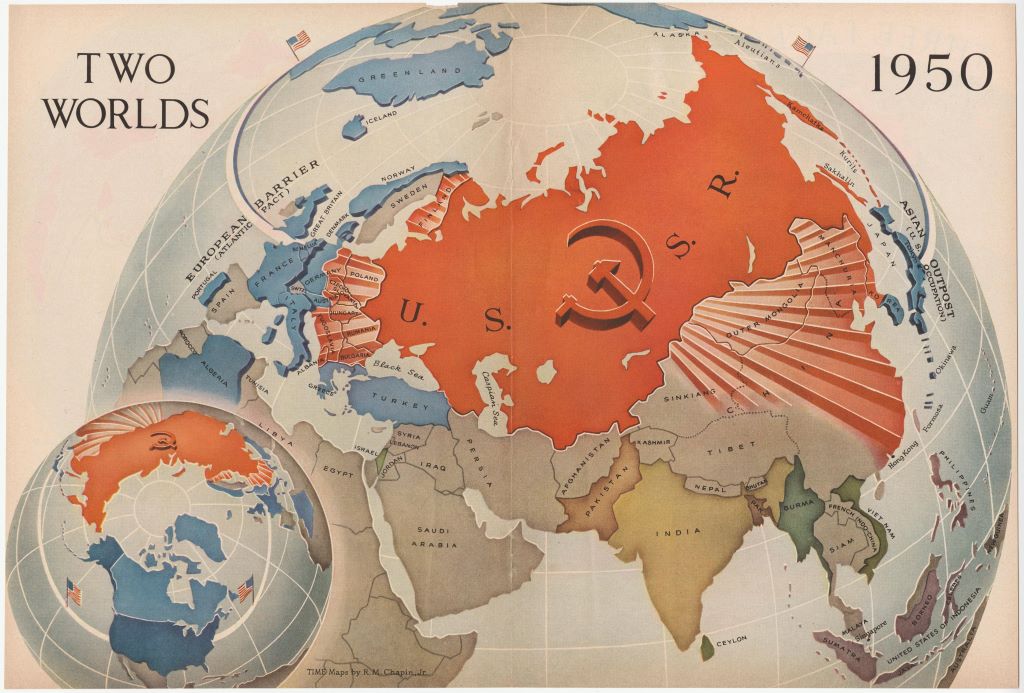
The Cold War was a prolonged period of political tension, ideological rivalry, military competition, and geopolitical conflict between the United States and the Soviet Union and their respective allies. It began after the Second World War and lasted approximately from 1947 until the dissolution of the Soviet Union in 1991.
Although the two superpowers never fought a full-scale direct war against each other, they competed through military alliances, nuclear arms races, espionage, propaganda, technological achievements, space exploration, and proxy wars in different parts of the world.
The Cold War shaped modern international relations and influenced major historical events, including the Berlin Blockade, Korean War, Cuban Missile Crisis, Vietnam War, Soviet invasion of Afghanistan, and the fall of the Berlin Wall.
This collection contains more than 100 general knowledge questions covering the origins, important events, leaders, organizations, conflicts, and consequences of the Cold War. The answer key is provided at the end for self-assessment and quiz practice.
Section 1: General Knowledge About the Cold War
- What was the Cold War?
- Which two superpowers were the principal rivals during the Cold War?
- Approximately when did the Cold War begin?
- In which year did the Cold War come to an end?
- Why was the conflict called the Cold War?
- Which two major political and economic ideologies were in competition during the Cold War?
- Which country promoted capitalism and liberal democracy?
- Which country promoted communism during the Cold War?
- Who was the first leader of the Soviet Union during the Cold War period?
- Which major global war immediately preceded the Cold War?
- What was the main objective of the United States’ policy of containment?
- Which American president introduced the Truman Doctrine?
- What was the Iron Curtain?
- Who popularized the expression “Iron Curtain” in a famous 1946 speech?
- Which continent was the principal centre of early Cold War tensions?
Section 2: Origins and Early Events
- Which conference in 1945 brought together Roosevelt, Churchill, and Stalin to discuss the post-war world?
- In which German city was the Potsdam Conference held?
- What was the Marshall Plan?
- Which American secretary of state gave his name to the Marshall Plan?
- In which year was the Marshall Plan announced?
- Which two European countries initially received significant American assistance under the Truman Doctrine?
- What was the Berlin Blockade?
- In which year did the Soviet Union begin the Berlin Blockade?
- How did Western countries respond to the Berlin Blockade?
- What was the Berlin Airlift?
- In which year did the Berlin Blockade officially end?
- What were the two German states established in 1949?
- What was the capital of West Germany?
- What was the capital of East Germany?
- Which city became a major symbol of the division between East and West during the Cold War?
Section 3: Military Alliances and Organizations
- What does NATO stand for?
- In which year was NATO established?
- Which country was the leading power in NATO during the Cold War?
- What was the Warsaw Pact?
- In which year was the Warsaw Pact established?
- Which country led the Warsaw Pact?
- Which military alliance was formed in response to the creation of NATO?
- Which international organization was established in 1945 to promote world peace and cooperation?
- What does SEATO stand for?
- In which year was the Southeast Asia Treaty Organization established?
- Which alliance was established in the Middle East in 1955 and later became known as CENTO?
- Which country withdrew from the Warsaw Pact in 1968 following a military invasion?
- Which organization coordinated communist parties internationally in the early Cold War period and was established in 1947?
- What was the Council for Mutual Economic Assistance commonly known as?
- Which country was the principal rival of the United States in the Cold War?
Section 4: Important Cold War Leaders
- Who was the president of the United States when the Cold War began?
- Who was the Soviet leader during the Berlin Blockade?
- Which American president introduced the policy known as the Truman Doctrine?
- Who succeeded Harry S. Truman as president of the United States?
- Which Soviet leader denounced Stalin’s personality cult in 1956?
- Who was the Soviet leader during the Cuban Missile Crisis?
- Which American president faced the Cuban Missile Crisis?
- Who was the American president during the Vietnam War escalation in the 1960s?
- Which Soviet leader introduced the policies of glasnost and perestroika?
- Who was the last leader of the Soviet Union?
- Which American president famously called the Soviet Union an “evil empire”?
- Who was the British prime minister during the early years of the Cold War and delivered the famous Iron Curtain speech alongside Churchill?
- Who was the Chinese communist leader who established the People’s Republic of China in 1949?
- Who was the Cuban revolutionary leader who became closely associated with the Soviet Union?
- Which American president announced the Strategic Defense Initiative in 1983?
Section 5: Major Cold War Crises and Conflicts
- In which year did the Korean War begin?
- Which two countries were the principal opponents in the Korean War?
- Which international force fought in support of South Korea?
- Which country supported North Korea during the Korean War?
- In which year was the Korean Armistice Agreement signed?
- What was the Suez Crisis?
- In which year did the Hungarian Revolution take place?
- Which country invaded Hungary to suppress the 1956 revolution?
- In which year was the Berlin Wall constructed?
- Why was the Berlin Wall built?
- In which year did the Cuban Missile Crisis occur?
- Which country secretly deployed nuclear missiles in Cuba in 1962?
- How many days did the Cuban Missile Crisis last?
- Which American naval measure was used to prevent further Soviet missile deliveries to Cuba?
- What was the outcome of the Cuban Missile Crisis?
- In which year did the Vietnam War end?
- Which country invaded Afghanistan in December 1979?
- In which year did the Soviet Union withdraw its troops from Afghanistan?
- What was the Prague Spring?
- Which year saw the Soviet-led invasion of Czechoslovakia to suppress the Prague Spring?
Section 6: The Arms Race and Nuclear Weapons
- What was the nuclear arms race?
- Which country developed and used the first atomic bombs during the Second World War?
- In which year did the Soviet Union successfully test its first atomic bomb?
- Which country developed the hydrogen bomb first?
- What does ICBM stand for?
- What is the meaning of MAD in Cold War nuclear strategy?
- Which two superpowers possessed the largest nuclear arsenals during the Cold War?
- What was the Nuclear Non-Proliferation Treaty?
- In which year was the Nuclear Non-Proliferation Treaty opened for signature?
- What was the SALT I agreement?
- Which two countries signed the SALT I agreement in 1972?
- What was the purpose of the Strategic Arms Limitation Talks?
- What was the Intermediate-Range Nuclear Forces Treaty?
- In which year was the INF Treaty signed?
- Which American president signed the INF Treaty with Soviet leader Mikhail Gorbachev?
Section 7: Space Race and Technological Competition
- What was the Space Race?
- Which country launched the world’s first artificial satellite?
- What was the name of the first artificial satellite launched into space?
- In which year was Sputnik 1 launched?
- Who was the first human to travel into outer space?
- Which country sent the first human into space?
- In which year did Yuri Gagarin travel into space?
- Who was the first American astronaut to travel into space?
- What was the name of the Soviet space programme that sent Yuri Gagarin into orbit?
- Which American president announced the goal of landing a man on the Moon before the end of the 1960s?
- In which year did Apollo 11 land the first humans on the Moon?
- Who was the first human to walk on the Moon?
- Which American space agency played a leading role in the Space Race?
- What was the name of the first space station launched by the Soviet Union?
- In which year was the Soviet space station Salyut 1 launched?
Section 8: Espionage, Propaganda and Intelligence
- What was espionage during the Cold War?
- What does CIA stand for?
- In which country was the CIA established?
- What does KGB stand for in English?
- Which country operated the KGB?
- What was the Stasi?
- In which country did the Stasi operate?
- Which American U-2 spy plane was shot down over the Soviet Union in 1960?
- Who was the American pilot captured after the U-2 incident in 1960?
- What was the main purpose of propaganda during the Cold War?
- Which Soviet spy agency was responsible for foreign intelligence operations during much of the Cold War?
- What was the purpose of the Berlin Tunnel espionage operation, also known as Operation Gold?
Section 9: The End of the Cold War
- Who introduced the policies of glasnost and perestroika in the Soviet Union?
- What does glasnost mean?
- What does perestroika mean?
- In which year did the Berlin Wall fall?
- On which date did the Berlin Wall begin to open?
- Which European country experienced the peaceful Velvet Revolution in 1989?
- What was the significance of the fall of the Berlin Wall?
- In which year did Germany reunify?
- On which date did Germany officially reunify?
- In which year was the Warsaw Pact formally dissolved?
- In which year did the Soviet Union officially dissolve?
- Who became the first president of the Russian Federation after the dissolution of the Soviet Union?
- Which Soviet leader resigned on 25 December 1991, marking the final stage of the Soviet Union’s collapse?
Section 10: Cold War and the Wider World
- In which year did the People’s Republic of China come into existence?
- Who led the Cuban Revolution that overthrew Fulgencio Batista?
- In which year did the Cuban Revolution succeed?
- Which African country experienced a major Cold War-related conflict involving Soviet and American interests after independence?
- Which Southeast Asian country became a major battleground during the Cold War?
- Which country was divided into North Vietnam and South Vietnam during the Cold War?
- What was the Non-Aligned Movement?
- In which year was the Non-Aligned Movement formally established?
- Which Indian prime minister was one of the founding leaders of the Non-Aligned Movement?
- Which Egyptian president was a prominent founding leader of the Non-Aligned Movement?
- Which Yugoslav leader played a major role in establishing the Non-Aligned Movement?
- Which Indonesian city hosted the 1955 Asian-African Conference, an important precursor to the Non-Aligned Movement?
- Which Latin American country became the centre of the 1962 Cuban Missile Crisis?
- Which country was divided into two states following the Second World War and reunified in 1990?
- What major geopolitical change marked the end of the Cold War?
Answer Key
Answers: Section 1 – General Knowledge
- A prolonged political, ideological, military, and economic rivalry between the United States and the Soviet Union.
- The United States and the Soviet Union.
- Around 1947.
-
- Because the two superpowers did not fight a direct, full-scale war against each other.
- Capitalism and communism.
- The United States.
- The Soviet Union.
- Joseph Stalin.
- The Second World War.
- To prevent the spread of communism.
- Harry S. Truman.
- The political and ideological division between communist Eastern Europe and the Western democracies.
- Winston Churchill.
- Europe.
Answers: Section 2 – Origins and Early Events
- The Yalta Conference.
- Potsdam, Germany.
- An American economic assistance programme for rebuilding Europe after the Second World War.
- George C. Marshall.
-
- Greece and Turkey.
- The Soviet Union’s blockade of land access to West Berlin.
-
- By organizing an airlift to supply West Berlin.
- The operation that transported food, fuel, and other essential supplies into West Berlin by aircraft.
-
- The Federal Republic of Germany (West Germany) and the German Democratic Republic (East Germany).
- Bonn.
- East Berlin.
- Berlin.
Answers: Section 3 – Military Alliances and Organizations
- North Atlantic Treaty Organization.
- 1949
- The United States.
- A military alliance of the Soviet Union and its Eastern European allies.
- 1955
- The Soviet Union.
- The Warsaw Pact.
- The United Nations.
- Southeast Asia Treaty Organization.
- 1954
- The Baghdad Pact.
- Czechoslovakia.
- Cominform.
- Comecon.
- The United States.
Answers: Section 4 – Important Cold War Leaders
- Harry S. Truman.
- Joseph Stalin.
- Harry S. Truman.
- Dwight D. Eisenhower.
- Nikita Khrushchev.
- Nikita Khrushchev.
- John F. Kennedy.
- Lyndon B. Johnson.
- Mikhail Gorbachev.
- Mikhail Gorbachev.
- Ronald Reagan.
- Clement Attlee was the British prime minister in the early post-war period; Winston Churchill delivered the famous Iron Curtain speech in 1946.
- Mao Zedong.
- Fidel Castro.
- Ronald Reagan.
Answers: Section 5 – Major Cold War Crises and Conflicts
- 1950
- North Korea and South Korea.
- A United Nations-commanded force, led by the United States.
- China and the Soviet Union.
- 1953
- A 1956 international crisis involving Egypt, Israel, Britain, and France over control of the Suez Canal.
- 1956
- The Soviet Union.
- 1961
- To prevent people from fleeing East Berlin and East Germany to the West.
- 1962
- The Soviet Union.
- 13 days.
- A naval quarantine or blockade of Cuba.
- The Soviet Union agreed to remove its missiles from Cuba, while the United States publicly pledged not to invade Cuba and secretly agreed to remove American Jupiter missiles from Turkey.
- 1975
- The Soviet Union.
- 1989
- A period of political liberalization and reform in Czechoslovakia in 1968.
- 1968
Answers: Section 6 – Arms Race and Nuclear Weapons
- Competition between the United States and the Soviet Union to develop and accumulate increasingly powerful nuclear weapons.
- The United States.
-
- The United States.
- Intercontinental Ballistic Missile.
- Mutually Assured Destruction.
- The United States and the Soviet Union.
- An international treaty designed to prevent the spread of nuclear weapons and promote peaceful nuclear cooperation and disarmament.
- 1968
- The first Strategic Arms Limitation agreement.
- The United States and the Soviet Union.
- To limit the development and deployment of strategic nuclear weapons.
- A treaty banning an entire category of American and Soviet ground-launched intermediate-range and shorter-range missiles.
- 1987
- Ronald Reagan.
Answers: Section 7 – Space Race and Technological Competition
- The competition between the United States and the Soviet Union to achieve major milestones in space exploration.
- The Soviet Union.
- Sputnik 1.
- 1957
- Yuri Gagarin.
- The Soviet Union.
- 1961
- Alan Shepard.
- The Vostok programme.
- John F. Kennedy.
- 1969
- Neil Armstrong.
- NASA (National Aeronautics and Space Administration).
- Salyut 1.
- 1971
Answers: Section 8 – Espionage, Propaganda and Intelligence
- Secret intelligence gathering about rival countries, governments, military capabilities, and political activities.
- Central Intelligence Agency.
- The United States.
- Committee for State Security.
- The Soviet Union.
- The secret police and state security service of East Germany.
- East Germany.
- A U-2 reconnaissance aircraft.
- Francis Gary Powers.
- To influence public opinion and promote political and ideological beliefs.
- The KGB.
- To intercept Soviet military communications through a tunnel dug from West Berlin into East Berlin.
Answers: Section 9 – The End of the Cold War
- Mikhail Gorbachev.
- Openness.
- Restructuring or reorganization.
- 1989
- 9 November 1989.
- Czechoslovakia.
- It symbolized the collapse of communist control in Eastern Europe and the weakening of the division between East and West.
- 1990
- 3 October 1990.
- 1991
- 1991
- Boris Yeltsin.
- Mikhail Gorbachev.
Answers: Section 10 – Cold War and the Wider World
- 1949
- Fidel Castro.
- 1959
- Angola.
- Vietnam.
- Vietnam.
- A movement of countries that sought to remain independent of the major Cold War power blocs.
- 1961
- Jawaharlal Nehru.
- Gamal Abdel Nasser.
- Josip Broz Tito.
- Bandung, Indonesia.
- Cuba.
- Germany.
- The collapse of communist governments across Eastern Europe and the dissolution of the Soviet Union.
Important Cold War Dates – Quick Revision
| Year | Important event |
|---|---|
| 1945 | Yalta and Potsdam Conferences |
| 1947 | Truman Doctrine and Marshall Plan |
| 1948–1949 | Berlin Blockade and Airlift |
| 1949 | NATO established; Soviet Union tests its first atomic bomb |
| 1950–1953 | Korean War |
| 1955 | Warsaw Pact established |
| 1956 | Hungarian Revolution |
| 1957 | Sputnik 1 launched |
| 1961 | Berlin Wall constructed; first human spaceflight |
| 1962 | Cuban Missile Crisis |
| 1968 | Prague Spring; Nuclear Non-Proliferation Treaty opened for signature |
| 1969 | Apollo 11 Moon landing |
| 1972 | SALT I agreement |
| 1979 | Soviet invasion of Afghanistan |
| 1985 | Mikhail Gorbachev becomes Soviet leader |
| 1987 | INF Treaty signed |
| 1989 | Berlin Wall falls |
| 1990 | German reunification |
| 1991 | Warsaw Pact dissolved; Soviet Union collapses |
Conclusion
The Cold War was one of the most influential periods in modern world history. Its impact extended far beyond the United States and the Soviet Union, shaping international politics, military strategies, scientific research, technological development, and economic relationships across the world.
The rivalry also accelerated space exploration, nuclear technology, intelligence operations, and military innovation. Although the Cold War officially ended with the dissolution of the Soviet Union in 1991, its political and historical consequences continue to influence international relations today.
Editorial Note: These questions are intended for students, teachers, competitive examination candidates, quiz enthusiasts, and general readers interested in modern world history. They provide a foundation for understanding the origins, major developments, and lasting consequences of the Cold War.
Leave a Reply