

Introduction
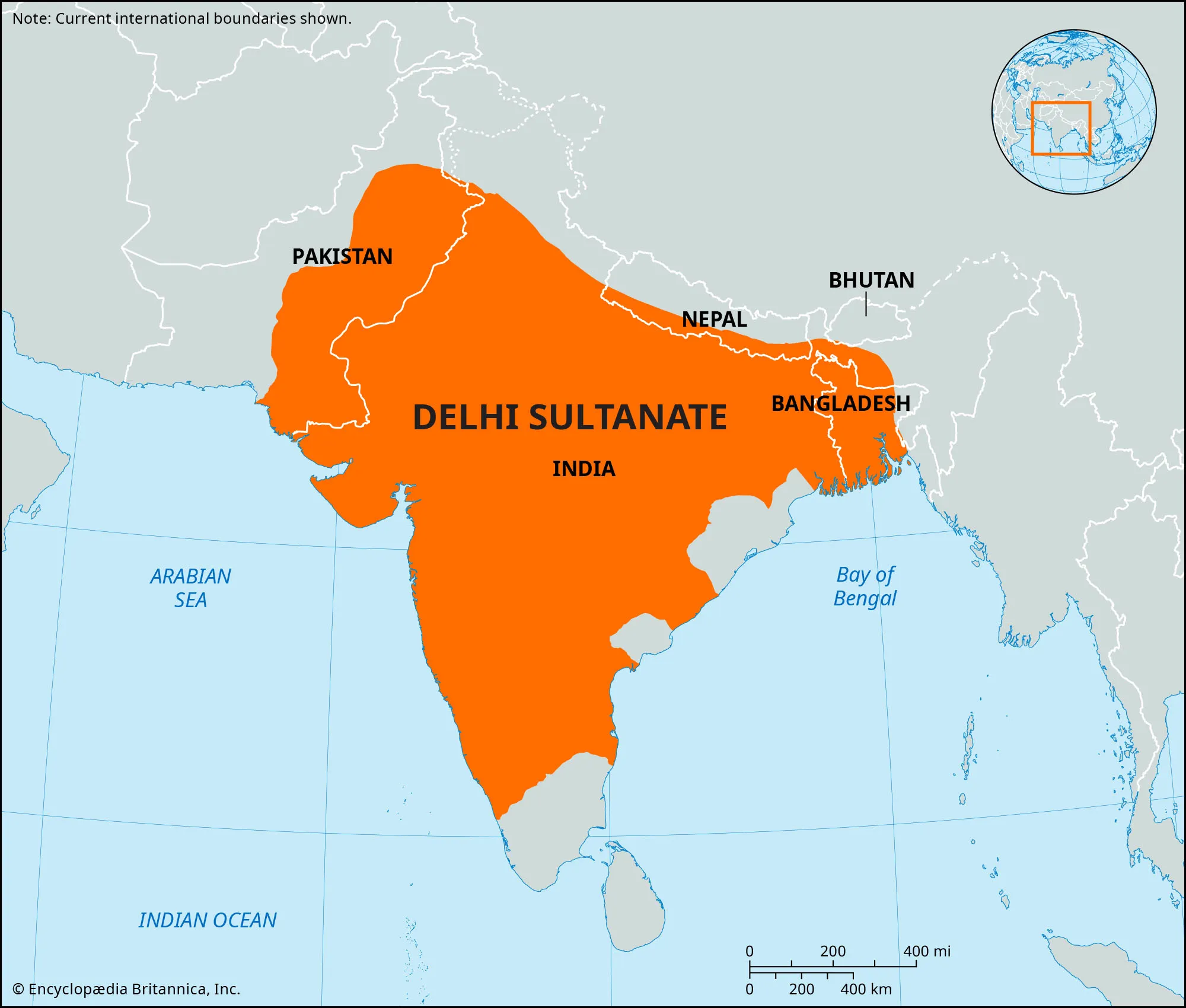
The Delhi Sultanate (1206–1526 CE) was one of the most significant political powers in medieval Indian history. For more than three centuries, it ruled large parts of the Indian subcontinent from its capital at Delhi, laying the foundations for major political, administrative, economic, and cultural transformations. Established by Muslim rulers of Turkic and Afghan origin, the Sultanate introduced new systems of governance, military organization, architecture, trade, and cultural exchange that profoundly influenced the course of Indian history.
The Delhi Sultanate was not a single dynasty but a succession of five ruling dynasties:
- The Mamluk (Slave) Dynasty (1206–1290)
- The Khalji Dynasty (1290–1320)
- The Tughlaq Dynasty (1320–1414)
- The Sayyid Dynasty (1414–1451)
- The Lodi Dynasty (1451–1526)
Each dynasty contributed in different ways to the political and cultural development of medieval India. The period ended in 1526, when Babur defeated Ibrahim Lodi in the First Battle of Panipat, leading to the establishment of the Mughal Empire.
Historical Background
The origins of the Delhi Sultanate can be traced to the invasions of Muhammad of Ghor during the late twelfth century.
In 1192, Muhammad of Ghor defeated the Rajput king Prithviraj Chauhan in the Second Battle of Tarain, gaining control over much of northern India.
Although Muhammad of Ghor did not establish a permanent empire in India, his military commander Qutb-ud-din Aibak consolidated these territories. After Muhammad’s death in 1206, Aibak declared himself Sultan, marking the beginning of the Delhi Sultanate.
The Five Dynasties of the Delhi Sultanate
1. Mamluk (Slave) Dynasty (1206–1290)
The Mamluk Dynasty was founded by Qutb-ud-din Aibak, a former slave who rose through military service to become ruler.
Qutb-ud-din Aibak
His achievements included:
- Establishing the Delhi Sultanate.
- Consolidating Muslim rule in northern India.
- Beginning construction of the Qutub Minar.
- Building the Quwwat-ul-Islam Mosque in Delhi.
He ruled for only four years before his accidental death in 1210.
Iltutmish
The greatest ruler of the Mamluk Dynasty was Shams-ud-din Iltutmish.
His major achievements included:
- Strengthening central administration.
- Defeating rival claimants.
- Expanding the Sultanate.
- Receiving formal recognition from the Abbasid Caliph.
- Introducing the silver Tanka and copper Jital coins.
He firmly established Delhi as the political center of northern India.
Razia Sultan
One of the most remarkable rulers of medieval India was Razia Sultan (1236–1240), the first and only woman to rule the Delhi Sultanate in her own right.
Despite opposition from powerful nobles, she proved herself a capable administrator and military leader.
Her reign remains an important milestone in Indian history for demonstrating that leadership could transcend gender, even in a deeply patriarchal society.
Ghiyas ud din Balban
Another notable Mamluk ruler was Ghiyas ud din Balban.
He strengthened royal authority by:
- Suppressing rebellions.
- Reorganizing the military.
- Strengthening frontier defenses.
- Introducing strict court discipline.
His policy of strong centralized monarchy helped stabilize the Sultanate.
2. Khalji Dynasty (1290–1320)
The Khalji rulers expanded the Sultanate to its greatest territorial extent.
Alauddin Khalji
The greatest ruler of this dynasty was Alauddin Khalji.
His achievements included:
- Defeating repeated Mongol invasions.
- Conquering Gujarat, Rajasthan, Malwa, and much of the Deccan.
- Introducing comprehensive market reforms.
- Strengthening the army.
- Controlling prices of essential commodities.
- Reforming revenue administration.
His economic policies enabled the maintenance of a large standing army while controlling inflation.
3. Tughlaq Dynasty (1320–1414)
The Tughlaq period witnessed ambitious reforms and extensive territorial expansion.
Muhammad bin Tughlaq
Perhaps the most controversial Sultan, Muhammad bin Tughlaq introduced several bold but often unsuccessful experiments.
These included:
- Shifting the capital from Delhi to Daulatabad.
- Introducing token copper currency.
- Expanding into southern India.
- Ambitious taxation reforms.
Many of these policies failed because of inadequate planning and implementation.
Firoz Shah Tughlaq
Firoz Shah focused on public welfare rather than military conquest.
His achievements included:
- Construction of canals.
- Irrigation projects.
- New cities.
- Hospitals.
- Schools (madrasas).
- Gardens.
He also restored ancient monuments, including several Ashokan pillars.
4. Sayyid Dynasty (1414–1451)
Following the invasion of Timur in 1398, the Delhi Sultanate entered a period of decline.
The Sayyid rulers governed a weakened kingdom with limited authority beyond Delhi and its surrounding regions.
Although politically less significant, they maintained the continuity of the Sultanate during a difficult period.
5. Lodi Dynasty (1451–1526)
The Lodi Dynasty was the first Afghan dynasty to rule the Delhi Sultanate.
Bahlul Lodi
He restored much of the Sultanate’s lost territory through diplomacy and military campaigns.
Sikandar Lodi
Sikandar strengthened administration and promoted agriculture and trade.
He also founded the city of Agra, which later became an important Mughal capital.
Ibrahim Lodi
The last Sultan of Delhi, Ibrahim faced opposition from Afghan nobles and regional rulers.
His defeat by Babur in the First Battle of Panipat (1526) marked the end of the Delhi Sultanate and the beginning of the Mughal Empire.
Administration
The Delhi Sultanate developed a sophisticated administrative system.
Central Government
The Sultan held supreme authority.
Important officials included:
- Wazir (Chief Minister).
- Military commanders.
- Revenue officers.
- Chief judges (Qazis).
- Intelligence officials.
Provincial Administration
The empire was divided into provinces known as Iqtas, governed by officials called Muqtis or Iqta holders.
These governors collected revenue, maintained law and order, and supplied troops to the Sultan.
Military Organization
The Delhi Sultans maintained a powerful standing army.
Military strength depended upon:
- Cavalry.
- War elephants.
- Archers.
- Fortifications.
- Efficient intelligence networks.
The Mongol invasions encouraged continuous military modernization.
Economy
Agriculture formed the backbone of the economy.
Major crops included:
- Wheat.
- Rice.
- Sugarcane.
- Cotton.
- Millets.
Trade flourished through both inland markets and overseas commerce.
Important exports included:
- Textiles.
- Spices.
- Indigo.
- Precious stones.
- Metal goods.
Delhi became one of the largest commercial centers of Asia.
Society
The Delhi Sultanate governed a culturally and religiously diverse population.
Society included:
- Muslims.
- Hindus.
- Jains.
- Buddhists.
- Merchants.
- Farmers.
- Soldiers.
- Artisans.
Urban centers experienced rapid growth due to trade and administrative development.
Religion and Culture
The Delhi Sultanate introduced important developments in Islamic culture while interacting with existing Indian traditions.
The period witnessed the growth of:
- Persian literature.
- Islamic scholarship.
- Sufi movements.
- Indo-Islamic architecture.
- Music.
- Calligraphy.
Many Sufi saints emphasized peace, charity, and spiritual devotion, attracting followers from diverse communities.
Architecture
The Delhi Sultanate produced some of India’s finest examples of medieval architecture.
Important monuments include:
- Qutub Minar.
- Alai Darwaza.
- Tughlaqabad Fort.
- Firoz Shah Kotla.
- Lodi Gardens tombs.
Architectural features included:
- Pointed arches.
- Domes.
- Minarets.
- Intricate geometric decoration.
- Arabic and Persian inscriptions.
These innovations greatly influenced later Mughal architecture.
Education and Literature
Persian became the official language of administration.
Educational institutions included:
- Madrasas.
- Mosques.
- Libraries.
Scholars produced important works in:
- History.
- Law.
- Theology.
- Poetry.
- Science.
Chroniclers such as Ziauddin Barani and Amir Khusrau left valuable accounts of the period.
Amir Khusrau, often called the “Parrot of India,” made lasting contributions to literature, music, and the development of Hindustani culture.
Challenges Faced by the Sultanate
Throughout its history, the Delhi Sultanate confronted numerous challenges:
- Mongol invasions.
- Regional rebellions.
- Succession disputes.
- Economic pressures.
- Administrative difficulties.
- Rival kingdoms.
Despite these obstacles, it remained a major political force for over three centuries.
Legacy of the Delhi Sultanate
The Delhi Sultanate profoundly influenced Indian history.
Its lasting contributions include:
- Establishing strong centralized administration.
- Expanding urbanization.
- Encouraging international trade.
- Introducing Indo-Islamic architecture.
- Promoting Persian literature and culture.
- Strengthening military organization.
- Laying the administrative foundations later adopted and refined by the Mughal Empire.
Interesting Facts
- The Delhi Sultanate lasted for more than 320 years.
- Razia Sultan remains the only woman to rule the Delhi Sultanate as sovereign.
- Qutub Minar, begun during the Mamluk period, is the world’s tallest brick minaret.
- Amir Khusrau contributed significantly to Indian music, poetry, and literature.
- The city of Agra was founded by Sikandar Lodi before becoming a major Mughal capital.
Lessons from the Delhi Sultanate
The history of the Delhi Sultanate offers valuable lessons:
- Strong institutions are essential for maintaining large empires.
- Cultural exchange enriches civilization.
- Effective administration and economic reforms strengthen governance.
- Religious and cultural interactions can produce enduring artistic and intellectual achievements.
- Political stability depends on capable leadership and sound succession.
Conclusion
The Delhi Sultanate was a defining chapter in the history of medieval India. For more than three centuries, it transformed the political, economic, and cultural landscape of the subcontinent through centralized governance, military innovation, expanding trade, and remarkable architectural achievements. While its history included periods of conflict and political change, it also witnessed significant developments in literature, education, urban life, and artistic expression.
The Sultanate’s legacy endured long after its fall in 1526, influencing the administrative systems, architecture, and cultural traditions of the Mughal Empire and shaping the course of Indian history. As a meeting point of diverse traditions, the Delhi Sultanate remains a significant example of the dynamic interactions that have contributed to India’s rich and multifaceted heritage.
Leave a Reply