

Introduction
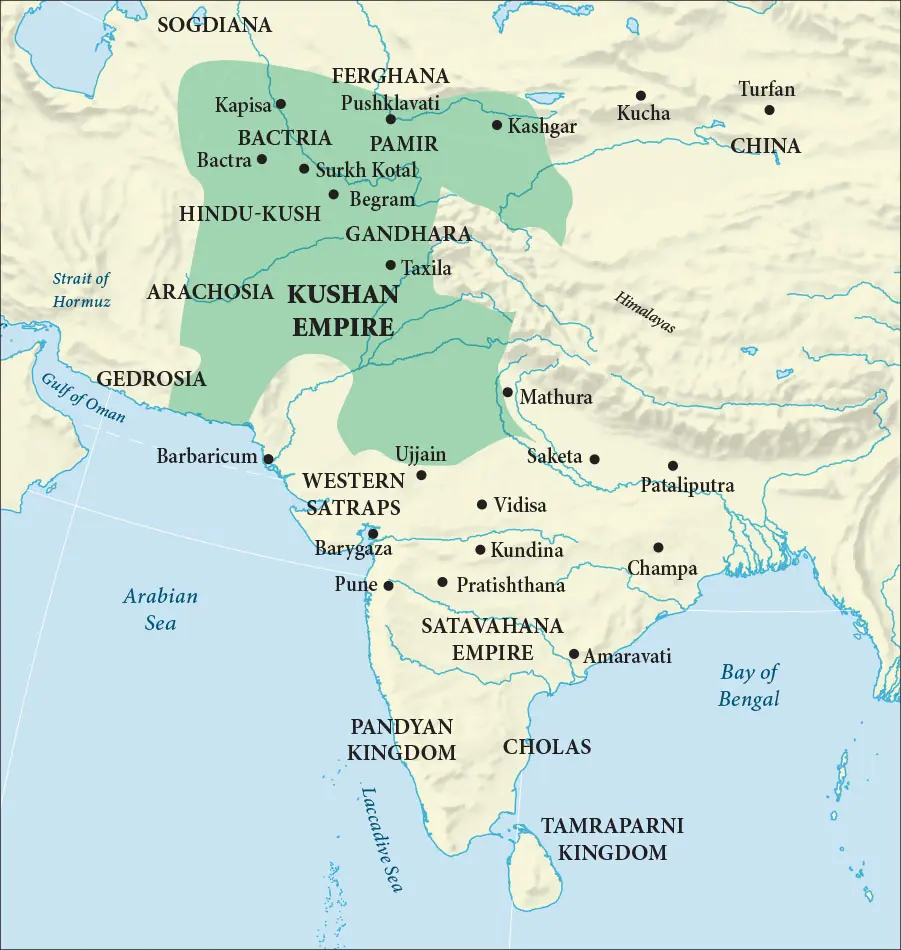
The Kushan Empire (1st–3rd Century CE) was one of the most influential empires of the ancient world, serving as a vital bridge between the civilizations of India, Central Asia, China, Persia, and the Roman Empire. Emerging from the nomadic Yuezhi tribes of Central Asia, the Kushans established a vast empire that stretched across present-day Afghanistan, Pakistan, northern India, Tajikistan, and parts of Uzbekistan.
The Kushan rulers are remembered for their military strength, flourishing international trade, religious tolerance, and extraordinary patronage of art and culture. Under the reign of Emperor Kanishka I, the empire reached its greatest extent and became one of the world’s leading centers of Buddhism, commerce, and cultural exchange.
The Kushan period marked a turning point in Indian and Asian history, as ideas, goods, religions, and artistic traditions moved freely along the famous Silk Road, connecting East and West.
Historical Background
The origins of the Kushans can be traced to the Yuezhi, a confederation of nomadic tribes that originally lived in northwestern China.
During the second century BCE, the Yuezhi were driven westward by the Xiongnu, another powerful nomadic group. They eventually settled in Bactria (modern Afghanistan and parts of Central Asia), where they absorbed elements of Greek, Persian, and local cultures following the decline of the Greco-Bactrian Kingdom.
Over time, one branch of the Yuezhi, known as the Kushans, emerged as the dominant power and began expanding southward into the Indian subcontinent.
Foundation of the Empire
The founder of the Kushan Empire was Kujula Kadphises, who united the various Yuezhi tribes during the first century CE.
His achievements included:
- Unifying the Yuezhi confederation.
- Conquering neighboring territories.
- Establishing centralized rule.
- Expanding into Afghanistan and northwestern India.
Kujula’s successors continued the expansion of the empire, transforming it into one of Asia’s greatest political powers.
Expansion Under Vima Kadphises
Vima Kadphises, one of Kujula’s successors, greatly expanded Kushan territory into northern India.
His reign witnessed:
- Control of important trade routes.
- Growth in commercial prosperity.
- Increased trade with the Roman Empire.
- The introduction of abundant gold coinage.
The gold coins issued during his reign reflect the empire’s wealth and extensive international commerce.
Emperor Kanishka I: The Greatest Kushan Ruler
The greatest monarch of the Kushan Empire was Emperor Kanishka I, who ruled during the early second century CE.
Although historians continue to debate the exact dates of his reign, his importance is unquestioned.
Under Kanishka, the empire extended from:
- Central Asia
- Afghanistan
- Kashmir
- Punjab
- The Gangetic plains
- Parts of present-day Uttar Pradesh
His capital is generally believed to have been Purushapura (modern Peshawar, Pakistan), while Mathura served as another major administrative and cultural center.
Kanishka combined military success with remarkable patronage of religion, learning, and the arts.
Kanishka and Buddhism
Kanishka is especially remembered for his support of Buddhism.
Although the empire remained religiously diverse, he became one of Buddhism’s greatest royal patrons after Emperor Ashoka.
Tradition credits him with convening the Fourth Buddhist Council in Kashmir, where Buddhist scholars discussed doctrine and compiled important commentaries.
His patronage helped spread Mahayana Buddhism, which emphasized:
- Compassion toward all beings.
- The Bodhisattva ideal.
- Universal salvation.
- Artistic representation of the Buddha.
Through Kushan support, Buddhism spread along the Silk Road into:
- Central Asia.
- China.
- Korea.
- Japan.
- Mongolia.
The influence of these missionary activities shaped Asian civilization for centuries.
Religious Tolerance
One of the defining features of the Kushan Empire was its remarkable religious diversity.
The Kushan rulers respected multiple faiths, including:
- Buddhism.
- Hinduism.
- Zoroastrianism.
- Greek religious traditions.
- Local Central Asian beliefs.
This tolerance is clearly reflected in Kushan coins, which depict deities from various religious traditions.
Such openness encouraged peaceful coexistence among diverse communities throughout the empire.
Administration
The Kushans governed a vast and multicultural empire.
The emperor exercised supreme authority while delegating power to provincial governors and local administrators.
Major cities functioned as administrative, commercial, and military centers.
The empire’s strategic location allowed efficient supervision of important trade routes linking India with Central Asia.
Economy and Trade
The Kushan Empire prospered because of its control over international commerce.
The Silk Road
The empire occupied a central position along the Silk Road, one of history’s most important trade networks.
Merchants carried goods between:
- China.
- India.
- Persia.
- Central Asia.
- The Roman Empire.
This trade brought enormous wealth to the Kushan state.
Major Exports
The Kushans exported:
- Cotton textiles.
- Silk.
- Spices.
- Ivory.
- Precious stones.
- Perfumes.
- Fine metalwork.
Imports
They imported:
- Roman gold.
- Glassware.
- Wine.
- Silverware.
- Luxury goods.
Large quantities of Roman coins discovered in India demonstrate the strength of Indo-Roman trade during this period.
Coinage
Kushan coinage is among the finest of the ancient world.
Their coins were minted in:
- Gold.
- Copper.
- Bronze.
The coins feature:
- Portraits of kings.
- Greek inscriptions.
- Iranian deities.
- Hindu gods.
- Buddhist symbols.
These coins illustrate the cosmopolitan nature of the empire.
Gandhara Art
The Kushan period witnessed the flowering of the famous Gandhara School of Art.
This artistic tradition blended:
- Greek realism.
- Roman artistic techniques.
- Persian influences.
- Indian religious themes.
For the first time, the Buddha was widely represented in human form.
Characteristics of Gandhara sculpture include:
- Wavy hair.
- Flowing robes.
- Realistic facial expressions.
- Fine anatomical detail.
These artistic innovations influenced Buddhist art across Asia.
Mathura School of Art
Alongside Gandhara, the Mathura School of Art flourished.
Unlike Gandhara, Mathura art displayed:
- Indigenous Indian styles.
- Red sandstone sculptures.
- Strong spiritual symbolism.
- Images of Hindu, Buddhist, and Jain deities.
Together, Gandhara and Mathura became two of the greatest artistic traditions of ancient India.
Literature and Learning
The Kushan rulers supported scholars, philosophers, and physicians.
Among the distinguished intellectuals associated with Kanishka’s court were:
- Ashvaghosha, the celebrated Buddhist poet and philosopher.
- Nagarjuna, one of Buddhism’s greatest philosophers.
- Charaka, the renowned physician whose work, the Charaka Samhita, became a foundational text of Ayurveda (though its compilation spans multiple periods).
The empire became an important center of learning and religious scholarship.
Society
Kushan society was ethnically and culturally diverse.
Its population included:
- Indians.
- Greeks.
- Persians.
- Central Asians.
- Buddhists.
- Hindus.
- Merchants.
- Farmers.
- Artisans.
- Soldiers.
The prosperity generated by trade encouraged urban growth and cultural interaction.
Architecture
The Kushans constructed:
- Buddhist monasteries.
- Stupas.
- Temples.
- Palaces.
- Fortifications.
The enormous Kanishka Stupa at Purushapura was one of the tallest religious monuments of the ancient world and attracted pilgrims from many countries.
Decline of the Kushan Empire
After Kanishka and his immediate successors, the empire gradually weakened.
Several factors contributed to its decline:
- Internal political struggles.
- Pressure from the rising Sasanian Empire in Persia.
- Regional rebellions.
- Loss of control over trade routes.
- Emergence of local kingdoms in northern India.
By the third century CE, the once-powerful Kushan Empire had fragmented into smaller states.
Legacy of the Kushan Empire
The Kushans made lasting contributions to Asian civilization.
Their achievements include:
- Promoting international trade through the Silk Road.
- Supporting the spread of Mahayana Buddhism.
- Encouraging religious tolerance.
- Developing Gandhara and Mathura art.
- Strengthening cultural exchange between East and West.
- Issuing magnificent coinage.
- Patronizing literature, philosophy, and medicine.
Their empire became a meeting place where ideas, religions, languages, and artistic traditions from multiple civilizations interacted.
Interesting Facts
- The Kushan Empire connected five major civilizations: India, China, Persia, Central Asia, and Rome.
- Emperor Kanishka is often compared with Emperor Ashoka for his support of Buddhism.
- Kushan coins depict more than thirty different deities from various cultures.
- The Gandhara School produced some of the earliest human images of the Buddha.
- The empire controlled important sections of the Silk Road, making it one of the wealthiest states of its time.
Lessons from the Kushan Empire
The history of the Kushan Empire teaches valuable lessons:
- Cultural diversity can strengthen a civilization.
- Trade encourages the exchange of ideas as well as goods.
- Religious tolerance promotes peace and stability.
- Patronage of education and the arts leaves a lasting legacy.
- Strategic geography can become a source of prosperity when combined with good governance.
Conclusion
The Kushan Empire occupies a unique place in world history as a civilization that connected the great cultures of Asia and the Mediterranean. Through military strength, commercial enterprise, religious tolerance, and artistic excellence, the Kushans transformed Central and South Asia into a vibrant crossroads of civilization.
Under the visionary leadership of Emperor Kanishka, the empire became a beacon of Buddhist learning, international trade, and cultural innovation. Its support for the Silk Road, the flourishing of Gandhara and Mathura art, and the spread of Mahayana Buddhism profoundly influenced the history of Asia. Even after its decline, the Kushan Empire’s legacy endured through its contributions to religion, art, commerce, and intercultural dialogue, securing its place among the greatest empires of the ancient world.
Leave a Reply