

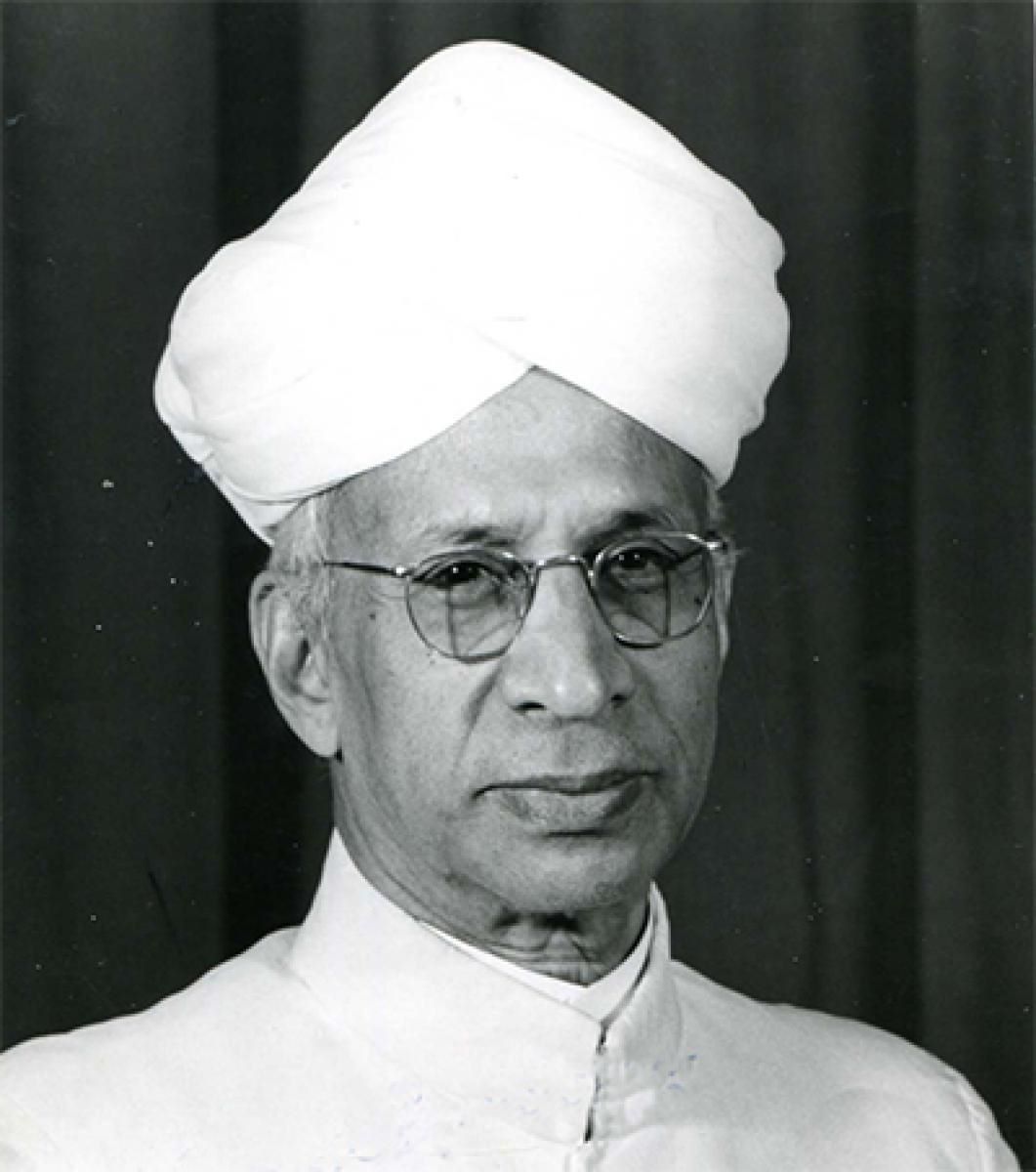
Philosopher, Teacher, Scholar and Second President of India


Dr. Sarvepalli Radhakrishnan (5 September 1888 – 17 April 1975) was one of India’s most distinguished philosophers, educators and statesmen. He was a scholar who helped introduce Indian philosophical thought to international audiences, a professor who devoted much of his life to education, India’s first Vice-President, and the country’s second President, serving from 1962 to 1967. (President of India)
His birthday, September 5, is celebrated throughout India as Teachers’ Day, making his life particularly significant to generations of Indian students and teachers.
📌 At a Glance
| Particular | Details |
|---|---|
| Full name | Sarvepalli Radhakrishnan |
| Born | September 5, 1888 |
| Birthplace | Tiruttani, then in the Madras Presidency |
| Died | April 17, 1975 |
| Age at death | 86 |
| Profession | Philosopher, professor, author, educationist, statesman |
| First major political office | Vice-President of India |
| Vice-President | 1952–1962 |
| President of India | 1962–1967 |
| Presidency | 2nd President of India |
| Ambassador to the Soviet Union | 1949–1952 |
| Bharat Ratna | 1954 |
| Teachers’ Day | September 5 in India |
| Major fields | Indian philosophy, comparative religion, education |
| Died | Chennai, Tamil Nadu |
The official President of India biography confirms his dates of life, his service as India’s first Vice-President and second President, his ambassadorship to the Soviet Union, and his academic leadership at Andhra University and Banaras Hindu University. (President of India)
👶 Early Life
Sarvepalli Radhakrishnan was born on September 5, 1888, in Tiruttani, a town in the present-day Tiruvallur district of Tamil Nadu.
He came from a Telugu-speaking family. His father, Sarvepalli Veeraswami, worked in the revenue department and his mother was Sitamma.
Radhakrishnan grew up in a traditional environment but received an education that exposed him to both Indian cultural traditions and Western philosophy.
His intellectual abilities became evident during his student years.
🎓 Education
Radhakrishnan received his early education in schools in Tiruttani and Tirupati before continuing his higher education in Madras.
He studied at Madras Christian College, where he specialized in philosophy.
His university education was particularly important because it gave him an opportunity to study Western philosophical traditions while also thinking deeply about Indian philosophical and religious traditions.
His master’s dissertation dealt with the philosophical significance of Vedanta.
This combination—deep engagement with Indian thought and familiarity with Western philosophy—became a defining feature of his intellectual career.
📚 Radhakrishnan as a Teacher
Before entering politics, Radhakrishnan was primarily known as an educator and philosopher.
He began his academic career as a philosophy teacher and went on to occupy important academic positions.
He taught at institutions including:
- Madras Presidency College
- University of Mysore
- University of Calcutta
- Oxford University
The official President of India’s profile records his work as a professor at the University of Mysore and University of Calcutta and his appointment to the Spalding Professorship of Eastern Religions and Ethics at Oxford. (President of India)
His academic reputation eventually extended far beyond India.
🧠 The Philosopher
Radhakrishnan’s central intellectual project was to explain Indian philosophical traditions to the modern world and to place them in conversation with Western philosophy.
He wrote extensively about:
- Hindu philosophy
- Vedanta
- Comparative religion
- Ethics
- Idealism
- Religious experience
- The relationship between science and spirituality
- Eastern and Western philosophical traditions
He argued that Indian philosophy was not merely an ancient collection of religious ideas but represented a sophisticated intellectual tradition capable of engaging with modern philosophical questions.
📖 His Major Books
Radhakrishnan was an extraordinarily productive writer.
Among his important works are:
Indian Philosophy
A major scholarly study of Indian philosophical traditions.
The Philosophy of Rabindranath Tagore
An exploration of Tagore’s philosophical and religious ideas.
An Idealist View of Life
One of his significant philosophical works dealing with consciousness, religion and the nature of reality.
Eastern Religions and Western Thought
An attempt to explore relationships and differences between Eastern and Western intellectual traditions.
The Hindu View of Life
A concise presentation of important aspects of Hindu religious and philosophical thought.
The Principal Upanishads
An influential scholarly interpretation and translation of the Upanishadic tradition.
His writings played an important role in making Indian philosophy accessible to international academic audiences.
🌏 Introducing Indian Philosophy to the World
One of Radhakrishnan’s greatest intellectual contributions was his role as an interpreter of Indian philosophy for the English-speaking world.
At a time when Indian traditions were often poorly understood or represented through limited Western interpretations, he presented Indian philosophical ideas as intellectually serious traditions worthy of global study.
He was particularly interested in the relationship between:
Reason and faith
Science and spirituality
East and West
Tradition and modernity
Philosophy and religion
He believed that different philosophical and religious traditions could enter into meaningful dialogue.
🕉️ His Understanding of Hinduism
Radhakrishnan interpreted Hinduism primarily as a broad philosophical and spiritual tradition rather than as a rigid system with a single doctrine.
He emphasized ideas such as:
- Religious experience
- Spiritual realization
- Tolerance
- Unity underlying diversity
- Ethical living
- Search for truth
He also sought to show that Hindu philosophical thought could respond to the challenges of modernity.
His interpretation has been highly influential, although later scholars have also critically examined and debated some aspects of his presentation of Hinduism.
🏛️ Academic Leadership
Radhakrishnan held several important academic leadership positions.
He served as:
Vice-Chancellor of Andhra University
He served as the university’s second Vice-Chancellor from 1931 to 1936.
Vice-Chancellor of Banaras Hindu University
He served as the fourth Vice-Chancellor of Banaras Hindu University from 1939 to 1948. (President of India)
These positions demonstrated that his contribution to education extended beyond classroom teaching into the administration and development of higher education.
🇮🇳 Entry into Public Life
Radhakrishnan was not a conventional career politician.
His reputation as a scholar and philosopher brought him into India’s public life.
After India’s independence, he was appointed India’s Ambassador to the Soviet Union, serving from 1949 to 1952. (President of India)
His appointment reflected the importance attached to intellectual diplomacy during India’s early years as an independent nation.
🇮🇳 India’s First Vice-President
In 1952, Radhakrishnan became the first Vice-President of India.
He served two terms, from 1952 to 1962.
As Vice-President, he also served as the ex officio Chairman of the Rajya Sabha, India’s Council of States.
His scholarly background gave parliamentary debates a distinctive intellectual dimension.
🏛️ The Second President of India
On May 13, 1962, Radhakrishnan became the second President of India, succeeding Dr. Rajendra Prasad.
He served until May 13, 1967. (President of India)
His presidency coincided with an extremely challenging period in Indian history.
India faced major political and economic pressures, including the Sino-Indian War of 1962 and the Indo-Pakistani War of 1965.
As President, Radhakrishnan represented the Indian Republic at a time when the young nation was consolidating its democratic institutions.
🎖️ Bharat Ratna
In 1954, Radhakrishnan was awarded the Bharat Ratna, India’s highest civilian honour. (President of India)
The award recognized his extraordinary contributions to education, philosophy and public life.
His other honours included international academic distinctions and honorary degrees from institutions in India and abroad.
👨🏫 Why September 5 Became Teachers’ Day
This is perhaps the most famous part of Radhakrishnan’s legacy.
When his students and admirers wanted to celebrate his birthday, the commonly recounted story says that Radhakrishnan suggested that the day be dedicated instead to teachers.
Thus, September 5 became India’s Teachers’ Day.
The Government of India’s Ministry of Education describes September 5 as the day on which India celebrates the birth anniversary of Radhakrishnan as National Teachers’ Day, emphasizing his contributions as a statesman, scholar, philosopher and educationist. (Education Government of India)
The tradition has made his birthday one of the most important dates in India’s educational calendar.
📚 His Philosophy of Education
For Radhakrishnan, education was not simply about acquiring information.
He believed education should help develop the whole person.
It should cultivate:
- Intelligence
- Character
- Moral judgment
- Independent thinking
- Tolerance
- Spiritual awareness
- Social responsibility
His vision of education placed considerable importance on the teacher.
A teacher should not merely transfer information but should inspire students to think and search for truth.
🧑🎓 Teacher as a Nation Builder
Radhakrishnan regarded education as fundamental to nation-building.
The basic idea can be expressed simply:
Educate the mind → develop character → strengthen society → build the nation.
This is why his legacy is particularly appropriate for Teachers’ Day.
The Ministry of Education has quoted Radhakrishnan in emphasizing the role of teachers in developing young minds and building the nation. (Education Government of India)
🕊️ His Views on Religion and Humanity
Radhakrishnan believed that religion should contribute to the moral and spiritual development of humanity.
He was interested in finding common ground among religious traditions while respecting their differences.
He emphasized:
- Spiritual experience
- Ethical responsibility
- Religious tolerance
- Human unity
- Dialogue between traditions
He believed that genuine religion should contribute to peace, compassion and human understanding.
🌐 East and West
One of the recurring themes of Radhakrishnan’s philosophy was the relationship between Eastern and Western civilizations.
He did not believe that one civilization possessed a monopoly on truth.
Instead, he encouraged dialogue.
He wanted Western audiences to understand Indian philosophy while encouraging Indians to engage critically with Western science, philosophy and political thought.
His approach can be summarized as:
Learn from the West without abandoning India’s intellectual heritage.
🧪 Science and Spirituality
Radhakrishnan lived during a period when scientific knowledge was expanding rapidly.
He did not regard science and spirituality as necessarily incompatible.
Science investigates the physical world through empirical methods.
Philosophy and spirituality address broader questions concerning:
- Meaning
- Values
- Consciousness
- Human purpose
- Ethics
For Radhakrishnan, humanity needed both scientific knowledge and moral wisdom.
👨👩👧 His Influence on Students
Perhaps his greatest legacy is not his presidency or books but his influence as an educator.
His life demonstrates that a teacher can eventually influence an entire nation.
He moved through an unusual path:
Student → Teacher → Professor → Philosopher → Academic leader → Diplomat → Vice-President → President
Yet even after reaching the highest constitutional offices, his public identity remained strongly associated with education and scholarship.
🏅 National Teachers’ Awards
Radhakrishnan’s association with teachers is also reflected in India’s national teacher-recognition system.
The National Teachers’ Awards were instituted in 1958, and September 5 became the established date for the award ceremony from the mid-1960s because of Radhakrishnan’s birthday. (DSEL Education)
Today, the awards recognize teachers whose commitment and excellence have made a significant difference to students and education.
🕯️ Final Years and Death
After completing his presidential term in 1967, Radhakrishnan largely withdrew from public life.
He continued to be respected internationally as a philosopher and elder statesman.
He died on April 17, 1975, at the age of 86. The official President of India biography confirms his date of death. (President of India)
His death marked the end of the life of one of India’s most prominent intellectual statesmen.
🏛️ Legacy
Radhakrishnan’s legacy exists in several different worlds.
📚 In philosophy
His writings remain important in the study of Indian philosophy and comparative religion.
🎓 In education
His name is permanently associated with the dignity and importance of teaching.
🇮🇳 In public life
He demonstrated how scholarship and intellectual leadership could contribute to the highest levels of public service.
🌏 In international relations
His diplomatic service helped represent India abroad during its early years as an independent nation.
🕊️ In interreligious thought
His writings promoted dialogue between religious and philosophical traditions.
🤔 Criticism and Scholarly Debate
A balanced account of Radhakrishnan should also recognize that his interpretation of Indian philosophy has not gone unquestioned.
Some later scholars have argued that his presentation of Hindu philosophy sometimes organized diverse Indian traditions into a more unified philosophical system than their historical development necessarily supports.
Others have debated his tendency to interpret Indian thought partly through categories familiar to Western philosophy.
These criticisms do not diminish his historical importance. Rather, they demonstrate that his writings became influential enough to generate continuing academic debate.
🌟 20 Interesting Facts About Dr. Radhakrishnan
- He was born on September 5, 1888.
- His birthday is celebrated as Teachers’ Day in India.
- He studied philosophy at Madras Christian College.
- He became a distinguished professor of philosophy.
- He taught at the University of Mysore.
- He taught at the University of Calcutta.
- He held the Spalding Professorship at Oxford.
- He served as Vice-Chancellor of Andhra University.
- He served as Vice-Chancellor of Banaras Hindu University.
- He was India’s first Vice-President.
- He served as Vice-President for 10 years.
- He was India’s second President.
- He served as President from 1962 to 1967.
- He was India’s Ambassador to the Soviet Union.
- He received the Bharat Ratna in 1954.
- He wrote extensively on Indian philosophy.
- He wrote extensively on comparative religion.
- His books helped introduce Indian philosophy to international readers.
- He regarded education as central to human development and nation-building.
- His legacy continues every year when millions of Indians celebrate Teachers’ Day on September 5.
The official President of India’s records confirm his major academic, diplomatic and constitutional positions. (President of India)
📜 Famous Quotations Associated with Radhakrishnan
Radhakrishnan’s writings and speeches contain many reflections on education, philosophy and humanity. Among the frequently cited ideas associated with him are:
“The end-product of education should be a free creative man, who can battle against historical circumstances and adversities of nature.”
Another often-cited educational principle is:
“Teachers should be the best minds in the country.”
Such statements reflect his belief that education should develop independent, creative and responsible human beings, rather than merely produce examination results.
🌺 What Students Can Learn From His Life
Radhakrishnan’s life offers several lessons for students.
1. Education can transform lives
He came from a relatively modest background but rose through scholarship and dedication.
2. Read beyond textbooks
His intellectual life crossed philosophy, religion, history, politics and culture.
3. Respect different viewpoints
His writings repeatedly engaged with different intellectual traditions.
4. Think independently
He believed education should develop the ability to think rather than merely memorize.
5. Knowledge carries responsibility
His transition from professor to statesman illustrates how knowledge can be placed at the service of society.
6. Remain a lifelong learner
Even after achieving political prominence, he remained fundamentally an intellectual.
🌹 Why Radhakrishnan Remains Relevant Today
The world has changed enormously since Radhakrishnan’s lifetime.
Students now live in an age of:
- Smartphones
- Social media
- Artificial intelligence
- Digital classrooms
- Online education
- Global communication
- Rapid scientific development
Yet his central educational question remains relevant:
What is the purpose of education?
If education produces only people who can pass examinations, it has achieved something—but not everything.
Education should also develop people who can:
Think critically.
Act ethically.
Respect others.
Question intelligently.
Serve society.
Live responsibly.
That is why Radhakrishnan’s legacy continues to resonate with teachers and students.
🇮🇳 Dr. Radhakrishnan and Teachers’ Day
Every September 5, schools and colleges across India celebrate Teachers’ Day.
Students may:
- Organize special assemblies
- Give speeches
- Present flowers and cards
- Perform cultural programs
- Write essays
- Organize teacher appreciation events
- Conduct classes themselves
- Honour outstanding teachers
Behind all these celebrations is the memory of a philosopher who believed deeply in the power of education.
India therefore remembers Radhakrishnan not simply as a President, but as a teacher who became President.
That distinction is central to understanding his legacy.
🕊️ A Lasting Tribute
Dr. Sarvepalli Radhakrishnan’s life connects the classroom and the Constitution, philosophy and politics, scholarship and public service.
He demonstrated that intellectual excellence and public leadership need not exist in separate worlds.
His journey—from a philosophy student to an internationally respected scholar, from professor to diplomat, from Vice-President to President—was extraordinary.
But perhaps the most fitting tribute is that India chose to remember his birthday not primarily with political ceremonies, but by honouring teachers.
That is a powerful legacy.
A nation remembers its great leaders through monuments and history books.
But it remembers its great teachers through the lives of their students.
📌 Dr. Sarvepalli Radhakrishnan — Timeline
| Year | Milestone |
|---|---|
| 1888 | Born on September 5 |
| 1900s | Pursued higher education in philosophy |
| 1910s | Began academic career |
| 1931–1936 | Vice-Chancellor, Andhra University |
| 1939–1948 | Vice-Chancellor, Banaras Hindu University |
| 1949–1952 | Ambassador to the Soviet Union |
| 1952 | Became India’s first Vice-President |
| 1954 | Awarded Bharat Ratna |
| 1962 | Became India’s second President |
| 1967 | Completed presidential term |
| 1975 | Died on April 17 |
| Every September 5 | Teachers’ Day celebrated in India |
The official President of India website identifies Radhakrishnan as the country’s second President and records his life dates as September 5, 1888–April 17, 1975. (President of India)
Dr. Sarvepalli Radhakrishnan
1888–1975
Philosopher • Teacher • Scholar • Diplomat • Vice-President • President • Bharat Ratna
His greatest legacy was not simply becoming India’s President—it was helping India remember the power and dignity of the teacher.
Official biography — President of India
Leave a Reply