

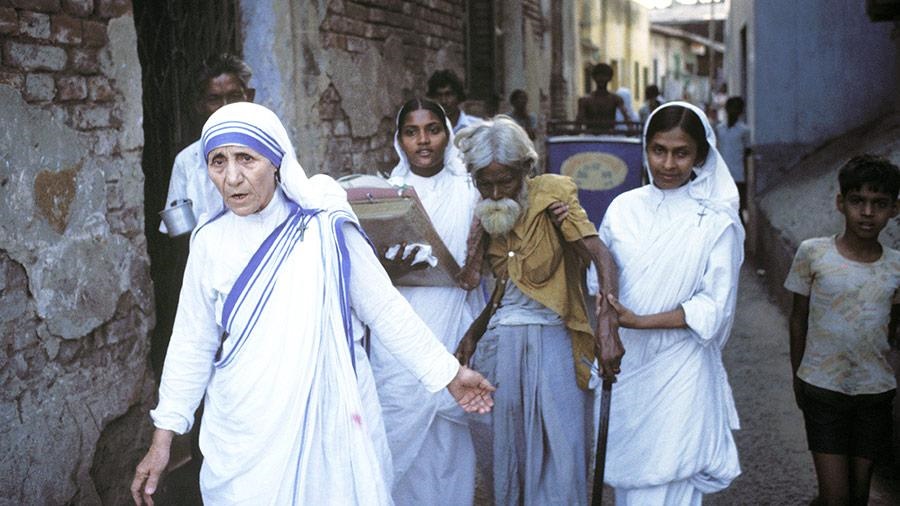
Saint Teresa of Calcutta (1910–1997) — A Life of Compassion, Service and Love
Mother Teresa of Calcutta, now officially known as Saint Teresa of Calcutta, was one of the most recognizable Catholic missionaries and humanitarian figures of the 20th century. Born Anjezë Gonxhe Bojaxhiu on August 26, 1910, in Skopje, she devoted her life to serving people who were poor, sick, abandoned and dying.
She founded the Missionaries of Charity in Calcutta (now Kolkata) in 1950. Her congregation eventually established homes, shelters and charitable services in many countries.
She received the Nobel Peace Prize in 1979 and the Bharat Ratna in 1980. She died in Kolkata on September 5, 1997, and was canonized by Pope Francis on September 4, 2016, becoming Saint Teresa of Calcutta.
Her life is particularly significant on September 5, which is both the International Day of Charity and her feast day in the Catholic Church.


📌 Mother Teresa at a Glance
| Particular | Details |
|---|---|
| Birth name | Anjezë Gonxhe Bojaxhiu |
| Religious name | Sister Mary Teresa / Mother Teresa |
| Born | August 26, 1910 |
| Birthplace | Skopje, Ottoman Empire (now North Macedonia) |
| Died | September 5, 1997 |
| Place of death | Kolkata, India |
| Age at death | 87 |
| Religious congregation | Missionaries of Charity |
| Founded | 1950 |
| Nobel Peace Prize | 1979 |
| Bharat Ratna | 1980 |
| Canonized | September 4, 2016 |
| Canonization pope | Pope Francis |
| Feast day | September 5 |
| Patron saint of | Various causes associated with missionaries and charity; her principal liturgical memorial is September 5 |
👶 Early Life
Anjezë Gonxhe Bojaxhiu was born on August 26, 1910, in Skopje.
At the time, Skopje was part of the Ottoman Empire. Today the city is the capital of North Macedonia.
She was the youngest child of Nikola Bojaxhiu and Dranafile Bojaxhiu.
Her family was Catholic, and religious faith played an important role in her childhood.
Her father died when she was young, leaving her mother to raise the family.
From an early age, Anjezë was attracted to missionary life and was deeply influenced by stories about missionaries serving people in distant countries.
✝️ The Call to Religious Life
At the age of 18, Anjezë decided to join the Sisters of Loreto, an Irish congregation involved in education and missionary work.
She traveled to Ireland in 1928, where she entered the Loreto novitiate.
There she received the name Sister Mary Teresa, after Saint Thérèse of Lisieux, the French Carmelite nun known as the “Little Flower.”
She subsequently went to India.
🇮🇳 Arrival in India
Sister Teresa arrived in India in 1929.
She began her religious life in the Loreto community and eventually became a teacher.
She taught at St. Mary’s School in Calcutta, where she later became principal.
For many years, she lived a relatively sheltered life as a teacher and religious sister.
But her understanding of her vocation was about to change dramatically.
🌆 The “Call Within a Call”
On September 10, 1946, while traveling by train from Calcutta to Darjeeling for a retreat, Sister Teresa experienced what she later described as a profound spiritual experience.
She understood this experience as a call from Christ to leave her teaching work and devote herself directly to serving the poorest people.
She referred to it as a:
“call within a call.”
She believed she was being asked to leave the convent school and work among people living in extreme poverty.
Obtaining permission to do so took time.
Eventually, she left the Loreto community and began her new mission.
🏙️ Serving the Poor of Calcutta
In 1948, Mother Teresa received permission to begin her new work.
She learned basic medical skills and began working among poor people in the streets and neighborhoods of Calcutta.
Her appearance became familiar:
- A simple white sari
- Blue borders
- Sandals
- A rosary
The sari eventually became closely associated with the Missionaries of Charity.
Her work initially involved teaching poor children and caring for sick and abandoned people.
Soon others began joining her.
🕊️ Founding the Missionaries of Charity
In 1950, the Catholic Church formally recognized the Missionaries of Charity as a religious congregation.
The congregation’s purpose was to serve what Mother Teresa described as:
“the poorest of the poor.”
Its members committed themselves to serving people who were often neglected by society.
Their work included caring for:
- Abandoned children
- Homeless people
- People with serious illnesses
- Dying people
- People with disabilities
- People experiencing extreme poverty
- People affected by social exclusion
The congregation eventually spread beyond India to countries across the world.
🏠 Nirmal Hriday
One of Mother Teresa’s best-known institutions was Nirmal Hriday, meaning “Pure Heart.”
It was established in 1952 near Kalighat in Kolkata.
The home provided care for people who were dying and had nowhere else to go.
Mother Teresa’s approach emphasized that people should not die alone or without dignity.
Her workers tried to provide:
- Food
- Shelter
- Basic medical care
- Clean surroundings
- Human companionship
- Spiritual support according to the person’s faith and wishes
The home became one of the most recognizable symbols of her work.
👶 Missionaries of Charity and Children
Mother Teresa was also deeply concerned about abandoned and vulnerable children.
The Missionaries of Charity established children’s homes and adoption-related services.
One important institution was Shishu Bhavan, established in Kolkata to care for children.
The congregation’s work with children eventually expanded to many parts of the world.
🌍 Expansion Around the World
What began as a small mission in Kolkata developed into an international organization.
Missionaries of Charity communities were eventually established in:
- India
- Asia
- Africa
- Europe
- North America
- Latin America
- Australia and Oceania
The sisters worked in:
- Homes for the dying
- Orphanages
- Shelters
- Hospitals and clinics
- Leprosy centers
- AIDS care facilities
- Homes for people with disabilities
- Programs for people experiencing homelessness
Her work attracted volunteers, donors and supporters from many countries.
🏆 Nobel Peace Prize — 1979
One of the greatest international recognitions of Mother Teresa’s work came in 1979, when she received the Nobel Peace Prize.
The Nobel Committee recognized her work among suffering people and her contribution to humanitarianism.
Mother Teresa famously chose to emphasize the poor rather than herself.
She also requested that the money normally associated with the Nobel banquet be directed toward helping people in need.
Her Nobel lecture emphasized the importance of love, compassion and service to vulnerable people.
🇮🇳 Bharat Ratna — 1980
In 1980, Mother Teresa received the Bharat Ratna, India’s highest civilian honour.
The award recognized her humanitarian service in India.
By this point she had become one of the most internationally recognized figures associated with Kolkata and humanitarian work.
🏅 Other Major Honours
Mother Teresa received numerous awards during her lifetime.
Among them were:
- Padma Shri — 1962
- Ramon Magsaysay Award for Peace and International Understanding — 1962
- Jawaharlal Nehru Award for International Understanding — 1969
- Nobel Peace Prize — 1979
- Bharat Ratna — 1980
- Presidential Medal of Freedom — 1985
Her international reputation grew steadily throughout the 1960s, 1970s and 1980s.
❤️ Her Philosophy of Service
Mother Teresa’s approach was remarkably simple.
She believed that a person did not need to change the entire world at once.
Instead:
Help the person in front of you.
If someone was hungry, feed them.
If someone was sick, care for them.
If someone was lonely, accompany them.
If someone was dying, give them dignity.
If a child was abandoned, protect the child.
Her spirituality emphasized performing small acts with great love.
👐 “The Poor”
Mother Teresa’s work was particularly focused on people who were socially invisible.
She often spoke about people who were:
- Unwanted
- Unloved
- Uncared for
- Abandoned
- Forgotten
For her, poverty was not only a lack of money.
A person could also suffer from loneliness, rejection and lack of human dignity.
This expanded the meaning of charity beyond financial assistance.
🩺 Her Approach to the Sick and Dying
One of the most distinctive aspects of her work was caring for people who were dying.
At a time when people with terminal illnesses could be abandoned in the streets, her homes offered them a place where they could receive basic care and human companionship.
Her workers sought to ensure that people could die with dignity.
She believed that every human life has value, regardless of a person’s social status, health, wealth or circumstances.
🙏 Spirituality
Mother Teresa’s service was deeply rooted in Catholic spirituality.
She understood her work as serving Christ in the poor.
The Eucharist, prayer, the Gospel and religious community life were central to the Missionaries of Charity.
Her spirituality emphasized:
- Prayer
- Humility
- Sacrifice
- Simplicity
- Compassion
- Service
- Love
- Perseverance
She believed that prayer and action belonged together.
🌑 Mother Teresa’s Spiritual Struggles
An important but sometimes overlooked aspect of Mother Teresa’s life was her experience of spiritual darkness and doubt.
After her death, letters published in a collection showed that she experienced long periods in which she felt God’s absence and struggled spiritually.
This surprised many people because she was publicly known as an exceptionally devout religious figure.
Rather than contradicting her public life, these writings reveal another dimension of her spirituality: she continued serving others even during periods when she experienced profound interior difficulty.
For Catholic spiritual writers, this has often been discussed in relation to the tradition of the “dark night of the soul.”
⚠️ Criticism and Controversy
A balanced biography should also discuss criticisms of Mother Teresa.
Although millions admired her, critics questioned several aspects of her work.
Medical standards
Some critics argued that conditions in certain homes were inadequate by modern medical standards and that pain treatment was sometimes insufficient.
Supporters responded that the homes were primarily intended to provide care and dignity to people who had otherwise been abandoned, often with limited resources.
Approach to suffering
Critics also argued that Mother Teresa sometimes appeared to place excessive spiritual value on suffering.
Supporters countered that her emphasis was not on glorifying suffering but on remaining present with people who were suffering.
Donations and financial transparency
Questions were also raised about financial oversight and about donations from controversial individuals.
Supporters maintained that her organization used donations to expand charitable services around the world.
Religious views
Her strong Catholic convictions also attracted criticism from people who disagreed with the Church’s positions on abortion, contraception and other moral questions.
These controversies remain part of the historical discussion surrounding her legacy.
⚖️ A Balanced Assessment
Mother Teresa’s historical legacy is complex.
There is broad recognition that:
- She drew global attention to extreme poverty.
- She created an international charitable congregation.
- She personally worked among marginalized people.
- She inspired thousands of religious sisters and volunteers.
- She helped establish charitable institutions across many countries.
- She became a powerful symbol of compassion.
At the same time, scholars and critics continue to debate:
- Medical practices in some of her institutions
- The quality of care
- Financial transparency
- Her understanding of suffering
- Her relationships with certain controversial donors
- Aspects of her religious and political views
A serious historical account should acknowledge both her extraordinary influence and the legitimate criticisms of her methods.
🕯️ Her Final Years
Mother Teresa continued working despite increasing health problems.
She suffered several serious illnesses, including heart problems.
In 1990, she announced her intention to step down as superior of the Missionaries of Charity but was subsequently re-elected.
She eventually retired from leadership in March 1997, with Sister Nirmala Joshi succeeding her as Superior General.
Mother Teresa died on September 5, 1997, in Kolkata.
She was 87 years old.
🇮🇳 State Funeral in India
Mother Teresa received a state funeral in India on September 13, 1997.
This was a remarkable honour for a Catholic nun who had spent much of her life serving people living in poverty.
The funeral was attended by representatives from India and around the world.
Her death generated widespread mourning.
⛪ Beatification
The Catholic Church began investigating Mother Teresa’s life and holiness soon after her death.
She was beatified by Pope John Paul II on October 19, 2003, in Vatican City.
The beatification followed recognition of a miracle attributed to her intercession.
✝️ Canonization as Saint Teresa of Calcutta
On September 4, 2016, Pope Francis canonized Mother Teresa in St. Peter’s Square, Vatican City.
She became:
Saint Teresa of Calcutta
The canonization took place one day before the 19th anniversary of her death.
September 5 subsequently became her liturgical feast day.
🌹 Feast Day — September 5
The Catholic Church celebrates the feast of Saint Teresa of Calcutta on September 5.
The date is significant because it is the anniversary of her death.
It is also the date chosen by the United Nations for the International Day of Charity, in recognition of her humanitarian legacy.
Thus, September 5 has a remarkable connection between:
Charity → Service → Mother Teresa → Saint Teresa of Calcutta
🌍 Mother Teresa and the International Day of Charity
The United Nations General Assembly established the International Day of Charity in 2012 and selected September 5 in memory of Mother Teresa.
The first observance took place in 2013.
The UN’s choice reflects the global recognition of the charitable and humanitarian dimension of her work.
Her legacy therefore extends beyond the Catholic Church and India into the broader international discussion about charity, volunteering and humanitarian service.
💬 Famous Sayings Associated With Mother Teresa
Mother Teresa became famous for concise sayings about love and service.
Among the best known are:
“If you can’t feed a hundred people, then feed just one.”
“We can do no great things; only small things with great love.”
“Not all of us can do great things. But we can do small things with great love.”
“I alone cannot change the world, but I can cast a stone across the waters to create many ripples.”
These sayings capture the central philosophy associated with her work: ordinary acts of compassion can have extraordinary consequences.
🌟 25 Interesting Facts About Mother Teresa
- She was born Anjezë Gonxhe Bojaxhiu.
- She was born in 1910.
- Her birthplace was Skopje.
- She joined the Sisters of Loreto at age 18.
- She arrived in India in 1929.
- She worked as a teacher before beginning her street ministry.
- She became known as Mother Teresa.
- She experienced her “call within a call” in 1946.
- She left the Loreto community to work among the poor.
- She founded the Missionaries of Charity in 1950.
- Her congregation began in Calcutta.
- Nirmal Hriday was opened in 1952.
- Her work expanded internationally.
- She received the Nobel Peace Prize in 1979.
- She received the Bharat Ratna in 1980.
- She received numerous other international awards.
- She continued working despite serious health problems.
- She died on September 5, 1997.
- She received a state funeral in India.
- She was beatified in 2003.
- She was canonized in 2016.
- Her feast day is September 5.
- She is officially known as Saint Teresa of Calcutta.
- September 5 is also the International Day of Charity.
- Her legacy remains one of the most discussed examples of modern Christian humanitarian service.
🕊️ What We Can Learn From Mother Teresa
Mother Teresa’s life offers lessons that extend beyond religious boundaries.
1. See the person
Do not reduce someone to their poverty, illness or social status.
2. Begin with what is near
You do not have to travel across the world to help someone.
3. Give dignity
Helping someone should never mean humiliating them.
4. Small actions matter
A meal, a kind word, a visit or a helping hand can make a difference.
5. Serve consistently
Real charity is not simply a one-day activity.
6. Care for the forgotten
A compassionate society is measured partly by how it treats people who have little social power.
7. Combine prayer and action
For people of faith, compassion becomes meaningful when it leads to concrete service.
❤️ Mother Teresa’s Greatest Legacy
Mother Teresa’s greatest contribution may not be any single institution or award.
It was the visibility she gave to people whom society often ignored.
She brought the suffering of the poorest people into the consciousness of millions around the world.
Her message was simple:
Every human being deserves love, care and dignity.
Whether one views her primarily as a saint, missionary, humanitarian, controversial public figure or a combination of these, her influence on the modern understanding of charity is undeniable.
📜 Mother Teresa — Timeline
| Year | Event |
|---|---|
| 1910 | Born in Skopje |
| 1928 | Joined the Sisters of Loreto |
| 1929 | Arrived in India |
| 1931 | Took first religious vows |
| 1937 | Took final vows |
| 1946 | Experienced the “call within a call” |
| 1948 | Began independent work among Kolkata’s poor |
| 1950 | Missionaries of Charity established |
| 1952 | Nirmal Hriday opened |
| 1962 | Received Padma Shri |
| 1979 | Received Nobel Peace Prize |
| 1980 | Received Bharat Ratna |
| 1997 | Retired as head of Missionaries of Charity |
| Sept. 5, 1997 | Died in Kolkata |
| 2003 | Beatified by Pope John Paul II |
| 2016 | Canonized by Pope Francis |
| Every Sept. 5 | Feast of Saint Teresa of Calcutta |
🌺 Saint Teresa of Calcutta
Mother Teresa began life as a young woman from Skopje who felt called to religious life.
She became a teacher.
Then a missionary.
Then the founder of an international congregation.
Then a Nobel laureate.
Then one of India’s most beloved humanitarian figures.
And finally, in the Catholic Church, Saint Teresa of Calcutta.
Her story is ultimately a story about love expressed through service.
“Do not wait for leaders; do it alone, person to person.”
Her life challenges every generation with a simple question:
Who is the person near me who needs my compassion today?
And perhaps that is why September 5 remains such a fitting day to remember her—not only as a Nobel laureate or a famous nun, but as a woman who made service to the vulnerable the central mission of her life.
Leave a Reply