

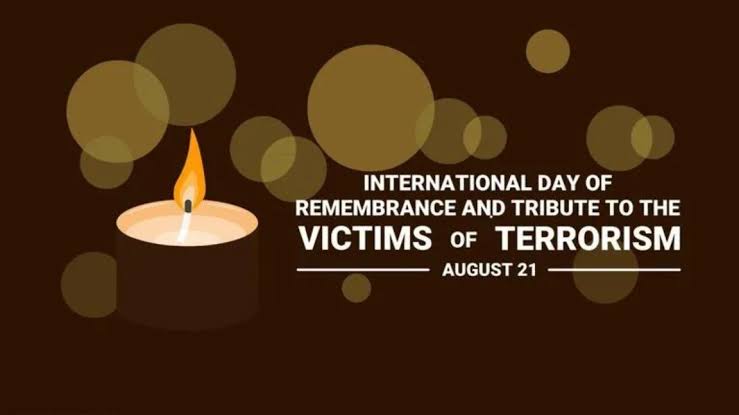
August 21 – Remembering the Victims, Supporting Survivors and Promoting a Culture of Peace
Every year on August 21, the world observes the International Day of Remembrance of and Tribute to the Victims of Terrorism. Established by the United Nations, this important observance honours people who have been killed, injured, traumatized or otherwise affected by acts of terrorism. It also recognizes the courage and resilience of survivors and calls upon governments and societies to protect their rights, support their recovery and ensure that they are never forgotten.
The day is not only about remembering those who lost their lives. It is also about listening to survivors, recognizing their dignity, addressing their long-term needs and building societies in which violence and hatred have no place.
The United Nations General Assembly established the International Day through Resolution 72/165 in 2017, designating August 21 as the annual day of remembrance and tribute. Its central purpose is to honour and support victims and survivors of terrorism and to promote and protect their human rights and fundamental freedoms. (United Nations)
🕊️ What Is the International Day About?
Terrorist attacks can last only minutes, but their consequences can last for decades.
A person may lose a loved one, suffer a permanent physical injury, experience psychological trauma or lose a sense of security. Families can be left facing emotional, social and financial difficulties. Entire communities can carry painful memories long after an attack has ended.
The International Day therefore reminds the world that the end of an attack is not the end of its consequences.
Victims and survivors may need long-term:
- Medical treatment
- Psychological and emotional support
- Financial assistance
- Legal assistance
- Rehabilitation
- Social support
- Educational support
- Assistance with employment
- Family and community support
- Protection of their human rights
The United Nations notes that victims often struggle to have their voices heard and their needs addressed after the immediate attention surrounding an attack has disappeared. Recovery can require long-term, multidimensional support. (United Nations)
📜 History of the International Day
The United Nations General Assembly adopted Resolution 72/165 in 2017, establishing August 21 as the International Day of Remembrance of and Tribute to the Victims of Terrorism.
The resolution called for the day to honour and support victims and survivors and to promote and protect their human rights and fundamental freedoms. (United Nations)
The establishment of the day reflected growing international recognition that victims must be at the centre of responses to terrorism.
Counter-terrorism efforts traditionally focused heavily on preventing attacks and prosecuting perpetrators. While these remain important, the international community increasingly recognizes that victims themselves must have a central place in policies concerning terrorism.
🌍 Terrorism and Its Human Cost
Terrorism affects far more people than those directly killed or injured in an attack.
Consider the different groups that can be affected:
Victims who survive
Survivors may experience physical injuries, disabilities, psychological trauma and difficulties returning to normal life.
Families of those killed
Family members may face grief, financial hardship and profound emotional consequences.
Children
Children may lose parents, relatives, teachers or friends. They may also experience fear, anxiety and disruption to education.
First responders
Police officers, firefighters, emergency medical workers and other responders can themselves experience physical and psychological consequences.
Communities
An attack can create fear and mistrust within an entire community.
Society
Repeated terrorist attacks can undermine social cohesion, public confidence and people’s sense of security.
For these reasons, terrorism should never be understood merely as an attack on a particular building, location or group of people. Its human consequences can extend across generations.
❤️ Remembering the Victims
One of the central purposes of this International Day is remembrance.
Remembering victims means recognizing that every person affected by terrorism was an individual with a name, a family, dreams, relationships and a unique story.
Memorials, photographs, personal stories, anniversaries and public ceremonies can help preserve these memories.
The UN’s Memories campaign, for example, has used film and photography to share the personal stories of victims of terrorism and the significance of objects connected to their memories. (United Nations)
Such remembrance is important because victims should not become merely statistics.
Behind every number is a human life.
🌱 2026 Theme: “Healing through Memory”
For 2026, the United Nations has chosen the theme:
“Healing through Memory”
The theme emphasizes the role that remembrance and memorialization can play in the dignity, recognition, healing and long-term recovery of victims and survivors.
The UN explains that remembering is not simply an exercise in looking backward. Preserving people’s stories can foster empathy, strengthen social cohesion and contribute to preventing future violence. (United Nations)
The theme also stresses that remembrance should be victim-centred and trauma-informed. Memorialization should honour victims without unnecessarily reopening wounds or causing further harm.
This is especially important in the digital age, when photographs, videos and stories can remain permanently available online.
🧠 The Psychological Impact of Terrorism
Physical wounds may sometimes be visible, but psychological wounds can remain hidden.
Survivors may experience:
- Fear
- Anxiety
- Depression
- Grief
- Post-traumatic stress
- Difficulty sleeping
- Survivor’s guilt
- Social withdrawal
- Loss of confidence
- Difficulty returning to work or education
Family members can also experience long-term trauma.
Psychological recovery is therefore an essential component of support for victims.
A compassionate response should not expect survivors to “move on” quickly. Healing can take years, and every person responds differently.
⚖️ Human Rights and the Rights of Victims
The International Day is closely connected with human rights.
Victims of terrorism have the right to dignity, recognition and appropriate support. Governments have an important responsibility to ensure that victims and survivors are not forgotten after the immediate emergency has passed.
The UN identifies Member States as having the primary responsibility for supporting victims and upholding their rights. The UN assists through advocacy, capacity-building, networks and technical support. (United Nations)
Support should address both immediate and long-term needs.
👩👧 Women and Children
Women and children can experience particular vulnerabilities in situations involving terrorism.
Children may suffer the loss of parents, displacement, interrupted education and psychological trauma.
Women can experience physical, psychological, social and economic consequences, including forms of sexual and gender-based violence associated with terrorist groups.
The UN’s 2023 review of the Global Counter-Terrorism Strategy specifically highlighted the importance of protecting and supporting women, children and victims of sexual and gender-based violence in the context of terrorism. It also encouraged Member States to develop comprehensive national assistance plans for victims and their families. (United Nations)
🤝 From Victims to Survivors and Advocates
Victims and survivors should not be viewed only as passive recipients of assistance.
Many survivors have transformed their experiences into advocacy for peace, justice, human rights and prevention of violence.
They speak in schools, participate in international conferences, support other survivors and work with governments and civil society organizations.
The UN increasingly emphasizes the importance of victim leadership and participation.
The Victims of Terrorism Associations Network (VoTAN) provides a global platform connecting victims and survivors from different regions and backgrounds. Its work seeks to strengthen peer support, advocacy and collective action. (United Nations)
🌐 The Role of the United Nations
The United Nations works with Member States and civil society organizations to strengthen support for victims.
The United Nations Office of Counter-Terrorism (UNOCT) has a Victims of Terrorism Unit that works to raise awareness, support victims’ rights and strengthen the capacity of governments and civil society organizations to respond to victims’ needs. (United Nations)
The UN’s work includes:
- Raising awareness about victims’ experiences.
- Promoting human rights.
- Supporting national assistance programmes.
- Strengthening victims’ associations.
- Encouraging international cooperation.
- Providing technical assistance and capacity-building.
- Promoting victim participation in counter-terrorism efforts.
🏛️ The UN Global Congress of Victims of Terrorism
An important milestone was the first United Nations Global Congress of Victims of Terrorism, held at UN Headquarters in September 2022.
The Congress brought together victims, survivors, governments and other stakeholders to discuss ways of strengthening the international victims-of-terrorism agenda.
The UN’s subsequent work has continued to emphasize the importance of placing victims and their needs at the centre of international efforts. (United Nations)
📅 How Is the Day Observed?
The International Day can be observed through peaceful and respectful activities such as:
🕯️ Moments of silence
Communities can hold a moment of silence in memory of those who lost their lives.
🏛️ Memorial ceremonies
Governments and institutions can organize commemorative programmes.
🎙️ Survivors’ testimonies
Survivors can be given opportunities to share their experiences, provided this is done voluntarily and sensitively.
📚 Educational programmes
Schools and universities can discuss peace, tolerance, human rights and the consequences of terrorism.
🎨 Art and cultural activities
Art, music, photography and exhibitions can provide constructive ways to remember victims.
🤝 Community programmes
Community organizations can organize activities that promote solidarity and social cohesion.
🌐 Responsible digital remembrance
Online platforms can share victims’ stories respectfully while avoiding sensationalism and harmful or graphic material.
🕊️ The Importance of Responsible Remembrance
Remembering terrorism requires sensitivity.
Victims should never be reduced to images of violence or used merely to attract attention.
Responsible remembrance should:
- Respect victims’ dignity.
- Avoid graphic imagery.
- Avoid sensationalism.
- Protect children’s privacy.
- Avoid glorifying perpetrators.
- Give survivors control over their stories where possible.
- Avoid spreading terrorist propaganda.
- Focus on human dignity, resilience and peace.
The 2026 UN theme specifically emphasizes victim-centred and trauma-informed remembrance, including in digital spaces. (United Nations)
📱 Terrorism, Social Media and Digital Memory
Modern technology has changed the way terrorist attacks are experienced and remembered.
Photographs, videos and messages can spread around the world within minutes. While this can help document events and preserve memories, it can also cause additional trauma to survivors and families.
Old images can unexpectedly reappear years later. Misleading information can circulate rapidly. Terrorist organizations can also attempt to exploit digital platforms for propaganda.
This makes responsible digital communication extremely important.
The 2026 UN observance specifically includes attention to online harms experienced by victims and survivors and to preventing digital spaces from causing retraumatization. (United Nations)
🕯️ Remembering Without Hatred
One of the greatest challenges of remembrance is ensuring that grief does not become hatred.
Terrorism frequently attempts to create fear, division and hostility between communities.
A constructive response should instead strengthen:
Peace rather than hatred.
Dialogue rather than division.
Justice rather than revenge.
Compassion rather than prejudice.
Unity rather than fear.
Remembering victims can therefore become an act of resistance against the forces that seek to divide societies.
🇮🇳 Relevance to India
India, like many countries, has experienced the devastating effects of terrorism over the decades.
Terrorist violence has affected civilians, security personnel, families and communities in different parts of the country.
The International Day offers an opportunity to remember all victims while reaffirming India’s commitment to peace, social harmony and the protection of human dignity.
It is also an opportunity to emphasize that terrorism should never be used to justify hatred against an entire religion, ethnicity, nationality or community.
Terrorism is a form of violence; it should not become a reason for collective blame.
The victims of terrorism come from diverse backgrounds, and solidarity with them should likewise cross boundaries of religion, nationality, culture and ethnicity.
🌍 Building a World Where Victims Are Not Forgotten
The fight against terrorism cannot be measured only by the number of attacks prevented.
It must also be measured by how societies treat those who have already suffered.
Are survivors receiving medical care?
Are traumatized people receiving psychological support?
Are families receiving assistance?
Are victims’ voices being heard?
Are children receiving the support they need?
Are survivors able to return to education and employment?
Are governments protecting victims’ rights?
Are communities helping survivors rebuild their lives?
These questions are at the heart of a genuinely victim-centred approach.
🌟 What Can Individuals Do?
Everyone can contribute to a culture of remembrance and peace.
We can:
- Remember victims with dignity.
- Listen respectfully to survivors.
- Reject hatred and violence.
- Avoid spreading unverified information about terrorist incidents.
- Refuse to share terrorist propaganda.
- Support legitimate organizations helping victims.
- Promote tolerance and peaceful dialogue.
- Teach children the value of human dignity.
- Stand against discrimination and prejudice.
- Support communities affected by violence.
Small acts of compassion can help create stronger communities.
🕯️ A Message of Hope
The International Day of Remembrance and Tribute to the Victims of Terrorism carries a solemn message:
We remember those who were lost.
We stand with those who survived.
We listen to those whose lives were changed.
We support those who continue to heal.
And we work together for a world where terrorism no longer destroys innocent lives.
The 2026 theme, “Healing through Memory,” reminds us that remembering can be part of healing. When memories are preserved with dignity, when survivors are heard, and when communities stand together, remembrance can become a force for hope and social cohesion. (United Nations)
📌 International Day of Remembrance and Tribute to the Victims of Terrorism – Key Facts
| Fact | Details |
|---|---|
| Official name | International Day of Remembrance of and Tribute to the Victims of Terrorism |
| Date | August 21 |
| Established by | United Nations General Assembly |
| Resolution | A/RES/72/165 |
| Year established | 2017 |
| Main purpose | To honour, remember and support victims and survivors of terrorism |
| Human-rights focus | Protection and promotion of victims’ human rights and fundamental freedoms |
| 2026 theme | Healing through Memory |
| UN office involved | United Nations Office of Counter-Terrorism (UNOCT) |
| Important global initiative | Victims of Terrorism Associations Network (VoTAN) |
| First UN Global Congress of Victims of Terrorism | September 2022 |
The UN’s official information confirms the date, legal foundation, purpose and 2026 theme of the observance. (United Nations)
🌺 Conclusion
The International Day of Remembrance of and Tribute to the Victims of Terrorism is a day of sorrow, solidarity, dignity and hope.
It reminds us that behind every terrorist attack are human beings whose lives and families may be changed forever. The victims deserve more than momentary sympathy immediately after an attack. They deserve long-term support, justice, recognition and respect.
Remembering them is an act of humanity.
Supporting survivors is an act of compassion.
Protecting their rights is an act of justice.
And working to prevent future violence is a responsibility shared by the entire international community.
On August 21, let us remember every victim and stand beside every survivor with one common message:
“Their lives mattered. Their stories matter. Their dignity matters. And they must never be forgotten.”
May remembrance lead to healing, healing lead to hope, and hope lead to a more peaceful world.
Leave a Reply