

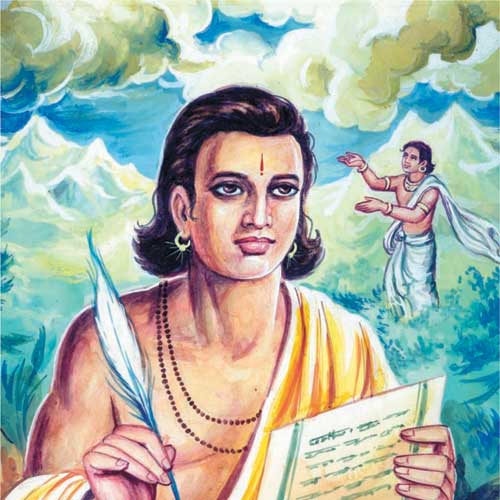
“Among poets, Kalidasa shines like the sun among the stars. His mastery of language, profound understanding of human emotions, and exquisite descriptions of nature have made him one of the greatest literary figures in world history.”
Introduction
Kalidasa is widely regarded as the greatest poet and dramatist in Sanskrit literature. Revered as the “Shakespeare of India,” he occupies an unparalleled position in Indian literary history. His works represent the golden age of classical Sanskrit literature, blending poetic beauty, philosophical depth, and vivid portrayals of love, heroism, devotion, and nature.
Although the details of his life remain shrouded in mystery, Kalidasa’s literary genius has endured for more than fifteen centuries. His poems and plays continue to inspire readers, scholars, playwrights, and artists across the world. His influence extends beyond literature into Indian art, music, dance, theatre, and cinema, while his works have been translated into numerous languages and admired by renowned thinkers such as Sir William Jones, Johann Wolfgang von Goethe, and Rabindranath Tagore.
Historical Background
The exact period in which Kalidasa lived remains uncertain. Most modern scholars place him between the 4th and 5th centuries CE, during the reign of the Gupta Empire, often described as the Golden Age of ancient India. Many associate him with the court of Chandragupta II Vikramaditya (c. 375–415 CE), though definitive historical evidence is lacking.
The Gupta period witnessed remarkable achievements in literature, science, mathematics, astronomy, philosophy, sculpture, and architecture. Sanskrit flourished as the language of learning and high culture, providing the ideal environment for Kalidasa’s extraordinary literary accomplishments.
Legends About Kalidasa
Several popular legends surround Kalidasa’s life, though they are not historically verifiable.
According to one well-known tradition, Kalidasa was initially an uneducated shepherd or woodcutter. Through a series of events, he married a learned princess who soon discovered his ignorance and ridiculed him. Humiliated, Kalidasa sought the blessings of the goddess Kali, undertaking intense penance. Pleased by his devotion, the goddess granted him exceptional wisdom and poetic genius.
Whether historically true or not, this story symbolizes the transformative power of divine grace, perseverance, and the pursuit of knowledge.
Life and Career
Little is known with certainty about Kalidasa’s personal life. His writings, however, reveal a man deeply acquainted with:
- Hindu philosophy
- Vedic traditions
- Royal courts
- Geography of India
- Classical music
- Dance
- Astronomy
- Botany
- Human psychology
His works demonstrate intimate knowledge of both urban sophistication and rural simplicity, suggesting extensive travel and broad intellectual interests.
Literary Style
Kalidasa’s writing is celebrated for its elegance, simplicity, emotional richness, and vivid imagery. His poetry reflects a perfect balance between intellectual refinement and emotional sensitivity.
Some defining characteristics of his style include:
- Graceful and melodious Sanskrit
- Rich use of similes and metaphors
- Detailed descriptions of nature
- Psychological insight into human emotions
- Harmonious blending of romance and spirituality
- Idealized yet realistic characterization
- Balance between poetic imagination and moral values
His famous similes became so renowned that later critics declared:
“Upama Kalidasasya”
“The simile belongs to Kalidasa.”
This expression reflects the belief that no poet surpassed him in the art of comparison.
Major Works
Kalidasa’s surviving writings include three plays, two epic poems, and two lyrical poems.
1. Abhijnanasakuntalam (The Recognition of Shakuntala)
This masterpiece is considered one of the greatest dramas in world literature.
Based on an episode from the Mahabharata, it tells the story of King Dushyanta and Shakuntala, whose love is disrupted by a sage’s curse that causes the king to forget her until he sees a ring that restores his memory.
The play explores themes such as:
- Love and separation
- Memory and destiny
- Forgiveness
- Dharma
- Divine providence
When Sir William Jones translated it into English in 1789, it captivated European audiences. Johann Wolfgang von Goethe praised the play, declaring it one of the finest works of dramatic literature.
2. Vikramorvasiyam (Urvashi Won by Valor)
This drama narrates the romance between King Pururavas and the celestial nymph Urvashi.
Combining mythology with romance, the play explores the tension between mortal life and divine existence. It highlights themes of love, sacrifice, jealousy, and the enduring quest for happiness.
3. Malavikagnimitram (Malavika and Agnimitra)
Probably Kalidasa’s earliest surviving play, it recounts the love story of King Agnimitra and the beautiful maid Malavika, who is later revealed to be a princess.
The drama is known for its lively dialogue, courtly humor, and engaging portrayal of palace life.
4. Raghuvamsha (The Dynasty of Raghu)
This epic poem traces the history of the Raghu dynasty, culminating in the life of Lord Rama.
Comprising nineteen cantos, it celebrates ideal kingship, courage, generosity, and righteousness. The work combines historical traditions, mythology, and philosophical reflections into a magnificent literary achievement.
5. Kumarasambhava (The Birth of Kumara)
One of Kalidasa’s finest epics, Kumarasambhava recounts the marriage of Shiva and Parvati and the birth of their son Kartikeya (Kumara), destined to defeat the demon Tarakasura.
The poem is admired for its majestic descriptions of the Himalayas, profound exploration of divine love, and philosophical insights into asceticism, devotion, and cosmic purpose.
6. Meghaduta (The Cloud Messenger)
Perhaps Kalidasa’s most beloved lyrical poem, Meghaduta tells the story of a Yaksha (a celestial being) who is exiled by his master, Kubera. Separated from his beloved wife, he asks a passing cloud to carry a message of love to her in the distant Himalayas.
The poem is divided into two parts:
- Purva Megha (The First Cloud) – describing the cloud’s journey across India.
- Uttara Megha (The Second Cloud) – describing the message delivered to the Yaksha’s wife.
Meghaduta is celebrated for its exquisite imagery, emotional depth, and evocative descriptions of landscapes.
7. Ritusamhara (The Cycle of Seasons)
This lyrical poem celebrates the six seasons of the Indian year, portraying how nature influences human emotions, festivals, agriculture, and romance.
The work demonstrates Kalidasa’s extraordinary sensitivity to the natural world.
Themes in Kalidasa’s Works
Nature as a Living Presence
Kalidasa’s descriptions of mountains, rivers, forests, flowers, birds, and changing seasons are among the finest in world literature. Nature is never merely a backdrop; it actively reflects and participates in human emotions.
Love
Love is the central theme in many of Kalidasa’s writings. He portrays romantic love as both joyful and transformative, often intertwined with longing, separation, and reunion.
Dharma
Duty, righteousness, and moral responsibility form the ethical foundation of his characters. His heroes and heroines strive to balance personal desires with social and cosmic obligations.
Divine and Human Relationships
Kalidasa seamlessly blends mythology with human experience, presenting gods and mortals as participants in the same moral and emotional universe.
Beauty
His writings celebrate beauty in all its forms—physical, moral, intellectual, and spiritual. Beauty, for Kalidasa, reveals the harmony inherent in creation.
Kalidasa’s Influence
Kalidasa’s works profoundly influenced subsequent Sanskrit poets such as Bhavabhuti, Magha, and Sriharsha. His literary techniques also shaped regional literatures across India, including Tamil, Kannada, Telugu, Malayalam, Bengali, Marathi, and Hindi.
Beyond India, his writings gained international recognition through translations into English, German, French, Russian, Chinese, Japanese, and many other languages. His influence can be seen in comparative literature, theatre, and the performing arts worldwide.
Kalidasa in Indian Culture
Kalidasa’s legacy remains vibrant in contemporary India.
His works are regularly:
- Studied in universities
- Performed in classical theatre
- Adapted into films and television series
- Presented in dance dramas
- Celebrated in literary festivals
The annual Kalidasa Festival held in Ujjain honors his enduring contribution to Indian literature and culture.
Literary Significance
Kalidasa occupies a unique position because he united several literary qualities seldom found together:
- Profound philosophical insight
- Masterful poetic craftsmanship
- Dramatic excellence
- Psychological realism
- Cultural richness
- Universal human appeal
His writings transcend the boundaries of language, religion, and geography, speaking to readers across generations.
Lessons from Kalidasa’s Life and Works
Kalidasa’s legacy continues to offer valuable lessons:
- Knowledge and wisdom transform individuals.
- Nature is a source of spiritual inspiration and artistic creativity.
- Love is strengthened by patience, sacrifice, and fidelity.
- Beauty and morality can coexist harmoniously.
- Great literature reflects universal human experiences.
- Art has the power to preserve cultural values across centuries.
- Humility and lifelong learning are the marks of true greatness.
Conclusion
Kalidasa stands among the greatest literary figures in world history. Through his plays, epics, and lyrical poems, he elevated Sanskrit literature to extraordinary heights of artistic perfection. His works capture the beauty of nature, the complexity of human emotions, and the timeless ideals of love, duty, and spiritual harmony.
More than fifteen centuries after they were composed, Kalidasa’s writings continue to enchant readers with their elegance, emotional depth, and universal wisdom. His enduring legacy as the foremost poet of classical India ensures that his voice remains one of the most celebrated in the annals of world literature, inspiring generations to appreciate the profound connection between humanity, nature, and the divine.
Leave a Reply