

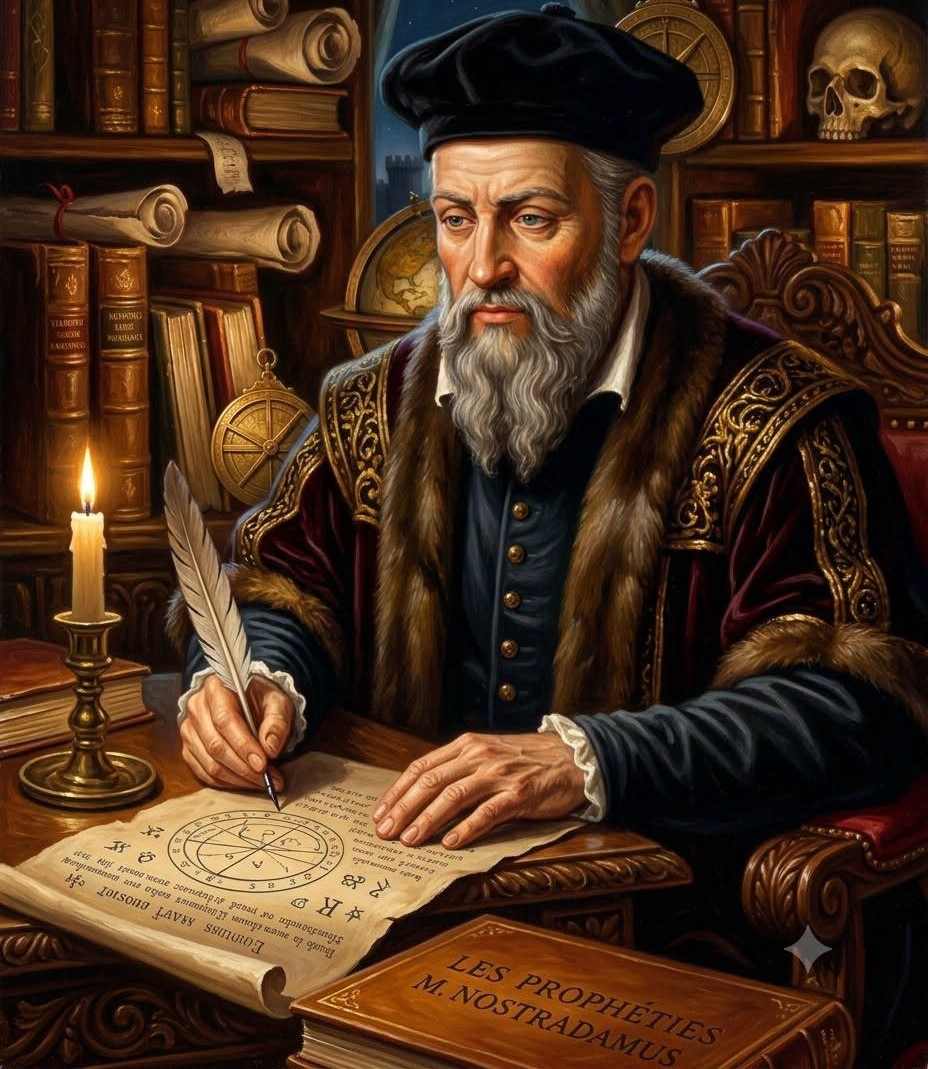
Nostradamus—the Latinized name of Michel de Nostredame (1503–1566)—is probably the most famous prophetic figure in Western history. A French physician, astrologer, apothecary, writer and almanac-maker, he became famous in his own lifetime, but his reputation as a “prophet who predicted the future” grew enormously after his death.
For almost five centuries, people have claimed that his writings predicted the death of King Henry II, the French Revolution, Napoleon, Hitler, the atomic bomb, the Apollo Moon landing, the Great Fire of London, the death of Princess Diana, 9/11 and even COVID-19.
But there is an important distinction between what Nostradamus actually wrote and what later interpreters claim he wrote.
The historical evidence establishes that Nostradamus wrote hundreds of deliberately obscure four-line verses. It does not establish that he possessed supernatural powers or that he successfully predicted specific modern events. Modern scholars and skeptics generally explain the apparent “hits” through vagueness, retrospective interpretation, mistranslation, selective quotation and the enormous number of possible interpretations. (Biography)


1. Who was Nostradamus?
His real name was Michel de Nostredame.
He was born in Saint-Rémy-de-Provence, France, in 1503, into a relatively prosperous family. His family had converted from Judaism to Catholicism before his birth. He later Latinized his surname to Nostradamus, a form under which he became famous.
He lived during one of the most turbulent periods of European history:
- the Renaissance
- religious conflicts between Catholics and Protestants
- epidemics
- wars between European monarchies
- political assassinations
- astronomical and astrological speculation
- widespread belief in magic and supernatural forces
This environment is essential for understanding Nostradamus.
To a sixteenth-century European, astrology and celestial signs were not necessarily regarded as bizarre fringe subjects. Astrology was intertwined with medicine, astronomy, politics and ideas about divine providence.
2. His early life
Michel de Nostredame was born in 1503.
The exact day of his birth is sometimes given differently in historical sources, but December 1503 is generally accepted.
His family was well educated for its social position. Several members of his family were involved in professions requiring literacy and learning.
He received an education that exposed him to:
- Latin
- classical literature
- mathematics
- astrology
- medicine
- religious writings
He eventually became interested in medicine and travelled extensively.
3. Nostradamus and medicine
One of the most important facts often lost in the popular image of Nostradamus is that he was a physician.
He lived at a time when Europe was repeatedly devastated by epidemic disease, especially plague.
Nostradamus travelled through parts of France and Italy and treated victims of epidemic disease.
He gained a reputation for being willing to work among plague victims.
This is significant because his early career was not that of a mysterious fortune-teller living in isolation.
He was a Renaissance medical practitioner who later became famous for astrology and prophecy. (Biography)
4. The plague
The plague profoundly influenced Nostradamus.
Sixteenth-century medicine had limited understanding of infectious disease.
Doctors did not know about:
- bacteria
- viruses
- modern epidemiology
- antibiotics
- germ theory
Nostradamus nevertheless developed his own approaches to treating patients.
Some later accounts have exaggerated his medical achievements, so claims that he “discovered a cure for the plague” should be treated cautiously.
His experience with epidemics, however, undoubtedly contributed to his reputation.
People naturally became interested in anyone who appeared capable of predicting or managing disasters.
5. His marriage and family tragedy
Nostradamus married Henriette d’Encausse.
They had children.
But tragedy struck his family when his wife and children died, traditionally associated with an epidemic.
The loss deeply affected him.
After this period he travelled extensively and eventually rebuilt his professional and intellectual career.
His personal experiences with death and disease are important background to his later writings, which contain frequent references to:
- war
- plague
- famine
- death
- earthquakes
- floods
- political upheaval
- celestial phenomena
6. How did Nostradamus become a prophet?
Nostradamus began publishing annual almanacs containing predictions.
These became increasingly popular.
His almanacs contained forecasts concerning:
- weather
- political events
- rulers
- wars
- disasters
- diseases
- social conditions
This was an important development.
He discovered that people were fascinated by predictions.
Eventually, he began producing a much more ambitious work.
That work became Les Prophéties.
7. Les Prophéties


Nostradamus’s most famous work was:
Les Prophéties de M. Michel Nostradamus
It was first published in 1555.
The work consists largely of short four-line poems called quatrains.
The poems were grouped into sections traditionally called Centuries.
A “Century” does not mean a period of 100 years.
It refers to a collection intended to contain approximately 100 quatrains.
The surviving corpus contains just under 1,000 quatrains, conventionally numbered across ten Centuries, although the textual history is complicated. (Wikipedia)
8. Why are the prophecies so difficult to understand?
This is probably the single most important question about Nostradamus.
His verses are notoriously obscure.
He used:
- archaic French
- Latin
- Greek
- Italian
- Occitan/Provençal forms
- anagrams
- historical references
- astrology
- mythology
- biblical imagery
- unusual spelling
- deliberately ambiguous expressions
The result is a text that can often be interpreted in multiple ways.
For example, a verse may mention:
a ruler, a city, fire, war, a river and death
without giving an unambiguous date or identifying the precise event.
After an event happens, however, readers can sometimes reinterpret those words so that they appear to describe it.
That is the foundation of much of Nostradamus’s modern reputation.
9. Did Nostradamus deliberately make his prophecies vague?
This remains debated.
One possibility is that he deliberately obscured his predictions because of the religious and political dangers of his time.
Another possibility is that his style reflected the literary and prophetic traditions of the sixteenth century.
His writing was also influenced by earlier prophetic literature.
Modern research has identified similarities between Nostradamus’s work and older sources, including biblical and classical historical material. (Wikipedia)
Thus, his verses were not necessarily spontaneous supernatural visions.
They were part of a much older European tradition of prophecy and apocalyptic literature.
10. Nostradamus and astrology
Astrology was central to Nostradamus’s intellectual world.
He claimed to use what was known as judicial astrology—the attempt to interpret celestial configurations to forecast earthly events.
He examined:
- planets
- zodiac signs
- planetary positions
- conjunctions
- astronomical cycles
However, there is an interesting historical irony.
Some astrologers of his own time criticized Nostradamus’s astrological methods.
He was accused of incompetence and of using questionable methods for connecting past planetary configurations with future events. (Wikipedia)
So the skepticism surrounding Nostradamus did not begin in the twentieth century.
He had critics while he was still alive.
11. Catherine de’ Medici and Nostradamus
One of the most important people associated with Nostradamus was Catherine de’ Medici, queen consort of France.
She became interested in his writings and summoned him to court.
Nostradamus subsequently became associated with the French royal court.
He prepared horoscopes for members of the royal family and became an important royal adviser and physician.
His relationship with Catherine de’ Medici helped transform him from a successful almanac writer into an internationally famous figure.
Catherine de’ Medici
12. The famous prophecy about Henry II
Perhaps the most famous alleged success of Nostradamus during his lifetime concerns King Henry II of France.
One of Nostradamus’s quatrains refers to a:
- young lion
- older lion
- duel
- eye injury
- cruel death
In 1559, Henry II participated in a jousting tournament.
A lance penetrated his helmet and seriously injured him around the eye and head.
He died after prolonged suffering.
Because the quatrain seemed to resemble the event, later readers regarded it as a remarkable prediction.
Henry II of France
But there is an important caveat.
The interpretation was largely made after the event.
The verse does not plainly say:
“King Henry II will die in a jousting accident in 1559.”
That distinction is fundamental to evaluating Nostradamus.
13. The “Hitler” prophecy
One of the most famous modern claims concerns Adolf Hitler.
The argument usually focuses on the name:
Hister
Some popular books and websites claim that “Hister” was Nostradamus’s name for Hitler.
This is almost certainly a misunderstanding.
Hister/Ister was an ancient name associated with the Danube River.
It appears in historical and geographical traditions predating Hitler.
Therefore:
Hister ≠ Hitler
The similarity of the words is intriguing but is not evidence that Nostradamus predicted Adolf Hitler.
Adolf Hitler
Historical analyses note that the supposed Hitler prophecy becomes much less convincing when the original historical context and terminology are examined. (Sky HISTORY TV channel)
14. Did Nostradamus predict the French Revolution?
Some interpreters claim that Nostradamus predicted the French Revolution of 1789.
His writings certainly contain themes of:
- rebellion
- political violence
- rulers losing power
- executions
- social disorder
But these themes were not unusual in prophetic literature.
The difficulty is that his verses do not provide a uniquely identifiable description of the French Revolution.
Consequently, the claim remains an interpretation rather than a demonstrated prediction.
15. Did he predict Napoleon?
Another popular claim is that Nostradamus predicted Napoleon Bonaparte.
Various verses have been interpreted as referring to:
- a military leader
- an emperor
- France
- war
- conquest
But again, none clearly identifies Napoleon in the manner a genuine historical prediction would.
Napoleon Bonaparte
The interpretation became stronger only after Napoleon’s rise.
This is an example of retrospective interpretation.
16. Did Nostradamus predict the Great Fire of London?
Another famous claim concerns the Great Fire of London of 1666.
Supporters often point to a Nostradamus verse mentioning:
- London
- fire
- the year 66
This sounds impressive.
But the verse is sufficiently ambiguous that it cannot securely be established as a prediction of the 1666 fire.
The problem becomes even greater when multiple historical fires and disasters can be matched against similar imagery.
17. Did Nostradamus predict World War II?
Many modern books claim that Nostradamus predicted:
- Hitler
- Nazi Germany
- World War II
- concentration camps
- the Holocaust
But these interpretations are mostly constructed retrospectively.
The texts contain general imagery of:
- war
- armies
- destruction
- famine
- political rulers
- violence
Those themes were hardly unusual for a sixteenth-century prophet writing during an age of almost constant warfare.
18. Did he predict 9/11?


The claim that Nostradamus predicted the September 11, 2001 terrorist attacks became extremely popular immediately after the attacks.
One supposed prophecy circulated online mentioning:
- a new century
- a great king of terror
- fire from the sky
- a great city
It sounded astonishingly accurate.
But there is a major problem:
The widely circulated 9/11 “prophecy” was not an authentic Nostradamus quatrain.
It was a modern fabrication/constructed text that was circulated after the attacks.
The Skeptic documented how the supposed prophecy was being misrepresented in the aftermath of 9/11. (The Skeptic)
This is one of the clearest examples of how Nostradamus’s reputation can be exploited.
19. Did Nostradamus predict COVID-19?
During the COVID-19 pandemic, numerous social-media posts claimed that Nostradamus had predicted:
- a mysterious plague
- a pandemic
- quarantine
- millions of deaths
- a disease emerging from China
Again, the problem is that many of the quotations circulating online were:
- mistranslated,
- taken out of context,
- fabricated,
- or derived from modern interpretations.
There is no convincing historical evidence that Nostradamus explicitly predicted COVID-19.
20. Did he predict the atomic bomb?
Some interpreters have linked passages about:
- fire from the sky
- great destruction
- death
- weapons
to nuclear weapons.
But such imagery is too general.
Fire from heaven is an extremely old apocalyptic motif.
It appears in religious and mythological literature centuries before Nostradamus.
Therefore, interpreting it as a nuclear weapon requires retrospective fitting.
21. Did he predict the Moon landing?
This claim is another example of interpretive flexibility.
Some verses have been connected with:
- the sky
- journeys
- strange machines
- celestial events
and therefore interpreted as descriptions of space travel.
But there is no clear quatrain stating that humans would land on the Moon in 1969.
22. Did Nostradamus predict Princess Diana’s death?
After Princess Diana died in 1997, various Nostradamus passages were interpreted as predictions of her death.
Again, the supposed connections depend heavily upon:
- translations
- substitutions of names
- selective quotations
- retrospective interpretation
The original texts do not plainly identify Princess Diana.
23. The “future dates” of Nostradamus
One fascinating feature of Nostradamus’s work is that some passages have been interpreted as extending centuries into the future.
Popular accounts sometimes claim that his predictions continue until 3797.
This is indeed associated with a statement in the traditional textual history of his work.
But that does not mean that Nostradamus supplied a clear calendar of future events from 1555 to 3797.
Instead, his verses are fragmented, unordered and obscure. (EBSCO)
24. A major problem: no chronological order
If Nostradamus really intended to provide a detailed forecast of future history, his method was extraordinarily difficult to use.
The quatrains do not form a straightforward chronological narrative.
Instead, they jump between:
- rulers
- wars
- cities
- disasters
- historical figures
- astrological events
- religious imagery
This makes almost any chronological interpretation dependent upon the interpreter.
25. The problem of vague predictions
Consider a prediction such as:
There will be war, famine, disease and political upheaval.
Such a prediction has a high probability of appearing “correct.”
Why?
Because these things happen repeatedly throughout human history.
Europe in Nostradamus’s own lifetime experienced:
- wars
- epidemics
- famine
- religious conflict
- political assassination
- rebellion
Consequently, a prediction involving catastrophe is not necessarily evidence of supernatural knowledge.
26. The problem of retrospective interpretation
This is perhaps the strongest criticism of Nostradamus.
Imagine that a prophet writes:
“Fire will destroy a great city.”
Before an event, this could refer to thousands of possibilities.
After a famous city burns, people can say:
“That is exactly what he predicted!”
This is called retrospective fitting or post hoc interpretation.
The interpretation is made after the event rather than being demonstrated before it.
27. The “multiple-choice” problem
Nostradamus wrote hundreds of quatrains.
Each quatrain can contain several images.
Over centuries, thousands of possible events have occurred.
Therefore, it is statistically unsurprising that some verses can be made to resemble historical events.
This is one reason skeptics emphasize that the correct question is not:
“Can we find a quatrain that resembles an event?”
but:
“Could the event have been identified from the quatrain before it happened, with enough precision to rule out alternatives?”
That is a much harder test.
28. Translation problems
Nostradamus wrote in a form of sixteenth-century French mixed with other languages and unusual terminology.
Translation can radically change meaning.
A word can acquire a completely different appearance when translated from:
Old French → modern French → English
Some popular Nostradamus books have therefore been criticized for relying on highly creative translations.
This makes claims based only on English translations particularly questionable. (Sky HISTORY TV channel)
29. The problem of forged or altered quotations
Nostradamus’s fame has generated a huge industry of:
- books
- websites
- videos
- social-media posts
- documentaries
- fictional predictions
Some quotations circulating under his name are not authentic.
The 9/11 example is particularly instructive.
Therefore, any serious investigation should ask:
- Does the quotation appear in an authentic edition?
- What is the original French?
- When was the verse first published?
- Does the earliest edition contain it?
- Was the interpretation made before or after the event?
Without these checks, almost anything can be attributed to Nostradamus.
30. Was Nostradamus a fraud?
This is a more complicated question than it appears.
Calling him simply a “fraud” may be too simplistic.
He genuinely existed.
He genuinely wrote the works attributed to him.
He genuinely practiced medicine.
He genuinely studied astrology.
He genuinely published predictions.
He genuinely believed in some form of predictive astrology and prophetic interpretation.
The question is whether he possessed supernatural predictive powers.
There is no reliable scientific evidence demonstrating that he did.
31. Was Nostradamus a psychic?
There is no scientifically established evidence that Nostradamus possessed psychic powers.
His writings do not provide the kind of precise, independently verifiable predictions that would allow his abilities to be scientifically tested.
For example, a highly testable prophecy would say:
“On 12 October 2027, a specific named city will experience a specific event.”
Nostradamus’s verses generally do not work like this.
Instead, they are cryptic and metaphorical.
32. Was he a magician?
Nostradamus certainly lived in a world where magic, astrology, alchemy and occult traditions existed alongside medicine and natural philosophy.
But the modern image of Nostradamus as a stereotypical sorcerer is misleading.
His intellectual world was much more complicated.
He was a Renaissance intellectual operating within a culture where astrology could be regarded as a legitimate method of understanding earthly events.
33. The “prophet” versus “astrologer” distinction
This is another important distinction.
Nostradamus is often called a:
prophet
But he was also:
physician + astrologer + almanac writer + apothecary + author
His predictive system was substantially connected to the intellectual traditions of astrology and historical prophecy.
He should therefore not simply be imagined as a biblical prophet receiving direct revelations from God.
34. Did Nostradamus believe he could predict the future?
He clearly presented his work as forecasting future events.
However, modern scholars have offered different interpretations of his method.
One influential line of research suggests that Nostradamus drew heavily on earlier historical and prophetic writings, then transformed past events into future-looking predictions.
In other words:
He may have been projecting the past into the future rather than literally seeing future history.
Research has identified material resembling works by classical historians and earlier prophetic collections. (Wikipedia)
35. Nostradamus as a “bibliomancer”
Some modern interpretations have described Nostradamus as a bibliomancer—someone using books or texts as a means of divination.
The idea is that he may have drawn inspiration from existing historical and prophetic literature, sometimes selecting passages and transforming them into his own predictions.
This interpretation is controversial, but it offers an interesting alternative to the supernatural explanation.
36. His death
Nostradamus died in 1566, at approximately 62 years of age.
He had suffered from health problems including conditions associated with arthritis and gout.
He reportedly knew that his health was deteriorating.
His death did not end his fame.
In fact, it was the beginning of a much larger legend.
37. Nostradamus after death
His reputation expanded dramatically during the centuries following his death.
Every generation discovered new “predictions” that supposedly applied to its own circumstances.
This is remarkable.
During different periods, people claimed Nostradamus had predicted:
- wars
- revolutions
- kings
- emperors
- dictators
- technological discoveries
- nuclear weapons
- space travel
- terrorist attacks
- pandemics
- climate disasters
His texts became a kind of historical mirror.
Each generation looked into the verses and saw its own fears.
38. Why are people fascinated by Nostradamus?
There are several reasons.
1. Humans want to know the future
Fear of uncertainty is one of the oldest features of human psychology.
2. His verses are mysterious
The ambiguity creates endless possibilities.
3. Some verses appear remarkably specific
Especially when presented in modern translations.
4. Famous disasters create emotional connections
After a catastrophe, people search for warnings they believe were overlooked.
5. Confirmation bias
People remember the apparent successes and forget the failures.
6. The Internet amplifies extraordinary claims
A sensational “Nostradamus predicted this!” headline spreads much faster than a careful historical analysis.
39. Confirmation bias
Suppose Nostradamus has 900+ quatrains.
A reader searches them after a major event.
They find one that seems vaguely similar.
The other hundreds that do not match are forgotten.
This is a classic example of confirmation bias.
The process can be summarized as:
Event → search prophecy → find resemblance → ignore non-matches → claim prediction
A proper scientific approach reverses the process:
Prediction → define criteria → wait for event → test accuracy
That distinction is crucial.
40. Nostradamus’s major alleged predictions — a critical table
| Event | Common claim | Historical assessment |
|---|---|---|
| Death of Henry II | “Young lion” prophecy | Interesting resemblance, but not an unambiguous prediction |
| French Revolution | Revolution and royal downfall | Possible retrospective interpretation |
| Napoleon | Great French military ruler | Not clearly identified |
| Great Fire of London | London/fire/1666 | Ambiguous |
| Hitler | “Hister” | Hister refers to the Danube, not Hitler |
| World War II | War and Germany | Retrospective interpretation |
| Atomic bomb | Fire/destruction from sky | Not specific |
| Moon landing | Celestial journey | Not demonstrable |
| Princess Diana | Royal death | Retrospective interpretation |
| 9/11 | “Great King of Terror” | Famous circulated text was not an authentic Nostradamus prophecy |
| COVID-19 | Pandemic prediction | No convincing specific prophecy |
The distinction between “resemblance” and “prediction” is the key to understanding the table.
41. The most important criticism
The strongest criticism of Nostradamus is not simply that his predictions were wrong.
It is that his verses are usually too ambiguous to be objectively tested.
A scientifically useful prediction should ideally contain:
- identifiable subject
- identifiable event
- location
- approximate date
- measurable outcome
Nostradamus generally provides none or only some of these.
Therefore, almost any major event can potentially be fitted into his language.
42. Why some people still believe in him
It is also unfair to dismiss every believer as irrational.
People are attracted to Nostradamus because:
- some passages really are striking;
- his historical knowledge was considerable;
- he lived through extraordinary events;
- some predictions seem surprisingly close to later developments;
- his language has an eerie atmosphere;
- the possibility of genuine prophecy is emotionally fascinating.
The historical question is therefore not whether Nostradamus is “interesting.”
He unquestionably is.
The question is whether the evidence demonstrates supernatural foresight.
It does not.
43. What historians can say with confidence
We can be reasonably confident that:
✓ Nostradamus was a real historical person.
✓ He lived from 1503 to 1566.
✓ He practiced medicine.
✓ He became famous as an astrologer and almanac writer.
✓ He published Les Prophéties beginning in 1555.
✓ The work contains hundreds of obscure quatrains.
✓ Catherine de’ Medici was interested in him and summoned him to court.
✓ His writings drew upon earlier historical, biblical and prophetic traditions.
✓ He was famous during his lifetime.
✓ His reputation expanded enormously after his death.
✓ Modern popular culture attributes many predictions to him that cannot be securely established from the original texts. (Biography)
44. What historians cannot establish
There is no solid historical or scientific evidence that:
- Nostradamus possessed supernatural powers;
- he literally saw future events;
- he predicted 9/11 precisely;
- he predicted COVID-19 precisely;
- “Hister” meant Hitler;
- he produced a reliable chronological forecast of world history.
These claims belong primarily to popular interpretation, not established historical fact.
45. Nostradamus: prophet or clever observer?
There are several possible ways to interpret him.
Interpretation 1 — Genuine prophet
Nostradamus somehow perceived future events.
This is the supernatural interpretation.
Interpretation 2 — Astrological predictor
He genuinely believed planetary configurations could forecast earthly events.
This fits the intellectual world of the sixteenth century.
Interpretation 3 — Historical pattern-maker
He studied earlier history and projected recurring patterns into the future.
This is supported by research identifying historical sources behind many passages.
Interpretation 4 — Literary strategist
He deliberately wrote ambiguous verses that could acquire new meanings over time.
Interpretation 5 — Combination
Perhaps he sincerely believed in astrology while also using literary techniques and historical material.
This final interpretation may best capture the complexity of the historical Nostradamus.
46. Nostradamus’s greatest “prediction”
Ironically, his greatest success may not have been predicting a particular war or disaster.
It may have been creating a body of writing capable of being repeatedly reinterpreted by future generations.
His verses survived because they are:
- mysterious,
- incomplete,
- dramatic,
- symbolic,
- frightening,
- adaptable.
A precise prediction would eventually become dated.
An ambiguous prediction can be interpreted again and again.
That may explain why Nostradamus remains famous after nearly five centuries.
47. Nostradamus and the modern Internet
The Internet has transformed Nostradamus into a permanent prediction machine.
Whenever something major happens, social media users search his name.
Typical headlines become:
“Nostradamus predicted this!”
This happened after:
- 9/11
- COVID-19
- major wars
- royal deaths
- elections
- earthquakes
- natural disasters
- technological developments
But many viral claims involve fabricated quotations or interpretations that have no basis in the original sixteenth-century text.
This makes source verification essential.
48. How to verify a Nostradamus prophecy
Whenever you encounter a claim that “Nostradamus predicted X,” ask:
Question 1
What is the original French text?
Question 2
Which Century and quatrain is it?
Question 3
Does the earliest surviving edition contain it?
Question 4
Was the translation made accurately?
Question 5
Was the interpretation published before or after the event?
Question 6
Does the text actually name the person, place and event?
Question 7
Could the same words describe several other events?
Question 8
Has the quotation been altered?
These questions eliminate many of the most sensational Nostradamus claims.
49. The enduring mystery
There is still something genuinely fascinating about Nostradamus.
Even after stripping away the sensational claims, we are left with a remarkable Renaissance figure:
a physician who lived through epidemics,
an astrologer fascinated by the heavens,
a writer who studied ancient and medieval sources,
an adviser connected to the French royal court,
and an author whose mysterious verses survived for nearly five centuries.
Whether he was a prophet or not, he became a cultural phenomenon.
50. Final verdict: Did Nostradamus really predict the future?
The historical answer is:
There is no reliable evidence that Nostradamus possessed supernatural predictive powers.
Some of his verses can appear remarkably relevant to later events, but the apparent accuracy is generally explained by:
- ambiguity,
- retrospective interpretation,
- selective quotation,
- mistranslation,
- historical borrowing,
- confirmation bias,
- and occasionally outright fabrication.
That does not make Nostradamus unimportant.
Quite the opposite.
He is an extraordinarily important figure in the history of Renaissance medicine, astrology, prophecy, popular culture and the human fascination with the future.
His greatest legacy is perhaps not that he knew what the future would bring, but that generation after generation has continued to find its own future hidden in his words.
Quick Facts about Nostradamus
| Fact | Detail |
|---|---|
| Full name | Michel de Nostredame |
| Common name | Nostradamus |
| Born | 1503 |
| Birthplace | Saint-Rémy-de-Provence, France |
| Died | 1566 |
| Profession | Physician, astrologer, writer, almanac-maker |
| Famous work | Les Prophéties |
| First publication | 1555 |
| Form | Four-line quatrains |
| Major patron | Catherine de’ Medici |
| Main subject | Future events, disasters, rulers and political upheaval |
| Famous alleged predictions | Henry II, Napoleon, Hitler, London Fire, 9/11, COVID-19 |
| Most famous disputed claim | Prediction of Hitler through “Hister” |
| Most famous fabricated modern claim | 9/11 prophecy |
| Scientific proof of supernatural ability | None |
| Historical importance | Enormous |
One-sentence summary
Nostradamus was a sixteenth-century French physician and astrologer whose cryptic Prophecies made him history’s most famous seer, but the evidence for genuine supernatural prediction is weak, while the evidence for ambiguity, historical borrowing and retrospective interpretation is substantial. (Live Science)
Leave a Reply