

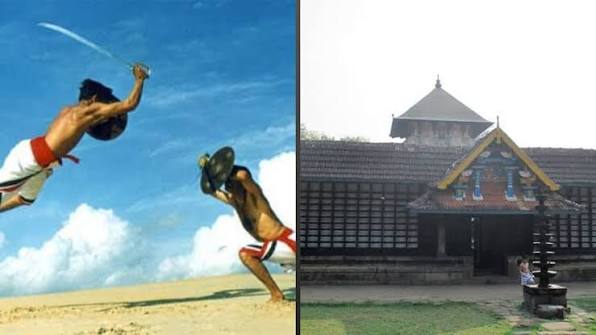
Mamankam (മാമാങ്കം / Māmāṅkam) is one of the most fascinating and tragic episodes in the history of Kerala. What began as a major religious, cultural and commercial gathering at Tirunavaya on the banks of the Bharathapuzha (Nila) gradually acquired enormous political importance. In the later medieval period, the festival became closely associated with the rivalry between the Zamorin (Samoothiri) of Calicut and the rulers of Valluvanad, and the festival ground became the scene of repeated attempts by warriors known as Chavers (ചാവേർ) to kill the Zamorin. (Department of Economics and Statistics)
Today, Tirunavaya in Malappuram district is remembered as the land of Mamankam, and several surviving sites preserve the memory of the festival and its violent political history. (Kerala Tourism)


1. What was Mamankam?
Mamankam was a great periodic assembly or festival held at Tirunavaya, approximately 8 km south of Tirur, on the banks of the Bharathapuzha. It was traditionally held once every twelve years and is described as lasting 28 days. (Kerala Tourism)
It was far more than a religious festival.
Mamankam brought together:
- Rulers and chieftains
- Brahmins and religious scholars
- Warriors
- Traders and merchants
- Artisans
- Performers
- Martial-arts experts
- Pilgrims
- Foreign merchants and travellers
The event therefore combined religion, politics, commerce, culture, entertainment and warfare.
The Kerala government’s description of Tirunavaya notes that traders reached the area through the nearby port of Ponnani, making the festival an important commercial gathering as well. (Land Revenue Kerala)
2. Where was Mamankam held?
The principal venue was Tirunavaya, beside the Bharathapuzha.
The river was historically known by several names, including Nila, Perar and Ponnani River.
Tirunavaya was already an important religious centre because of the Navamukunda Temple, associated with the Vaishnava tradition. The sacred landscape around the river and temple helped make it an appropriate location for a major festival. (Scholar)


3. The religious background
The exact origin of Mamankam is not completely certain, and historians have proposed different explanations.
One historical tradition connects the festival with the Cheraman Perumals, the rulers of medieval Kerala. Kerala government historical material states that Mamankam was associated with the Chera period and that the Chera ruler originally presided over it. (Department of Economics and Statistics)
Other scholarly interpretations connect it with older assemblies and river festivals.
A University of Calicut historical study notes that Mamankam may have developed as a festival connected with Lord Vishnu and the Nila River, while traditions recorded in Keralolpatti associate Tirunavaya with important Brahmin assemblies and decisions concerning rulers. (Scholar)
Thus, the safest historical conclusion is that Mamankam evolved over a long period, rather than suddenly appearing as a single festival created by one ruler.
4. The importance of the twelve-year cycle
One of the most remarkable features of Mamankam was its twelve-year cycle.
Every twelve years, the festival transformed Tirunavaya into an enormous gathering.
The 28-day celebration reportedly included:
- Religious ceremonies
- Trade fairs
- Martial displays
- Wrestling and physical contests
- Cultural performances
- Intellectual gatherings
- Royal ceremonies
- Public celebrations
- Political negotiations
The festival consequently became an important occasion for rulers to display their wealth, military strength and political authority. (Incredible India)
5. Mamankam as a great trade fair
Mamankam was also an important economic event.
Tirunavaya was situated within the commercial network of the Malabar coast, while Ponnani was an important port.
Merchants arriving through the coast could travel inland to participate in the great gathering.
According to Kerala government sources, Mamankam attracted traders from different parts of the world through Ponnani. (Land Revenue Kerala)
Trade therefore formed an important part of the festival.
Goods, wealth and commercial opportunities increased the value of controlling Tirunavaya and, consequently, the political importance of Mamankam itself.
6. Who was the Rakshapurusha?
One of the most important political positions associated with Mamankam was that of the Rakshapurusha—literally, the protector or guardian of the festival.
The person holding this position possessed enormous prestige.
According to Kerala’s historical account, the Valluvanad ruler originally held the right to preside over Mamankam after the decline of Chera power. Later, the Zamorin of Calicut took control of this privilege. (Department of Economics and Statistics)
This transfer of authority changed the history of Mamankam forever.
7. Valluvanad and the Valluvakonathiri
To understand Mamankam’s bloody history, we need to understand Valluvanad.
Valluvanad was a powerful medieval polity in southern Malabar. Its ruler was known as the Valluvakonathiri, or Vellattiri.
The Valluvanad ruler had traditionally enjoyed the prestigious position associated with Mamankam.
The rise of the Zamorin of Calicut, however, changed the political balance of northern Kerala.
The Zamorin expanded southwards and came into conflict with Valluvanad.
The struggle was not merely about territory.
It was also about:
prestige + political authority + trade + control of Tirunavaya + the right to preside over Mamankam.
A University of Calicut historical study specifically notes that the Zamorin’s acquisition of the right to preside over Mamankam transformed the event into a political confrontation between Calicut and Valluvanad. (Scholar)
8. The Zamorin takes control
The Zamorin—Samoothiri of Calicut—gradually emerged as one of the most powerful rulers of Malabar.
His expansion brought him into conflict with Valluvanad.
Eventually, the Zamorin acquired control over Tirunavaya and the prestigious right associated with Mamankam.
The Kerala government’s historical material describes the change as a struggle in which the Zamorin took over the right previously associated with Valluvanad. (Land Revenue Kerala)
This was an enormous humiliation for the Valluvanad ruler.
For the Valluvanad political order, Mamankam was not simply a festival.
It represented honour, legitimacy and status.
9. The birth of the Chavers
This brings us to one of the most dramatic chapters in Kerala history:
The Chaver Pada — the warriors who went to die.
The word Chaver is generally understood in this historical context as referring to warriors who deliberately undertook a mission from which they expected not to return.
The Valluvanad ruler sent these warriors to Mamankam with the objective of killing the Zamorin.
Their ultimate objective was to restore the prestige and authority of their ruler.
The University of Calicut study describes these Chavers as suicide warriors sent by Valluvanad rulers to attack the Zamorin during Mamankam. (Scholar)
10. Why were they willing to die?
The Chaver tradition was based on an extraordinary concept of loyalty, honour and vengeance.
They knew that the Zamorin would be heavily protected.
The objective was therefore not simply to defeat an army.
It was to penetrate the protective formations surrounding the Zamorin and reach him.
The Kerala government’s historical account describes the Zamorin standing at Nilapadu Thara, surrounded by soldiers, while Chavers attempted to break through and assassinate him. (Land Revenue Kerala)
Most of these warriors were expected to die.
Their sacrifice became part of the political memory of Valluvanad.
11. Nilapadu Thara — the stage of death
One of the most important surviving Mamankam sites is Nilapadu Thara.
It was the ceremonial platform associated with the Zamorin’s position during Mamankam.
The site therefore became symbolically important because it represented the point where:
royal authority met rebellion.
The Zamorin stood there as the acknowledged protector of the festival, while the Chavers attempted to penetrate his guards and kill him.
Today, Nilapadu Thara is preserved as a Mamankam memorial. The Kerala Revenue Department notes that the site was taken over for protection by the Archaeology Department in 2008. (Land Revenue Kerala)
12. The Chaver attack
The attack followed a terrifying pattern.
The Chavers would arrive at the festival.
They knew that their mission was almost certainly fatal.
They would then attempt to fight their way through the Zamorin’s heavily armed guards.
Their objective:
Reach the Zamorin and kill him.
If they succeeded, it would have been an extraordinary political victory for Valluvanad.
If they failed, they would die.
The historical accounts therefore present Mamankam as a strange combination of festival and battlefield.
13. The famous eighteen Chavers
Popular historical traditions speak of groups of Chavers, sometimes particularly emphasizing eighteen warriors in the final assault.
The Chavers were associated with prominent martial families of Valluvanad.
Four important Panicker families frequently appear in traditions concerning the Chaver warriors:
- Chandrath Panicker
- Puthumana Panicker
- Kokat Panicker
- Verkot Panicker
These traditions should be treated carefully because later oral histories and historical chronicles do not always agree on every detail.
Nevertheless, the memory of these families became deeply embedded in the historical traditions of Valluvanad.
14. The Chaver tradition and Kerala’s martial culture
The story of Mamankam cannot be separated from Kerala’s martial traditions.
The Malabar region had a highly developed culture of:
- Kalaripayattu
- Sword fighting
- Spear fighting
- Shield fighting
- Archery
- Physical conditioning
- Warrior training
A site called Changampalli Kalari, near Tirunavaya, is traditionally associated with the training and treatment of warriors connected with the Mamankam period. Kerala Tourism identifies Changampalli Kalari among the important surviving landmarks associated with Mamankam. (Kerala Tourism)
15. Marunnara — the ammunition store
Another surviving Mamankam-related site is Marunnara.
It is traditionally identified as a place where materials associated with warfare, including explosives, were stored.
The Kerala Revenue Department identifies Marunnara as a storage site used by the Zamorin’s forces during the Mamankam battles. (Land Revenue Kerala)
The existence of such a site illustrates how the festival had evolved into a militarized political event.
16. Manikkinar — associated with the dead
Manikkinar is another place connected with the darker history of Mamankam.
It is traditionally identified with the disposal or burial of bodies associated with the fighting.
Kerala Tourism lists Manikkinar among the historical sites associated with Mamankam and describes it as a burial site. (Kerala Tourism)
Thus, the landscape around Tirunavaya itself became a kind of historical map of the festival:
Nilapadu Thara — royal authority
Changampalli Kalari — warrior training
Marunnara — military supplies
Manikkinar — death
17. Pazhukkamandapam
Another important landmark is Pazhukkamandapam.
It is traditionally associated with the royal viewing arrangements during Mamankam.
Kerala Tourism identifies it as a gallery from which kings and queens could watch the proceedings. (Kerala Tourism)
This gives us an idea of the extraordinary spectacle of Mamankam.
Imagine:
- thousands of spectators,
- royal representatives,
- merchants,
- warriors,
- religious figures,
- performers,
- elaborate temporary structures,
- martial displays,
- elephants and horses,
- trade stalls,
- and, at the centre, the heavily guarded ruler.
Mamankam was simultaneously a festival, fair, political summit and military theatre.
18. Was Mamankam always a bloody festival?
No.
This is an important distinction.
It is misleading to describe Mamankam simply as a “festival of bloodshed.”
Its earlier character appears to have been substantially broader and included religious, commercial, social and cultural elements.
The violent political dimension became particularly prominent after the struggle between Valluvanad and the Zamorin over control of the festival. A University of Calicut study explicitly notes that the acquisition of Mamankam by the Zamorin transformed it into a bloody political confrontation. (Scholar)
Thus:
Mamankam began as a great sacred and social institution.
Political rivalry transformed it into a theatre of violence.
19. The connection with the Cheraman Perumal tradition
Popular traditions also connect Mamankam with the Cheraman Perumal tradition.
According to Kerala historical tradition, the Chera ruler was associated with the festival in its earlier phase.
The Kerala government’s Economic & Statistics publication describes Tirunavaya as the place where Mamankam, traditionally associated with Cheraman Perumal, was held and states that the Chera emperor originally presided over it. (Department of Economics and Statistics)
However, many details surrounding Cheraman Perumal belong to a mixture of history, legend and later tradition, so they should not all be presented as firmly established historical facts.
20. Was the king of Kerala selected at Mamankam?
You will often encounter the claim that Mamankam was an occasion when the “King of Kerala” was selected every twelve years.
This is part of the traditional narrative surrounding the festival.
However, modern historical scholarship is more cautious.
The University of Calicut material notes that there are several theories concerning the origin and political meaning of Mamankam, and that some traditional accounts connect it with assemblies concerning rulers. (SDE UOC)
Therefore, it is better to say:
Traditional accounts associate Mamankam with the political recognition or selection of rulers, but the exact historical process and its evolution remain debated.
That distinction is important for a historically responsible article.
21. The final Mamankams
The exact date of the last Mamankam is another point where sources differ.
The Kerala government’s Economic & Statistics publication states that the festival is believed to have been celebrated for the last time in 1755. (Department of Economics and Statistics)
Other historical traditions give 1766 as the last Mamankam.
This discrepancy should be acknowledged rather than silently choosing one date.
A good historical formulation is:
Mamankam disappeared in the eighteenth century; sources differ on whether 1755 or 1766 should be regarded as the final celebration.
22. The famous final Chaver story
One later tradition tells a dramatic story about the final Chaver assault.
According to this tradition, the Valluvanad ruler was unable to find sufficient volunteers for the final mission and ultimately prepared to participate himself.
An eighteen-year-old warrior and a group of companions are then said to have undertaken the mission.
The young warrior supposedly penetrated the Zamorin’s defences and reached Nilapadu Thara.
He attempted to strike the Zamorin but missed, striking a large bronze lamp instead.
The lamp went out.
He was then killed.
This dramatic account has survived in Valluvanad oral tradition, but it should be identified as a traditional narrative rather than an independently established fact.
23. Why did Mamankam disappear?
Several major political changes transformed Kerala during the eighteenth century.
The old political order of:
Valluvanad ↔ Zamorin ↔ regional chieftains
was increasingly disrupted by larger military powers.
The Mysorean invasions, followed by the British expansion, fundamentally changed the political structure of Malabar.
The traditional political system that had sustained Mamankam consequently disappeared.
Thus Mamankam did not simply “stop being celebrated.”
Rather, the political world that had made Mamankam possible ceased to exist.
24. Mamankam and the Zamorin
Mamankam played a major role in the political symbolism of the Zamorin of Calicut.
The festival allowed the Zamorin to demonstrate:
- Military strength
- Royal wealth
- Political supremacy
- Control over Tirunavaya
- Authority over regional chiefs
- Commercial influence
The festival therefore became a powerful instrument of statecraft.
The University of Calicut study observes that the Zamorin used Mamankam as an opportunity to reinforce his authority over local rulers and feudal chiefs. (Scholar)
25. Mamankam and Valluvanad
For Valluvanad, Mamankam represented something different.
It represented a lost political honour.
The Chaver attacks were therefore not ordinary military campaigns.
They were attempts to recover:
a lost right + lost prestige + political independence + dynastic honour.
This explains why the Chaver tradition continued for generations despite repeated failure.
It developed into something resembling a hereditary blood feud, according to historical interpretations of the Chaver tradition. (Wikipedia)
26. Why Tirunavaya became so important
Tirunavaya possessed several advantages:
Religious importance
The Navamukunda Temple made the region an important sacred centre.
Geographic importance
It stood on the banks of the Bharathapuzha.
Commercial importance
It was connected with the coastal trade network through Ponnani.
Political importance
Control of Tirunavaya meant influence over Mamankam.
Military importance
The surrounding region could support large gatherings and military formations.
Therefore:
Whoever controlled Tirunavaya possessed more than a town—they possessed an important symbol of power in medieval Malabar.
27. Mamankam as a cultural festival
It would be a mistake to remember Mamankam only through warfare.
Historical descriptions associate the gathering with:
- Music
- Dance
- Martial arts
- Folk performances
- Religious ceremonies
- Intellectual contests
- Sports
- Trade
- Royal pageantry
In this sense, Mamankam was one of the great multi-dimensional public gatherings of pre-modern Kerala. Incredible India describes it as a convergence of trade, martial traditions, intellectual activities, rituals, sports and folk arts. (Incredible India)
28. Mamankam and Kalaripayattu
The Chaver stories also provide an important window into the martial traditions of Kerala.
The warriors who entered the Mamankam arena required exceptional training.
The tradition surrounding Kalaripayattu—especially the northern Kerala martial tradition—therefore forms an important cultural background to the story.
The kalari was not merely a place to learn fighting.
It was traditionally a place for:
- Physical training
- Weapon training
- Discipline
- Healing
- Military preparation
Changampalli Kalari’s association with Mamankam survives as part of the historical landscape of Tirunavaya. (Kerala Tourism)
29. Mamankam in historical memory
Mamankam has survived in Kerala’s collective memory through:
- Oral traditions
- Ballads
- Family histories
- Local chronicles
- Literary works
- Historical studies
- Archaeological sites
- Folk traditions
Among the traditional and historical works associated with Mamankam are references in texts such as Keralolpatti, Keralamahatmyam, Kozhikode Granthavari, and other local narratives. (Wikipedia)
These sources must be used critically because they were produced in different periods and contain varying combinations of history, memory and legend.
30. Mamankam in Malayalam culture
The word Mamankam has become much larger than the historical festival itself.
In modern Malayalam usage, Mamankam can evoke:
- Heroism
- Sacrifice
- Revenge
- Warrior culture
- Royal rivalry
- Valluvanad
- Zamorin
- Tirunavaya
- Chavers
- Kerala’s medieval past
It has therefore become one of the strongest historical symbols of medieval Malabar.
31. Mamankam sites you can visit today
If someone visits Tirunavaya today, the important Mamankam-related places include:
1. Nilapadu Thara
The principal memorial associated with the royal position of the Zamorin.
2. Marunnara
Traditionally associated with the storage of military materials.
3. Manikkinar
Associated with the disposal/burial of the dead.
4. Changampalli Kalari
Associated with warrior training and treatment.
5. Pazhukkamandapam
Associated with royal viewing of the festival.
6. Navamukunda Temple
The major sacred centre of Tirunavaya and an important part of the historical setting of Mamankam.
Kerala Tourism identifies these locations collectively as part of Tirunavaya’s Mamankam heritage. (Kerala Tourism)
32. Mamankam as a “place of bloodshed”
Your description of Mamankam as “a festival and a place of bloodshed” is particularly appropriate when referring to Tirunavaya.
The important point is that Mamankam was not a battlefield in the conventional sense.
It was a festival ground that became militarized because of a political dispute.
The same location could therefore represent:
Faith → Trade → Culture → Royal ceremony → Political rivalry → Assassination attempts → Death
That extraordinary transformation is what makes Mamankam so fascinating.
33. The deeper historical lesson
Mamankam teaches us something important about medieval Kerala.
In pre-modern societies, religion, commerce and politics were rarely separate spheres.
A religious festival could become:
- an economic fair,
- a meeting of rulers,
- a demonstration of military power,
- a symbol of political legitimacy,
- and eventually a battlefield.
Mamankam is perhaps one of the clearest examples of this transformation in Kerala history.
34. A simple timeline
| Period | Development |
|---|---|
| Early medieval period | Tirunavaya develops as an important sacred centre |
| Chera/Perumal period | Mamankam becomes associated with royal and religious authority |
| Later medieval period | Valluvanad rulers acquire the prestigious position associated with Mamankam |
| 13th–14th centuries onward | Zamorin expands southwards and challenges Valluvanad |
| Later medieval period | Zamorin acquires control over Tirunavaya and Mamankam |
| Following centuries | Chaver warriors of Valluvanad repeatedly attack the Zamorin |
| 17th–18th centuries | Mamankam remains a major political and cultural gathering |
| 18th century | The old political order collapses |
| c. 1755/1766 | Traditionally regarded as the final Mamankam; sources differ |
| British period | Mamankam survives primarily as historical memory |
| Today | Tirunavaya preserves several Mamankam-related monuments |
The dates in the timeline should be understood as approximate where the historical record and traditions differ. (Department of Economics and Statistics)
35. Mamankam: Festival or war?
The answer is:
It was both—but at different levels and periods.
Originally:
A sacred and cultural gathering.
Later:
A major commercial and political assembly.
Under the Zamorin–Valluvanad rivalry:
A symbol of competing political legitimacy.
During the Chaver tradition:
A deadly arena where warriors attempted to assassinate the Zamorin.
Today:
A remarkable historical heritage of Kerala.
36. Why Mamankam remains important
Mamankam is important because it brings together many dimensions of Kerala’s past in one story:
Religion — through Tirunavaya and the Navamukunda Temple.
Commerce — through the great trade fair.
Politics — through the struggle between Valluvanad and Calicut.
Warfare — through the Chaver warriors.
Martial arts — through the kalari tradition.
Royal culture — through the Zamorin and Valluvakonathiri.
Geography — through the Bharathapuzha.
Archaeology — through Nilapadu Thara, Marunnara, Manikkinar and other sites.
Folklore — through generations of stories about the Chavers.
Collective memory — through the continued identity of Tirunavaya as the Land of Mamankam.
37. The most famous image of Mamankam
If one image could summarize the later history of Mamankam, it would be this:
On the Nilapadu Thara stands the Zamorin, surrounded by armed guards.
From among the crowd emerge the Chavers of Valluvanad.
They know that they are entering a battle from which they are unlikely to return.
They fight their way through the soldiers.
One by one they fall.
Their objective remains the same:
Reach the Zamorin.
That dramatic confrontation became the defining memory of Mamankam—not because the festival was originally created for bloodshed, but because a struggle for political honour transformed one of Kerala’s greatest cultural gatherings into a theatre of sacrifice and death. (Land Revenue Kerala)
Mamankam in one paragraph
Mamankam was a great twelve-yearly festival and assembly held at Tirunavaya on the banks of the Bharathapuzha in medieval Kerala. Rooted in the religious and political traditions of the Chera/Perumal period, it developed into a vast 28-day gathering involving religion, trade, culture, martial arts and royal ceremony. After the Valluvanad ruler’s traditional authority over the festival was taken over by the Zamorin of Calicut, Mamankam became an arena for their political rivalry. Valluvanad sent Chaver warriors on repeated missions to penetrate the Zamorin’s guards and assassinate him, turning the festival grounds into a scene of extraordinary bloodshed. Today, Nilapadu Thara, Marunnara, Manikkinar, Changampalli Kalari and other sites around Tirunavaya preserve the memory of this remarkable and tragic chapter of Kerala history. (Kerala Tourism)
Leave a Reply