

Introduction
The Qin Dynasty (221–206 BCE) occupies a pivotal place in world history as the dynasty that unified China for the first time under a single emperor. Although it lasted only fifteen years, its impact on Chinese civilization was immense and enduring. The Qin transformed a collection of warring states into a centralized empire, standardized laws, currency, weights and measures, and writing, and laid the administrative foundations that would shape China for more than two thousand years.
The dynasty is best known for its remarkable first emperor, Qin Shi Huang, whose ambitious reforms, vast construction projects, and authoritarian rule left an indelible mark on history. During the Qin period, the earliest sections of the Great Wall were connected, an extensive network of roads and canals was built, and the famous Terracotta Army was created to guard the emperor in the afterlife. Though the dynasty collapsed soon after Qin Shi Huang’s death, its legacy lived on in every subsequent Chinese dynasty.
Historical Background
The Qin state originated during the Eastern Zhou Dynasty as one of several powerful kingdoms competing during the Warring States Period (475–221 BCE). Initially considered a frontier state, Qin gradually became the strongest military and political power through a series of reforms.
The most influential of these reforms were introduced by the statesman Shang Yang during the fourth century BCE. Inspired by the philosophy of Legalism, Shang Yang strengthened the state by:
- Centralizing political authority
- Rewarding military achievements
- Encouraging agriculture
- Reforming taxation
- Weakening the hereditary nobility
- Enforcing strict laws
These reforms transformed Qin into the most efficient and disciplined state in China, enabling it to conquer its rivals one by one.
The Rise of Qin Shi Huang
The architect of China’s unification was Ying Zheng, who became king of Qin at the age of thirteen.
Between 230 and 221 BCE, Qin armies defeated the six remaining rival states:
- Han
- Zhao
- Wei
- Chu
- Yan
- Qi
In 221 BCE, Ying Zheng declared himself Qin Shi Huang, meaning “First Emperor of Qin.”
Rather than calling himself king, he adopted the new title of Huangdi (Emperor), signifying supreme authority over all of China.
This marked the beginning of Imperial China.
Establishment of the Qin Empire
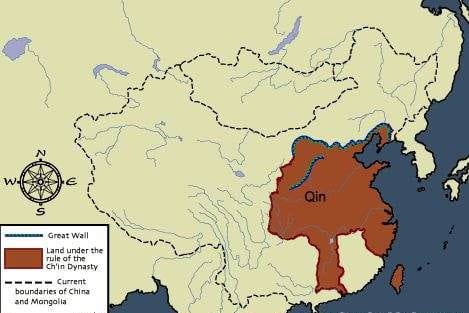
The newly unified empire stretched from the Yellow River valley to southern China.
Qin Shi Huang abolished the old feudal system and replaced it with a centralized bureaucracy directly controlled by the emperor.
His objectives were to:
- Prevent regional rebellions
- Strengthen imperial authority
- Standardize administration
- Promote economic growth
- Ensure national unity
For the first time in Chinese history, a single government ruled an immense and diverse territory.
Political Organization
The Qin Dynasty established one of the world’s earliest highly centralized governments.
The Emperor
Qin Shi Huang held absolute authority.
He controlled:
- Government
- Military
- Law
- Religion
- Public works
- Foreign policy
His word carried the force of law.
Central Government
Highly trained officials administered the empire on behalf of the emperor.
Appointments were based largely on ability and loyalty rather than noble birth.
Commanderies and Counties
The empire was divided into administrative districts known as:
- Commanderies
- Counties
Governors were appointed directly by the emperor and could be removed at any time.
This system greatly reduced the power of hereditary nobles.
Legalism: The Guiding Philosophy
The Qin government was based on Legalism, a political philosophy emphasizing strict laws, centralized authority, and severe punishments.
Legalists believed:
- Human nature is selfish.
- Strong laws create order.
- Rewards encourage obedience.
- Harsh punishments deter crime.
- The state is more important than individual interests.
Although often criticized for its severity, Legalism enabled Qin to govern a vast empire with remarkable efficiency.
Major Reforms
Qin Shi Huang introduced sweeping reforms that unified the empire.
Standardization of Writing
Before unification, different states used various writing systems.
The Qin introduced a standardized script that allowed officials throughout the empire to communicate effectively.
This became the foundation for the development of Chinese writing.
Standard Weights and Measures
Uniform systems of measurement were introduced across China.
This improved:
- Trade
- Construction
- Tax collection
- Agricultural production
Standard Currency
The Qin introduced standardized bronze coins.
A common currency promoted commerce and economic integration.
Road System
Thousands of kilometers of roads connected the empire.
The network enabled:
- Faster communication
- Efficient troop movement
- Increased trade
- Improved administration
Many later dynasties expanded these transportation systems.
Axle Standardization
The width of cart axles was standardized so that all vehicles fit the same road tracks.
This unusual reform greatly improved transportation efficiency.
Construction of the Great Wall
One of Qin Shi Huang’s most famous achievements was connecting and expanding earlier defensive walls built by northern states.
The resulting fortifications formed the earliest version of the Great Wall of China.
Its purpose was to defend the empire against raids by nomadic peoples from the north.
Although the famous stone walls visible today were largely built during the Ming Dynasty, the Qin laid the foundations of this monumental defensive system.
The Terracotta Army
Perhaps the greatest archaeological discovery associated with the Qin Dynasty is the Terracotta Army.
Discovered near the emperor’s mausoleum in Xi’an, it consists of more than:
- 8,000 life-sized soldiers
- Hundreds of horses
- Chariots
- Military officers
- Archers
- Cavalry units
Each figure possesses unique facial features and expressions.
The army was intended to protect Qin Shi Huang in the afterlife and reflects the extraordinary artistic and engineering achievements of the Qin period.
Economy
Agriculture remained the foundation of the economy.
Government policies encouraged farmers to:
- Expand cultivation
- Increase food production
- Pay taxes efficiently
Large infrastructure projects improved irrigation and transportation.
Trade expanded as standardized currency and measurements facilitated commercial activity throughout the empire.
Society
Qin society emphasized discipline and obedience.
Emperor
Supreme ruler with unlimited authority.
Government Officials
Professional administrators supervised law, taxation, and public works.
Farmers
Highly valued because agriculture supported the empire.
Soldiers
Military service was an important means of social advancement.
Successful soldiers received land and honors.
Merchants
Although commerce flourished, merchants were generally viewed with suspicion and ranked below farmers.
Education and Culture
The Qin government tightly controlled intellectual life.
Qin Shi Huang sought ideological unity by suppressing teachings that challenged Legalist principles.
According to traditional accounts, books on history and philosophy that contradicted official ideology were burned, while many scholars faced persecution.
Although historians continue to debate the scale of these events, they have become one of the most controversial aspects of Qin rule.
Military Strength
The Qin army was among the most powerful of the ancient world.
Its advantages included:
- Iron weapons
- Crossbows
- Large infantry forces
- Effective cavalry
- Strict military discipline
- Efficient logistics
Military success enabled Qin to conquer all rival states within a decade.
Decline of the Qin Dynasty
The dynasty’s rapid collapse resulted from several factors:
Heavy Taxation
Large public works imposed enormous burdens on ordinary people.
Forced Labor
Millions were conscripted to build:
- Roads
- Canals
- Palaces
- City walls
- The Great Wall
- The emperor’s mausoleum
Harsh Laws
Severe punishments created widespread resentment.
Succession Crisis
After Qin Shi Huang died in 210 BCE, political intrigue weakened the government.
His successor lacked his authority and leadership.
Popular Rebellion
Peasant uprisings spread across the empire.
The most famous rebellion was led by Chen Sheng and Wu Guang, inspiring further revolts.
In 206 BCE, the Qin Dynasty collapsed.
Rise of the Han Dynasty
Following the Qin’s fall, civil war erupted among competing leaders.
Eventually Liu Bang emerged victorious and founded the Han Dynasty in 202 BCE.
The Han retained many Qin administrative reforms while replacing harsh Legalist policies with more moderate Confucian principles.
Legacy of the Qin Dynasty
Despite its brief existence, the Qin Dynasty permanently transformed China.
Its lasting contributions include:
- Unification of China
- Creation of the imperial system
- Centralized bureaucracy
- Standardized writing
- Standardized currency
- Uniform weights and measures
- National road network
- Foundations of the Great Wall
- Terracotta Army
- Administrative model adopted by later dynasties
Even the English word “China” is widely believed to derive from the name Qin (pronounced “Chin”), reflecting the dynasty’s profound historical significance.
Significance in World History
The Qin Dynasty ranks among history’s most influential empires despite its short duration. While the Roman Republic was expanding across the Mediterranean and the Maurya Empire was flourishing in India, the Qin unified one of the world’s largest populations under a centralized government. Its innovations in administration, infrastructure, and standardization became models for later empires and helped shape one of the world’s oldest continuous civilizations.
Conclusion
The Qin Dynasty stands as one of the most transformative periods in Chinese history. Though it endured for only fifteen years, it achieved what centuries of warfare had failed to accomplish—the political unification of China. Through centralized administration, standardized systems, ambitious engineering projects, and military strength, the Qin established the foundations of imperial China. Its achievements, together with its lessons about the limits of authoritarian rule, continue to fascinate historians and make the Qin Dynasty one of the most significant chapters in the story of ancient civilization.
Leave a Reply