

Introduction
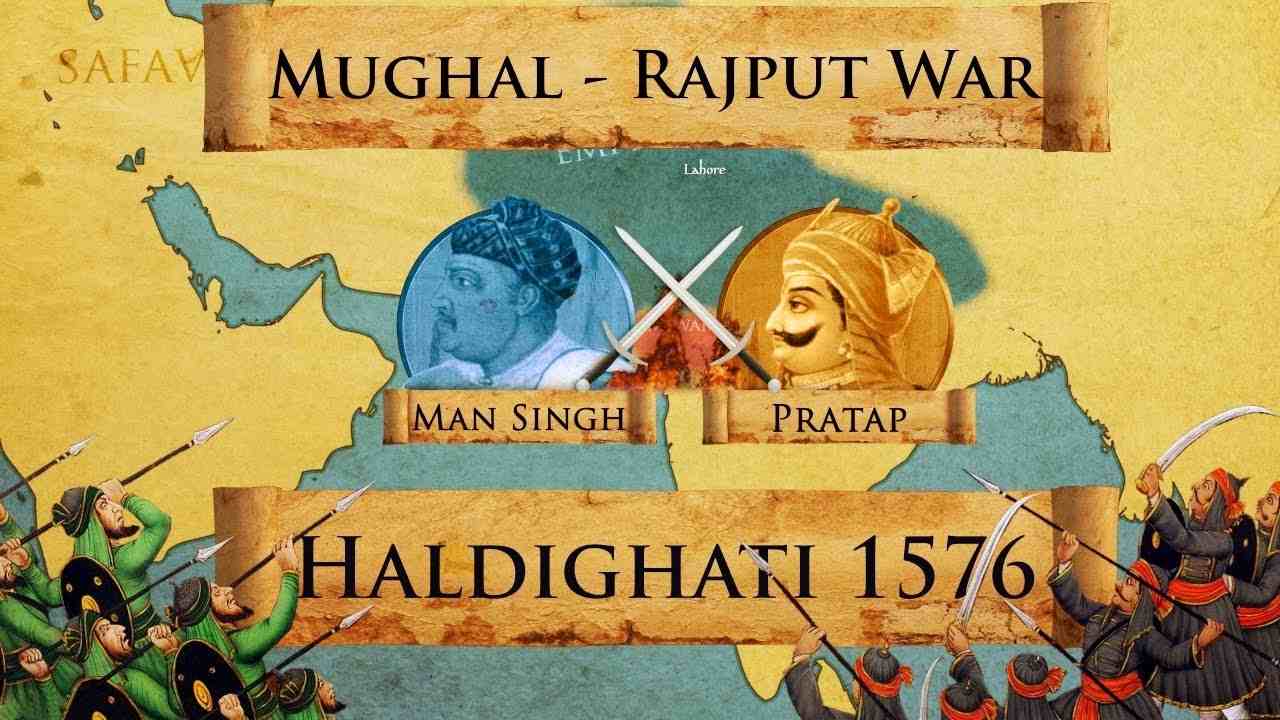
The Battle of Haldighati, fought on 18 June 1576 CE, is one of the most celebrated battles in Indian history. It was fought between the forces of the Kingdom of Mewar, led by Maharana Pratap, and the Mughal Empire, commanded by Raja Man Singh I of Amber on behalf of Emperor Akbar.
Although the Mughals gained control of the battlefield, the conflict did not end Mewar’s resistance. Maharana Pratap escaped, continued his struggle for independence, and eventually recovered much of his kingdom. As a result, the Battle of Haldighati is remembered less for its immediate military outcome than for its enduring legacy of courage, resilience, and the determination to defend sovereignty against overwhelming odds.
Today, the battle occupies a special place in Indian history and folklore, with Maharana Pratap revered as a symbol of patriotism, honor, and unwavering resistance.
Historical Background
The Rise of the Mughal Empire
By the mid-sixteenth century, the Mughal Empire had become the dominant power in northern India.
After the victories of Babur, Humayun, and especially Akbar, the empire expanded rapidly across the Indian subcontinent.
Akbar pursued a policy of combining military conquest with diplomacy. Many Rajput rulers entered into alliances with the Mughal Empire, accepting imperial authority while retaining varying degrees of local autonomy.
However, one major kingdom remained outside Mughal control—Mewar.
Mewar’s Tradition of Independence
The Kingdom of Mewar, ruled by the Sisodia Rajputs, had a long tradition of resisting foreign domination.
Its rulers considered political independence central to their identity.
Following the fall of Chittorgarh to Akbar in 1568, much of Mewar came under Mughal influence.
When Maharana Pratap ascended the throne in 1572, he refused to acknowledge Mughal supremacy despite repeated diplomatic efforts.
His decision made conflict inevitable.
The Opposing Commanders
Maharana Pratap
Born in 1540, Maharana Pratap Singh became one of India’s most admired warrior-kings.
Known for his courage, integrity, and determination, he rejected offers of submission to Akbar.
His objective was clear:
- Preserve Mewar’s independence.
- Recover lost territories.
- Defend Rajput honor.
Even when facing enormous hardships, he refused to surrender.
Raja Man Singh I
Akbar entrusted command of the Mughal expedition to Raja Man Singh I of Amber, one of his most capable generals and a respected Rajput noble.
Man Singh had successfully led numerous imperial campaigns and enjoyed Akbar’s complete confidence.
His mission was to bring Maharana Pratap under Mughal authority.
Why Haldighati Was Important
Haldighati is a narrow mountain pass in the Aravalli Range, near present-day Nathdwara in Rajasthan.
The soil of the pass has a yellowish color resembling turmeric (haldi), giving the area its name.
Control of Haldighati was strategically important because it connected the fertile plains with the mountainous interior of Mewar.
Its narrow terrain favored defensive warfare and limited the movement of large armies.
The Opposing Armies
Mewar Army
Modern historians estimate that Maharana Pratap commanded approximately:
- 3,000–8,000 soldiers
His force included:
- Rajput cavalry
- Bhil tribal archers
- Infantry
- War elephants
Among his trusted commanders were:
- Hakim Khan Sur, an Afghan noble who supported Mewar.
- Ram Shah Tanwar and his sons.
- Bhil warriors under local chiefs.
Mughal Army
The Mughal force is generally estimated at:
- 10,000–15,000 soldiers
It included:
- Mughal cavalry
- Rajput contingents loyal to the empire
- Infantry
- Archers
- Matchlock musketeers
- Artillery, though the difficult terrain limited its effectiveness
The Mughal army was larger, better supplied, and supported by the resources of the empire.
The Battle Begins
On the morning of 18 June 1576, the two armies met in the narrow pass of Haldighati.
Maharana Pratap launched an aggressive cavalry charge.
The initial attack surprised the Mughal forces.
Rajput warriors fought with extraordinary determination, engaging the enemy in fierce hand-to-hand combat.
The narrow terrain reduced the advantage of the larger Mughal army during the early stages.
Maharana Pratap’s Charge
According to tradition, Maharana Pratap personally led a daring charge toward Raja Man Singh.
Mounted on his famous horse Chetak, he attempted to reach the Mughal commander.
Some later accounts describe Chetak rearing onto the elephant carrying Man Singh, allowing Pratap to strike with his spear. While this episode has become a cherished part of Rajput tradition, historians note that its exact details cannot be confirmed from contemporary sources.
Regardless of the specifics, Maharana Pratap’s personal leadership inspired his troops throughout the battle.
The Heroism of Chetak
One of the most enduring stories of Haldighati concerns Chetak, Maharana Pratap’s loyal blue-grey horse.
According to tradition:
- Chetak was seriously wounded during the battle.
- Despite his injuries, he carried Maharana Pratap safely away from the battlefield.
- After leaping across a stream to secure his master’s escape, Chetak collapsed and died.
Whether every detail is historically verifiable or not, Chetak has become a lasting symbol of loyalty and sacrifice in Indian culture.
The Turning Point
As the battle continued, Mughal reinforcements arrived.
Their superior numbers gradually shifted the balance.
Several prominent Mewar commanders were killed defending Maharana Pratap.
One of them, Jhala Man Singh, is traditionally remembered for wearing the Maharana’s royal insignia to draw enemy attention and allow Pratap to escape. This act, celebrated in Rajput tradition, enabled the resistance to continue beyond the battlefield.
By afternoon, the Mewar army withdrew from the field.
The Outcome
The Mughal army held the battlefield, making the engagement a tactical victory for the Mughal Empire.
However, the Mughals failed to achieve their principal objective—capturing Maharana Pratap or forcing Mewar into submission.
Pratap survived and continued resisting Mughal rule for many years.
In the 1580s and 1590s, he recovered much of western Mewar, including Kumbhalgarh, Gogunda, and Chavand, though the strategically important fortress of Chittorgarh remained under Mughal control.
Why the Mughals Won the Battle
Several factors contributed to the Mughal tactical success.
Numerical Superiority
The Mughal army significantly outnumbered Mewar’s forces.
Better Resources
The Mughal Empire possessed greater logistical support and military supplies.
Reinforcements
Fresh Mughal troops strengthened the imperial army during the battle.
Sustained Fighting
The prolonged engagement gradually exhausted the smaller Mewar force.
Why Maharana Pratap Remained a Symbol of Victory
Although he did not win the battlefield, Maharana Pratap achieved several enduring successes.
Refusal to Surrender
Unlike many contemporary rulers, he never accepted Mughal sovereignty.
Continued Resistance
The war did not end at Haldighati.
He fought a long guerrilla campaign that recovered much of his kingdom.
Preservation of Independence
Mewar remained unconquered in spirit and retained substantial autonomy under Maharana Pratap’s leadership.
Enduring Inspiration
His perseverance became a lasting example of courage, self-respect, and commitment to freedom.
Long-Term Significance
Symbol of Resistance
Maharana Pratap became one of India’s greatest symbols of resistance against imperial domination.
Guerrilla Warfare
After Haldighati, he effectively used the rugged Aravalli terrain and guerrilla tactics to challenge Mughal authority.
Rajput Legacy
The battle reinforced the ideals of honor, sacrifice, and loyalty deeply associated with Rajput history.
National Memory
In modern India, Maharana Pratap is celebrated as a heroic figure whose life exemplifies resilience and devotion to independence.
Historical Debate
The Battle of Haldighati has been interpreted in different ways over the centuries.
Most historians agree that the Mughals achieved a tactical victory because they held the battlefield after the fighting.
However, they also note that Akbar’s strategic objective—subduing Maharana Pratap and permanently incorporating Mewar—was not accomplished.
Many legendary episodes, including some details concerning Chetak and individual acts of heroism, come from later Rajput traditions. While these stories are deeply embedded in cultural memory, historians distinguish them from what can be firmly established through contemporary sources.
Interesting Facts
- The Battle of Haldighati was fought on 18 June 1576.
- It took place in the Aravalli Hills of present-day Rajasthan.
- The yellow-colored soil of the pass inspired the name Haldighati (“Turmeric Pass”).
- Maharana Pratap’s horse Chetak remains one of the most famous animals in Indian history.
- Hakim Khan Sur, an Afghan commander, fought alongside Maharana Pratap, illustrating the diverse composition of Mewar’s resistance.
- Maharana Pratap later established Chavand as his new capital and rebuilt much of his kingdom.
- Numerous monuments, museums, and memorials in Rajasthan commemorate the battle and its heroes.
Military Lessons from the Battle
Military historians continue to study Haldighati for several enduring lessons:
- Terrain can offset numerical inferiority: Mountain passes can limit the advantages of larger armies.
- Leadership inspires resilience: Maharana Pratap’s personal courage sustained resistance even after the battle.
- Tactical and strategic outcomes may differ: Winning a battlefield does not always achieve broader political objectives.
- Guerrilla warfare can prolong resistance: Flexible tactics allowed Mewar to recover despite initial setbacks.
- Morale matters: The determination of a smaller force can have lasting historical significance beyond the immediate military result.
Conclusion
The Battle of Haldighati (1576 CE) remains one of the most iconic episodes in Indian history. While the Mughal Empire secured a tactical victory on the battlefield, Maharana Pratap’s refusal to surrender and his continued struggle ensured that the conflict did not end with defeat. His resilience, leadership, and unwavering commitment to Mewar’s independence transformed him into one of India’s most enduring heroes. The battle stands as a powerful reminder that the true measure of leadership is not only success in battle but also the courage to persevere in the face of overwhelming odds. More than four centuries later, Haldighati continues to inspire admiration as a story of valor, sacrifice, and the enduring spirit of freedom.
Leave a Reply