

Introduction
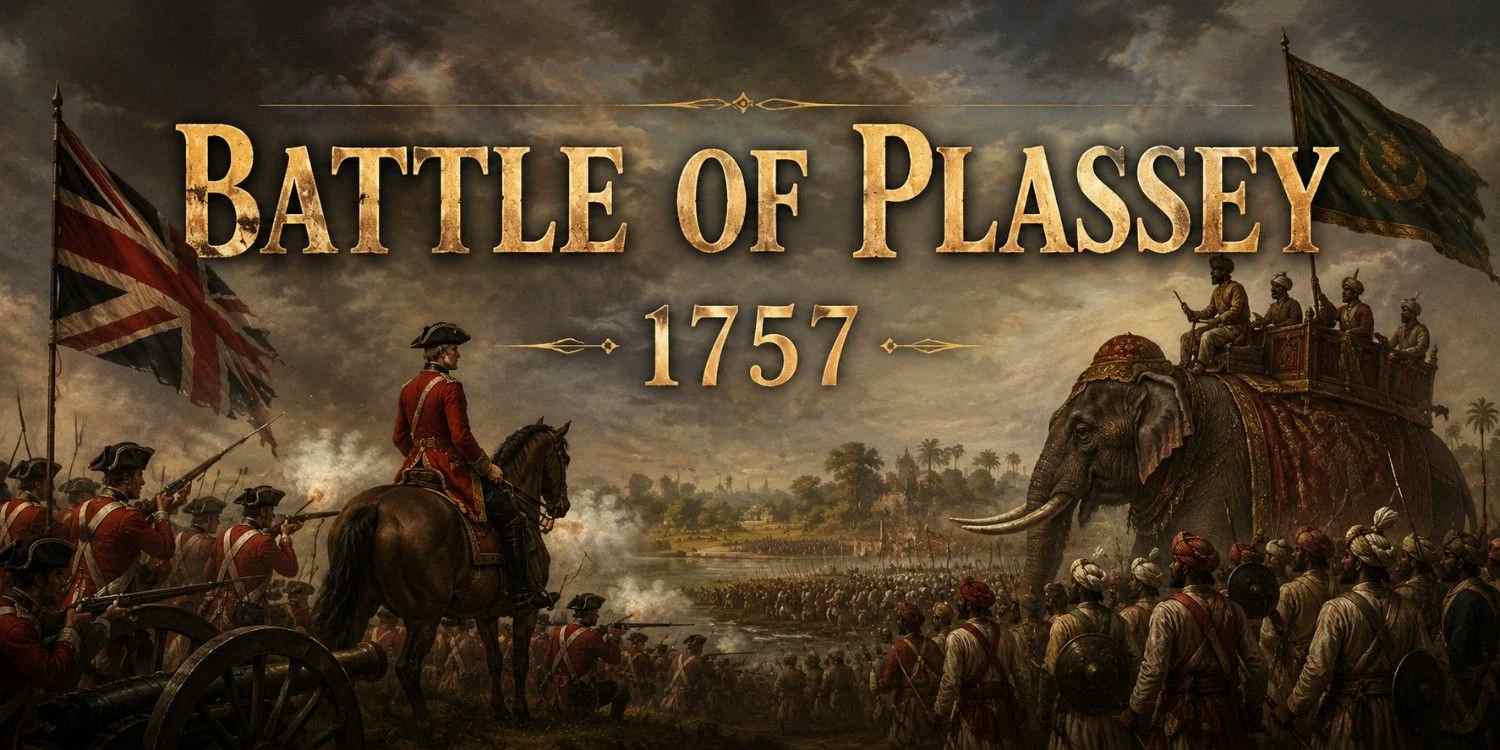
The Battle of Plassey, fought on 23 June 1757 CE, was one of the most consequential battles in the history of India and the British Empire. It was fought between the forces of the British East India Company, commanded by Robert Clive, and the army of the Nawab of Bengal, Siraj-ud-Daulah, near the village of Palashi (anglicized as Plassey) on the banks of the Bhagirathi River in present-day West Bengal.
Although the battle itself lasted only a few hours and involved relatively limited combat, its consequences were enormous. The victory of the British East India Company transformed it from a commercial enterprise into a territorial and political power. It marked the beginning of British colonial dominance in India, a period that would shape the country’s political, economic, and social development for nearly two centuries.
Often described as one of the most influential battles in world history, the Battle of Plassey laid the foundation for the expansion of the British Empire in South Asia.
Historical Background
The Decline of the Mughal Empire
By the mid-eighteenth century, the once-powerful Mughal Empire had entered a period of decline.
Following the death of Emperor Aurangzeb in 1707, central authority weakened significantly.
Provincial governors increasingly exercised independent authority.
Among the wealthiest of these provinces was Bengal.
Bengal: The Wealthiest Province
During the eighteenth century, Bengal was one of the richest regions in the world.
It possessed:
- Fertile agricultural lands
- Thriving textile industries
- Prosperous river trade
- Flourishing international commerce
European trading companies—including the British, French, Dutch, and Danish—established trading posts throughout Bengal.
Among them, the British East India Company steadily increased its commercial influence.
Siraj-ud-Daulah Becomes Nawab
In 1756, Siraj-ud-Daulah became the Nawab of Bengal.
Young and energetic, he sought to assert his authority over both local nobles and European trading companies.
He became increasingly suspicious of the British East India Company because it was:
- Strengthening the fortifications of Fort William in Calcutta without his approval.
- Expanding its military presence.
- Misusing trading privileges granted by earlier Mughal emperors.
- Offering protection to some of his political rivals.
These tensions soon escalated into open conflict.
The Capture of Calcutta
In June 1756, Siraj-ud-Daulah attacked and captured Fort William in Calcutta.
Following the capture, an incident known as the “Black Hole of Calcutta” was reported by British survivor John Zephaniah Holwell, who claimed that many prisoners died after being confined overnight in a small guardroom.
Modern historians debate both the scale and even aspects of this account. While some deaths likely occurred, many scholars consider Holwell’s reported numbers exaggerated, and the event remains a subject of historical controversy.
Regardless, the incident became a powerful rallying point for the British.
Robert Clive’s Expedition
The British East India Company dispatched a military expedition from Madras under Robert Clive, supported by Admiral Charles Watson.
By early 1757, the British had:
- Recaptured Calcutta.
- Defeated Nawab’s forces at several engagements.
- Negotiated a temporary settlement with Siraj-ud-Daulah.
However, Clive secretly pursued a more ambitious objective—the removal of the Nawab.
The Conspiracy
One of the defining features of the Battle of Plassey was political intrigue.
Clive entered into a secret agreement with influential figures in the Nawab’s court, including:
- Mir Jafar, commander of the Nawab’s army.
- The wealthy banking family known as the Jagat Seths.
- Rai Durlabh.
- Yar Lutuf Khan.
The conspirators promised that if the British helped place Mir Jafar on the throne, he would reward the Company with political and financial concessions.
This agreement would prove decisive.
The Opposing Armies
British East India Company
Robert Clive commanded approximately:
- 800 European infantry
- 2,100 Indian sepoys
- Around 100 artillerymen
- 10 field guns
Total strength: approximately 3,000 soldiers.
Despite its relatively small size, the force was highly disciplined and well-trained.
Army of Siraj-ud-Daulah
The Nawab’s army consisted of approximately:
- 35,000–40,000 infantry
- 15,000 cavalry
- Around 50 heavy artillery pieces
- Several French artillery advisers led by Jean Law de Lauriston
In terms of numbers, the Nawab’s forces greatly outnumbered the British.
The Battlefield
The battle took place near the village of Plassey, about 150 kilometers north of Calcutta.
The battlefield included:
- Mango groves
- Open fields
- Earthen embankments
- The Bhagirathi River
These features played an important role during the engagement.
The Battle Begins
On the morning of 23 June 1757, Siraj-ud-Daulah’s army advanced toward the British position.
The Nawab’s artillery began firing.
The British largely remained under cover within a dense mango grove protected by earthen embankments.
Throughout the morning, artillery exchanges continued.
The Monsoon Rain
Around midday, heavy monsoon rain fell across the battlefield.
The British had carefully covered their gunpowder with tarpaulins.
Much of the Nawab’s artillery ammunition, however, became wet and ineffective.
Believing that British weapons had also been disabled, sections of the Nawab’s army advanced.
The British artillery quickly resumed firing, causing significant confusion.
The Betrayal of Mir Jafar
The decisive factor in the battle was not military strength but political betrayal.
Despite commanding a large portion of the Nawab’s army, Mir Jafar deliberately kept his forces out of the fighting.
Other conspirators also remained inactive.
As a result, only part of Siraj-ud-Daulah’s army actively engaged the British.
Realizing that many of his commanders had abandoned him, the Nawab’s position rapidly collapsed.
The Defeat of Siraj-ud-Daulah
Siraj-ud-Daulah fled the battlefield.
A few days later, he was captured while attempting to escape.
He was executed on the orders of Miran, the son of Mir Jafar.
Mir Jafar was installed as the new Nawab of Bengal under British influence.
Why the British Won
Several factors explain the British victory.
Political Conspiracy
The defection of Mir Jafar and other senior commanders deprived the Nawab of much of his military strength.
Superior Discipline
The British troops maintained excellent battlefield coordination.
Effective Artillery
The British protected their gunpowder during the rain, allowing their artillery to remain operational.
Leadership
Robert Clive displayed patience and careful judgment throughout the battle.
Weak Internal Unity
The Nawab’s court was deeply divided by political rivalries and personal ambitions.
Immediate Consequences
British Political Power
For the first time, the British East India Company gained decisive political influence over an Indian province.
Financial Wealth
Mir Jafar paid enormous sums of money to:
- The East India Company.
- Company officials.
- Robert Clive personally.
These resources financed future British expansion.
Expansion Across India
The victory encouraged the Company to pursue further territorial conquests.
Subsequent campaigns eventually brought much of India under British control.
Long-Term Significance
Beginning of British Rule
Plassey is widely regarded as the starting point of British political dominance in India.
Transformation of the East India Company
The Company evolved from a trading corporation into a territorial power with its own army and administrative system.
Economic Impact
Control over Bengal’s immense revenues strengthened the Company’s finances and supported Britain’s global ambitions.
Many historians also argue that Company rule contributed to significant economic changes in Bengal, including shifts in taxation, trade, and traditional industries.
Global Consequences
The wealth acquired from Bengal helped Britain compete successfully with France during the Seven Years’ War (1756–1763) and contributed to the growth of the British Empire.
Historical Debate
Historians generally agree that the Battle of Plassey was won as much through diplomacy, intrigue, and betrayal as through military action.
Some scholars argue that it was less a conventional battle than a political coup supported by a limited military engagement.
There is also continuing debate about Robert Clive’s role. While many view him as a brilliant strategist, others criticize the methods by which the Company secured power and the long-term consequences of its rule for India.
Despite differing interpretations, there is broad consensus that Plassey marked a decisive turning point in Indian and global history.
Interesting Facts
- The Battle of Plassey was fought on 23 June 1757.
- The battle lasted for only a few hours.
- The British force numbered about 3,000, while the Nawab’s army was several times larger.
- Heavy monsoon rain played a significant role in the engagement.
- Mir Jafar’s decision not to fight was crucial to the British victory.
- The battle transformed the British East India Company from a trading company into a territorial power.
- Plassey paved the way for the Battle of Buxar (1764), which further consolidated British control in northern India.
Military and Political Lessons
Military historians and political analysts continue to study Plassey for several enduring lessons:
- Political unity is essential: Internal divisions can undermine even a numerically superior force.
- Intelligence and diplomacy matter: Secret alliances and negotiations may shape the outcome of conflicts before armies meet.
- Logistics influence victory: Protecting ammunition and maintaining operational readiness can be decisive.
- Economic resources strengthen military power: Control of Bengal’s wealth enabled the British East India Company to expand across India.
- Battles can reshape history: A relatively small engagement can have consequences that extend far beyond the battlefield.
Conclusion
The Battle of Plassey (1757 CE) was far more than a military encounter—it was a watershed in the history of India and the British Empire. Through a combination of political intrigue, disciplined military action, and strategic leadership, the British East India Company secured a victory that transformed it from a commercial enterprise into a ruling power. The battle marked the beginning of British colonial dominance in India, setting in motion political, economic, and social changes that would influence the subcontinent for nearly two centuries. More than 250 years later, the Battle of Plassey remains a defining moment in world history, illustrating how a single conflict can alter the destiny of nations and empires.
Leave a Reply