

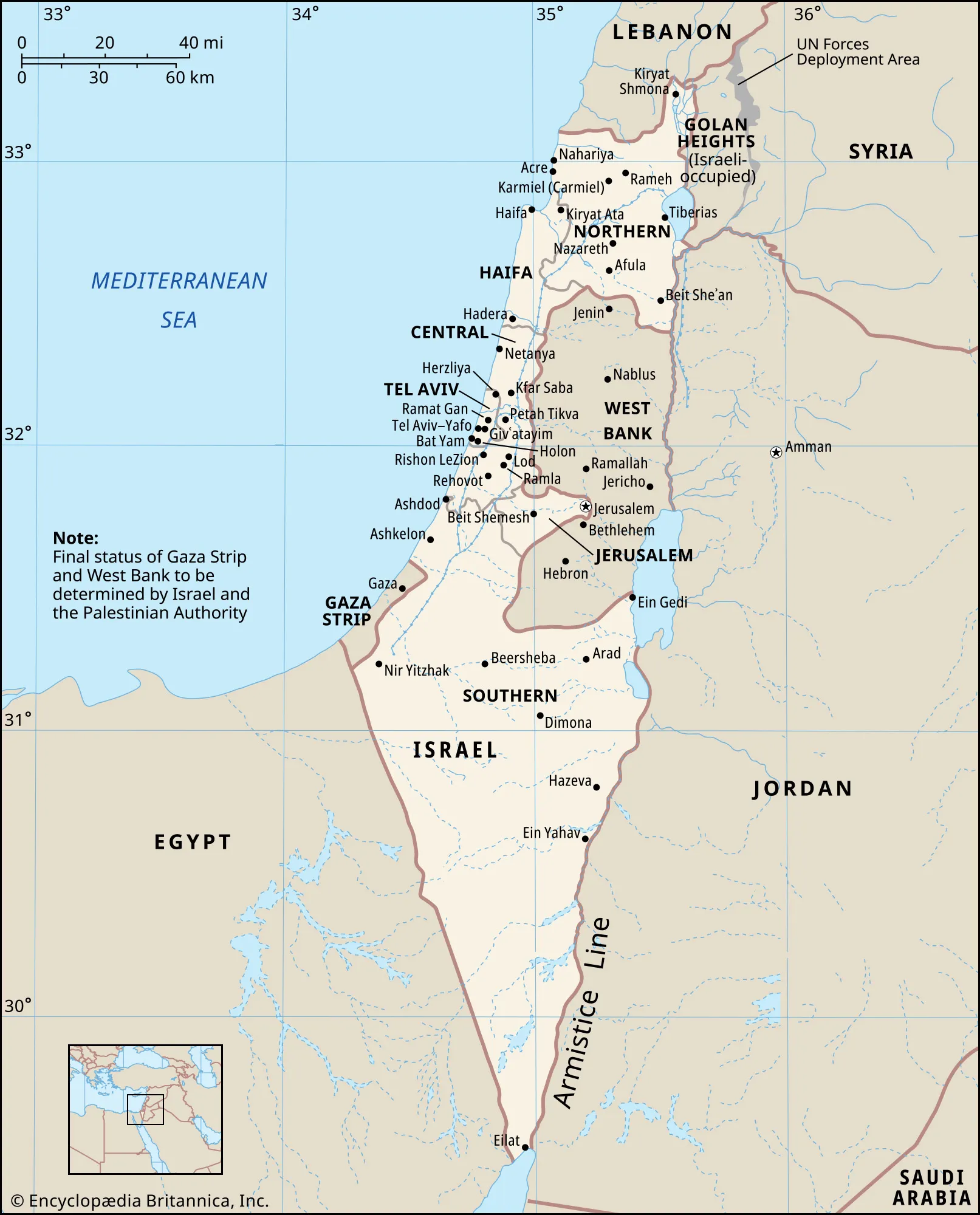
The modern State of Israel is one of the youngest nations in the world, yet its roots stretch back thousands of years. Its history is intertwined with ancient civilizations, religious traditions, nationalism, colonial politics, wars, immigration, and remarkable economic development. Since its establishment in 1948, Israel has transformed from a newly founded state facing existential challenges into a leading center of technology, innovation, and global influence.
Ancient Foundations
The land known today as Israel occupies a region historically called Canaan, situated at the crossroads of Asia, Africa, and Europe. According to Jewish tradition, the Israelites emerged in this land more than three thousand years ago. The ancient kingdoms of Israel and Judah flourished here, with Jerusalem serving as a political and religious center.
Over the centuries, the region came under the control of various empires, including the Assyrian, Babylonian, Persian, Greek, and Roman Empires. The destruction of the Second Temple in Jerusalem by the Romans in AD 70 marked a turning point in Jewish history, leading to the dispersion of many Jews throughout the Mediterranean world and beyond.
Despite centuries of exile, Jewish communities maintained cultural, religious, and emotional ties to the land, preserving the hope of eventual return.
The Rise of Zionism
The origins of modern Israel can largely be traced to the Zionist movement of the late nineteenth century. During this period, many Jews in Europe faced discrimination, persecution, and violent pogroms. At the same time, nationalist movements were spreading across Europe.
In 1896, Austrian journalist and political thinker Theodor Herzl published The Jewish State, arguing that Jews needed a homeland where they could live safely and govern themselves. Herzl became the leading figure of political Zionism and organized the First Zionist Congress in 1897 in Basel, Switzerland.
The movement encouraged Jewish immigration to Palestine, then part of the Ottoman Empire. New settlements, agricultural communities, and institutions began to emerge.
The British Mandate and the Balfour Declaration
During the First World War, the Ottoman Empire collapsed. In 1917, the British government issued the famous Balfour Declaration, expressing support for the establishment of a “national home for the Jewish people” in Palestine while also recognizing the rights of existing non-Jewish communities.
Following the war, the newly formed League of Nations granted Britain the Mandate for Palestine. During the Mandate period (1920–1948), Jewish immigration increased significantly, especially as antisemitism intensified in Europe.
At the same time, tensions grew between Jewish and Arab communities, each seeking political self-determination in the region.
The Holocaust and the Push for Statehood
The tragedy of the Holocaust profoundly influenced the movement for a Jewish state. Between 1939 and 1945, Nazi Germany murdered approximately six million Jews.
The Holocaust generated widespread international sympathy for Jewish survivors and strengthened support for the establishment of a secure homeland. Thousands of displaced Jews sought refuge in Palestine after the war.
As violence between Jewish and Arab groups escalated, Britain announced its intention to withdraw from Palestine and referred the issue to the newly established United Nations.
The Birth of Israel
In November 1947, the United Nations approved a partition plan that proposed creating separate Jewish and Arab states in Palestine while placing Jerusalem under international administration.
Jewish leaders accepted the proposal, while many Arab leaders rejected it.
On May 14, 1948, David Ben-Gurion proclaimed the independence of the State of Israel. The following day, neighboring Arab countries launched military operations against the new state, beginning the Arab–Israeli War of 1948.
Israel survived the conflict and expanded beyond the territory allocated by the UN partition plan. Hundreds of thousands of Palestinians became refugees during and after the war, an event Palestinians refer to as the Nakba, meaning “catastrophe.”
Nation Building and Immigration
The first decades of Israel’s existence were marked by rapid nation-building. The country absorbed large waves of Jewish immigrants from Europe, the Middle East, North Africa, and later the former Soviet Union and Ethiopia.
The government invested heavily in infrastructure, education, agriculture, and defense. New towns and cities were established, and institutions of democratic governance took shape.
Despite limited natural resources, Israel developed advanced agricultural techniques, including drip irrigation and desert farming, enabling productive agriculture in challenging environments.
Wars and Security Challenges
Israel’s history has been shaped by a series of conflicts with neighboring states and armed groups.
Major conflicts include:
- The Suez Crisis (1956)
- The Six-Day War (1967)
- The Yom Kippur War (1973)
- The Lebanon War and later confrontations
- Ongoing Israeli-Palestinian conflicts
The Six-Day War dramatically changed the region when Israel captured the West Bank, Gaza Strip, East Jerusalem, Sinai Peninsula, and Golan Heights. Some of these territories later became central issues in peace negotiations and international diplomacy.
Peace Efforts
Despite recurring conflict, significant peace agreements have been achieved.
In 1979, Israel signed a peace treaty with Egypt following negotiations led by Anwar Sadat, Menachem Begin, and Jimmy Carter.
In 1994, Israel and Jordan established formal diplomatic relations.
The 1990s also witnessed the Oslo Accords, which sought a framework for resolving the Israeli-Palestinian conflict. Although many issues remain unresolved, these agreements represented a major diplomatic milestone.
Economic Transformation
One of the most remarkable aspects of Israel’s development has been its economic success.
Initially dependent on agriculture and foreign aid, Israel gradually evolved into a high-tech powerhouse. Investments in education, scientific research, and entrepreneurship helped create a dynamic economy.
Today, Israel is often called the “Start-Up Nation” because of its high concentration of technology companies, innovation centers, and research institutions. Fields such as cybersecurity, artificial intelligence, biotechnology, medical technology, and agricultural innovation have become global strengths.
Major multinational companies operate research and development centers in Israel, contributing to its reputation as a center of innovation.
Society and Culture
Modern Israel is a diverse society composed of Jews from many cultural backgrounds, Arab citizens, Druze communities, Christians, and others.
Hebrew, once largely a liturgical language, was successfully revived as a modern spoken language and serves as one of the country’s official languages alongside Arabic’s special status in public life.
Israel is home to significant religious sites sacred to Judaism, Christianity, and Islam, making it one of the most spiritually significant regions in the world.
Israel Today
Today, Israel is a parliamentary democracy with a highly developed economy, advanced military capabilities, and strong scientific and technological sectors. It maintains diplomatic relations with many countries and plays an important role in regional and global affairs.
At the same time, challenges remain. The Israeli-Palestinian conflict continues to shape politics and security concerns. Questions regarding borders, settlements, refugees, and the status of Jerusalem remain subjects of ongoing debate and negotiation.
Conclusion
The history of modern Israel is a story of ancient heritage, national revival, survival, and transformation. Emerging from centuries of diaspora and persecution, the Jewish people established a modern state that has become a significant political, economic, and technological force.
At the same time, Israel’s history is deeply connected to the experiences and aspirations of other peoples in the region, particularly the Palestinians. Understanding the development of modern Israel requires recognizing both its remarkable achievements and the complex historical and political issues that continue to influence the Middle East today.
Leave a Reply