

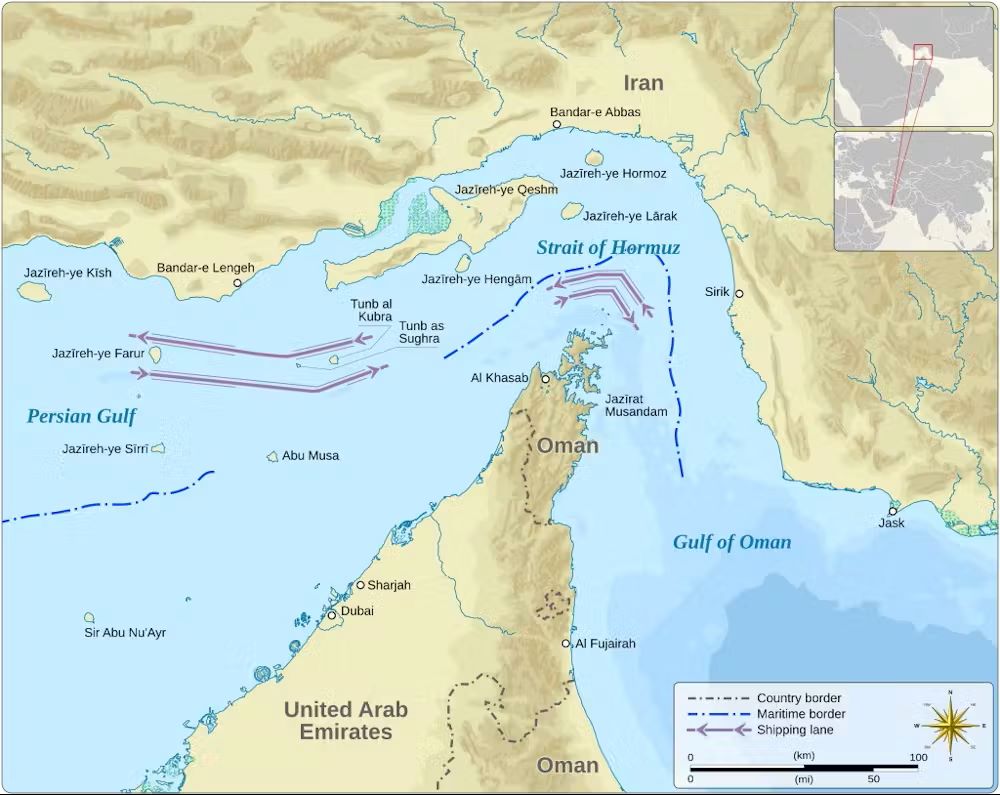
The Strait of Hormuz is one of the most important and strategically significant waterways in the world. Though relatively narrow in size, it plays a crucial role in global trade, energy security, and international politics. Often described as the world’s most important oil chokepoint, this narrow passage connects the Persian Gulf to the Gulf of Oman and the Arabian Sea, serving as a gateway between the oil-rich nations of the Middle East and the rest of the world.
Location and Geography
The Strait of Hormuz lies between Iran to the north and Oman to the south. It forms the only sea route through which ships can travel from the Persian Gulf to the open oceans. At its narrowest point, the strait is approximately 54 kilometers (29 nautical miles) wide, although the navigable shipping lanes used by large vessels are much narrower. These shipping channels are carefully managed to allow safe passage for thousands of vessels each year.
The strait connects several important Gulf countries, including Iran, Iraq, Kuwait, Qatar, Bahrain, Saudi Arabia, and the United Arab Emirates, to global markets. Because of this unique geographic position, it has become one of the most strategically valuable waterways on Earth.
Historical Background
The region surrounding the Strait of Hormuz has been an important trade route for centuries. Ancient merchants sailed through these waters carrying spices, silk, pearls, and other valuable goods between Asia, Africa, and Europe. The strait derives its name from the historic island and kingdom of Hormuz, which flourished as a major trading center during the medieval period.
Throughout history, various empires and naval powers sought to control this vital maritime passage because of its commercial and military significance. In modern times, the discovery of vast oil reserves in the Persian Gulf elevated the strait’s importance to an entirely new level.
Importance to Global Energy Supplies
The Strait of Hormuz is most famous for its role in the transportation of oil and natural gas. Around one-fifth of the world’s oil supply and a significant portion of global liquefied natural gas (LNG) exports pass through this narrow waterway every day. Countries such as Saudi Arabia, Iraq, Kuwait, Qatar, and the United Arab Emirates rely heavily on the strait to export their energy resources to international markets.
Much of this energy is destined for major economies in Asia, including China, India, Japan, and South Korea. Any disruption in shipping through the strait can have immediate effects on global oil prices and energy markets.
Geopolitical Significance
Because of its strategic importance, the Strait of Hormuz has often been at the center of international tensions. Conflicts in the Middle East, particularly involving Iran and neighboring countries, have frequently raised concerns about the security of shipping routes.
During the Iran-Iraq War in the 1980s, both countries targeted oil tankers in what became known as the “Tanker War.” International naval forces were deployed to protect commercial shipping and maintain the free flow of oil through the region. Since then, periodic confrontations, military exercises, and diplomatic disputes have continued to draw global attention to the strait.
Economic Impact
The global economy is closely linked to the uninterrupted operation of the Strait of Hormuz. A disruption, even for a short period, can lead to higher fuel prices, increased transportation costs, and economic uncertainty worldwide. Financial markets closely monitor developments in the region because of their potential impact on energy supplies and international trade.
The strait is not only important for oil. It also serves as a vital route for natural gas exports, particularly from Qatar, one of the world’s largest LNG exporters. As a result, industries, businesses, and consumers around the globe are indirectly affected by events occurring in this narrow waterway.
Recent Developments
In recent years, the Strait of Hormuz has remained a focal point of international attention due to regional tensions and concerns about maritime security. Shipping activity through the strait continues to influence global energy markets, demonstrating how a relatively small geographic feature can have enormous global consequences. Recent geopolitical developments have once again highlighted the vulnerability of international trade routes and the importance of maintaining safe navigation through this critical passage.
Conclusion
The Strait of Hormuz is far more than a narrow stretch of water between Iran and Oman. It is a lifeline for global energy supplies, a critical trade route, and a key strategic location in international affairs. Its importance extends beyond the Middle East, affecting economies, industries, and consumers around the world. As global demand for energy continues and geopolitical challenges persist, the Strait of Hormuz will remain one of the most significant waterways in modern history.
The story of the Strait of Hormuz illustrates how geography can shape world events. A narrow channel of water, only a few kilometers wide in places, continues to influence global politics, economics, and security in profound ways.
Leave a Reply