

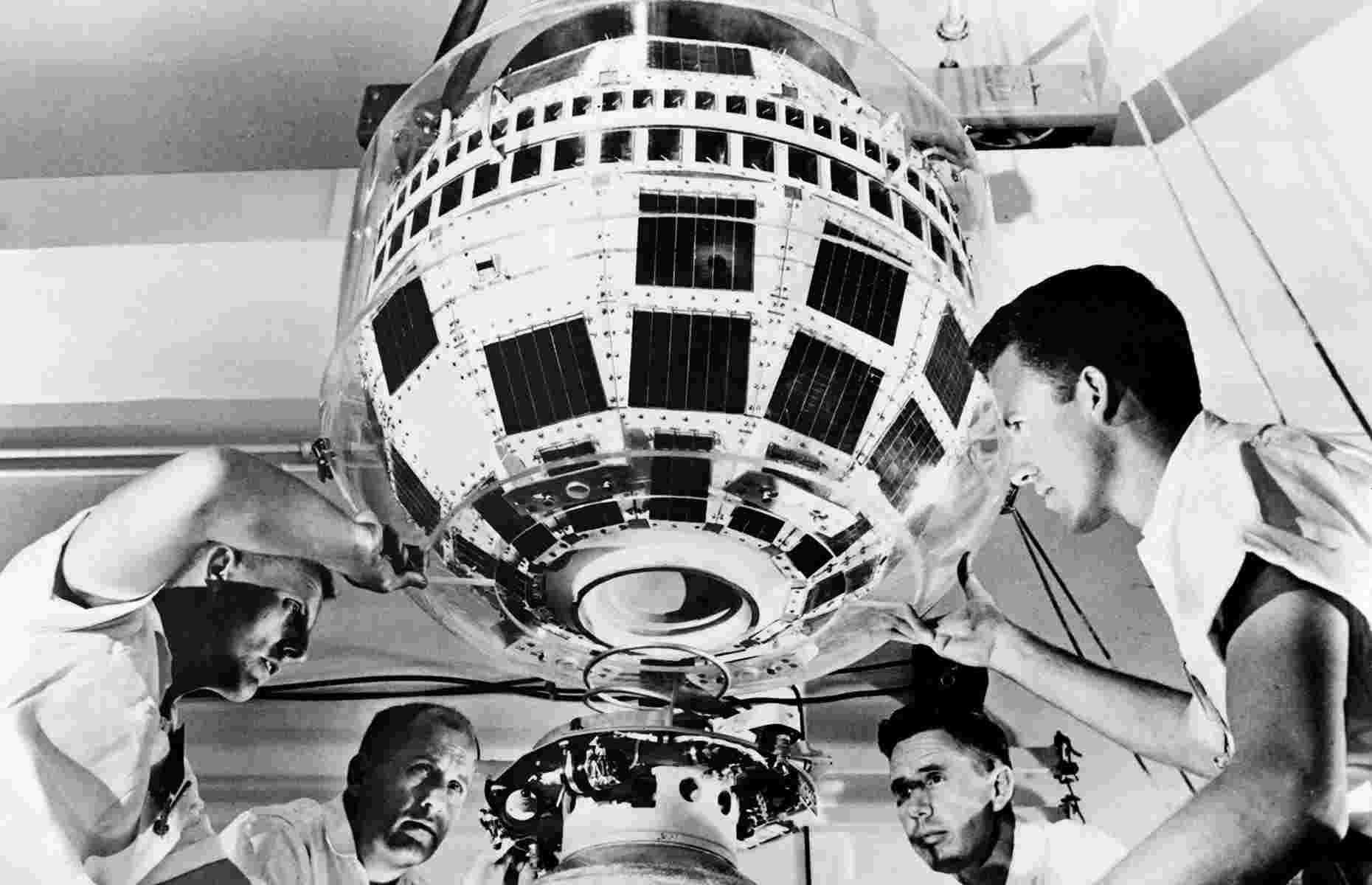
A Giant Leap in Global Communications
Introduction
On July 10, 1962, the world entered a new era of communication with the successful launch of Telstar 1, the world’s first active communications satellite. The satellite transformed the way people communicated across continents, making it possible to transmit live television broadcasts, telephone calls, and data between North America and Europe through space.
The launch of Telstar marked one of the most significant technological milestones of the twentieth century. It demonstrated that satellites could revolutionize global communications, laying the foundation for today’s interconnected world of satellite television, international phone networks, internet services, GPS, and global data transmission.


The World Before Telstar
Before communications satellites, international communication depended mainly on:
- Undersea telegraph cables
- Transatlantic telephone cables
- Shortwave radio transmissions
Although these technologies were effective, they had significant limitations:
- Limited capacity
- Signal interference
- Slow transmission
- High costs
- Poor reliability over long distances
Television broadcasts, in particular, could not easily be transmitted live across oceans.
Scientists began exploring whether satellites orbiting Earth could relay communication signals from one part of the world to another.
The Space Age Begins
The launch of the Soviet satellite Sputnik 1 in 1957 inaugurated the Space Age. Soon afterward, both the United States and the Soviet Union accelerated research into space technology.
Among the many possible applications of satellites, communications emerged as one of the most promising.
What Made Telstar Different?
Earlier experimental satellites, such as Echo 1, functioned as passive reflectors. They simply bounced radio signals back to Earth without amplifying them.
Telstar was revolutionary because it was an active communications satellite.
It could:
- Receive radio signals
- Amplify them electronically
- Retransmit them back to Earth
This greatly improved signal quality and transmission efficiency.
Development of Telstar
Telstar was developed by Bell Telephone Laboratories (Bell Labs) as part of an international effort involving:
- AT&T
- NASA
- European telecommunications organizations
- Aerospace manufacturers
The project demonstrated remarkable cooperation between scientists, engineers, governments, and private industry.
Technical Specifications
Telstar 1 was compact by modern standards.
Some of its characteristics included:
- Diameter: about 88 cm (34.5 inches)
- Weight: approximately 77 kilograms (171 pounds)
- Shape: Nearly spherical
- Covered with thousands of solar cells
- Powered by solar energy and rechargeable batteries
The satellite carried:
- Microwave receivers
- Signal amplifiers
- Transmitters
- Antennas
These systems enabled it to relay television, telephone, and data signals.
The Launch
On July 10, 1962, Telstar 1 was launched aboard a Thor-Delta rocket from Cape Canaveral Air Force Station.
The launch was successful, placing the satellite into a medium Earth orbit.
Unlike today’s geostationary communications satellites, Telstar orbited Earth approximately every 2 hours and 37 minutes.
As a result, it could communicate with ground stations only during the portions of its orbit when it was visible from both sides of the Atlantic.
Each communication window lasted about 20 minutes.
The First Live Transatlantic Television Broadcast
One of Telstar’s greatest achievements came shortly after launch.
On July 11, 1962, the satellite transmitted the first live television images across the Atlantic Ocean.
Millions of viewers witnessed:
- Images from the United States
- European television programs
- International news events
- Cultural exchanges
The broadcasts included:
- The American flag waving
- Scenes from New York
- Baseball games
- Press conferences
- European landmarks
For the first time in history, people on different continents could watch live television from one another almost instantly.
Revolutionizing Telephone Communications
Telstar also transformed international telephone service.
The satellite successfully transmitted:
- Hundreds of telephone conversations
- Television signals
- Radio broadcasts
- Data communications
Although capacity was limited compared to modern satellites, Telstar proved that satellite communications were practical.
Scientific Achievements
Beyond communications, Telstar carried scientific instruments to study:
- Radiation belts
- Space environment
- Solar energy performance
- Effects of cosmic radiation on electronics
These studies contributed valuable knowledge for future satellite design.
Challenges Faced by Telstar
Despite its success, Telstar faced significant difficulties.
Radiation Damage
In 1962, high-altitude nuclear tests conducted by the United States and the Soviet Union increased artificial radiation in Earth’s Van Allen radiation belts.
The additional radiation gradually damaged Telstar’s electronic components.
Limited Lifetime
The satellite experienced electronic failures within months.
Although engineers temporarily restored operations, Telstar eventually ceased functioning permanently in 1963.
Despite its relatively short operational life, its impact was enormous.
Why Telstar Was Revolutionary
Telstar demonstrated that satellites could reliably support international communications.
Its success led directly to:
- Commercial satellite communications
- Global television networks
- International news broadcasting
- Satellite telephone systems
- Modern telecommunications infrastructure
It fundamentally changed the communications industry.
Telstar’s Legacy
The success of Telstar inspired the rapid development of larger and more capable communications satellites.
Soon afterward came satellites such as:
- Relay 1
- Syncom 2
- Intelsat I (Early Bird)
These spacecraft eventually evolved into the sophisticated satellite networks that connect the modern world.
Communications Today
Modern communications satellites now provide:
- Satellite television
- Internet connectivity
- Mobile communications
- Weather forecasting
- Navigation services
- Disaster response
- Military communications
- Global broadcasting
Thousands of satellites orbit Earth, enabling billions of people to communicate almost instantly across the globe.
Interesting Facts About Telstar
- It was the first privately sponsored communications satellite.
- It was the first active communications satellite capable of amplifying signals.
- It enabled the first live transatlantic television broadcasts.
- It used solar panels for electrical power.
- It orbited Earth rather than remaining fixed over one location.
- Its success inspired decades of satellite innovation.
Cultural Impact
Telstar quickly became a symbol of technological optimism during the early Space Age.
The satellite inspired books, documentaries, educational programs, and even the popular instrumental music recording “Telstar” by The Tornados, which became an international hit in 1962.
It represented humanity’s growing ability to connect people across oceans and continents.
Conclusion
The launch of Telstar 1 on July 10, 1962, marked the dawn of the satellite communications era. By successfully receiving, amplifying, and retransmitting signals through space, Telstar proved that satellites could overcome the limitations of terrestrial communication systems and bring the world closer together.
Although its operational life was brief, Telstar’s influence has endured for generations. Every international television broadcast, satellite phone call, GPS navigation signal, internet connection via satellite, and live global event owes something to the pioneering achievements of this remarkable spacecraft. More than sixty years after its launch, Telstar remains a landmark in the history of science, engineering, and global communication, reminding us of how innovation can transform the way humanity connects across the world.
Leave a Reply