

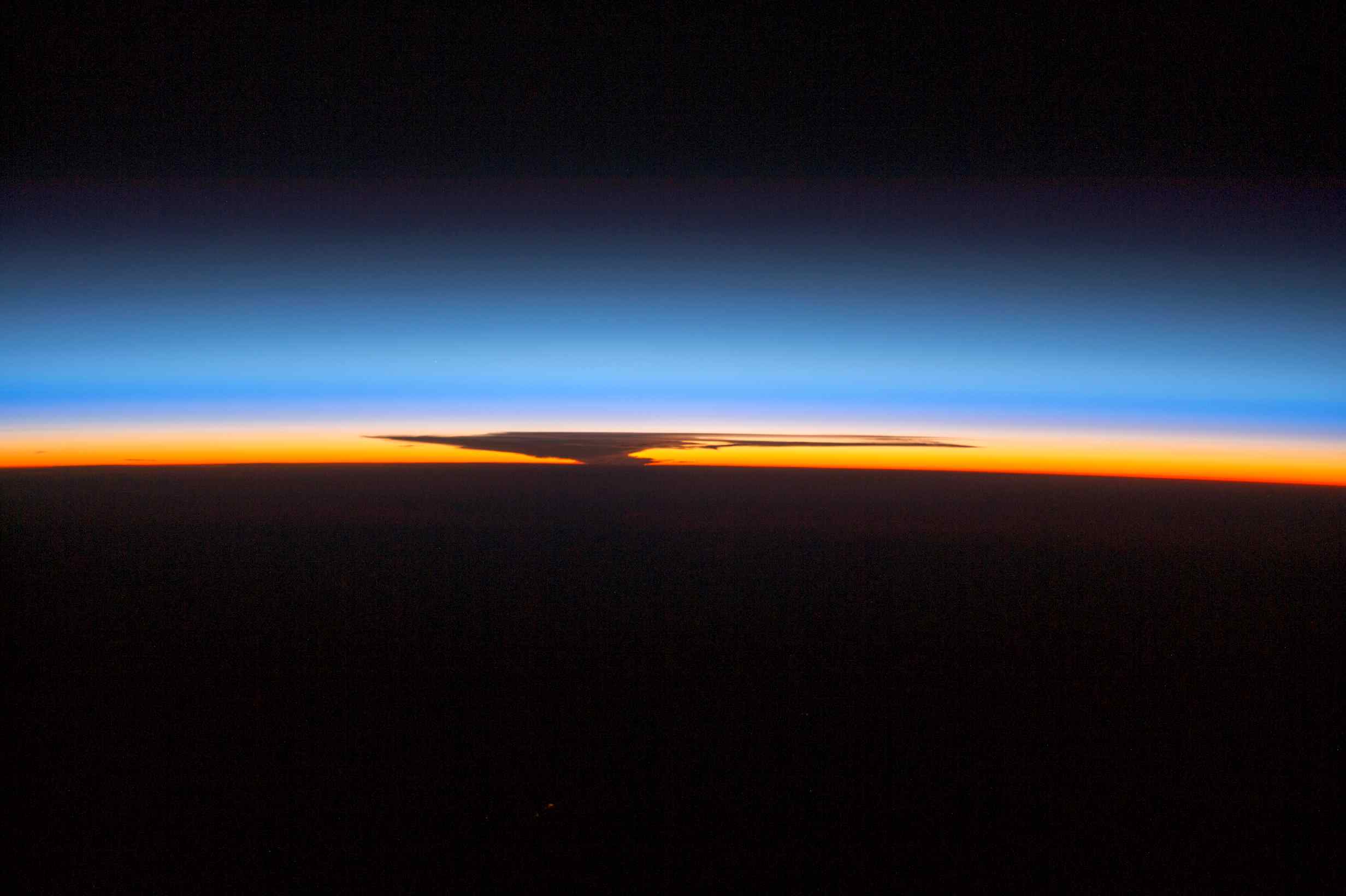
🌍 The ozone layer is one of the most important natural protection systems surrounding our planet. Though ozone makes up only a tiny fraction of the atmosphere, the ozone concentrated in the stratosphere absorbs much of the Sun’s harmful ultraviolet (UV) radiation, helping make life on Earth possible. (NASA Science)
For several decades, scientists warned that human-made chemicals were damaging this protective layer. The discovery of severe ozone depletion over Antarctica became one of the most important environmental warnings of the modern era. The international response—particularly the Montreal Protocol of 1987—has since become a major example of global environmental cooperation. (NOAA Chemical Sciences Laboratory)
Today, the story of the ozone layer is not simply one of environmental damage. It is also a story of scientific discovery, international action, technological change and gradual recovery.
🟦 What Is Ozone?
Ozone is a gas whose molecules contain three oxygen atoms (O₃).
Ordinary oxygen in the air consists mainly of O₂, while ozone contains three oxygen atoms. Ozone is chemically reactive and can be either beneficial or harmful depending on where it occurs.
Approximately 90% of atmospheric ozone is located in the stratosphere, roughly 10–50 kilometres above Earth’s surface. (NASA Science)
The ozone layer is not a solid sheet surrounding Earth. It is a region of the stratosphere where ozone concentrations are relatively higher than elsewhere.
Good ozone and bad ozone
The same chemical molecule can have very different effects depending on its location:
Stratospheric ozone — “good ozone”
- Absorbs harmful ultraviolet radiation.
- Protects humans, animals and plants.
- Helps maintain conditions suitable for life.
Ground-level ozone — “bad ozone”
- Is a major component of photochemical smog.
- Can irritate and damage the respiratory system.
- Can harm vegetation and ecosystems.
NASA describes this distinction as primarily a matter of where the ozone is located, rather than a difference in the molecule itself. (NASA Science)
☀️ Where Is the Ozone Layer?
The ozone layer is found mainly in the stratosphere, the atmospheric layer above the troposphere.
The stratosphere extends approximately from 10–12 km to around 50 km above Earth’s surface, although the boundaries vary with location and atmospheric conditions.
Ozone concentrations are particularly significant in the region around 20–35 km altitude, with peak concentrations around 32 km according to NASA’s Ozone Watch. (Ozone Watch)
Although the concentration of ozone is extremely small compared with the amount of ordinary oxygen and nitrogen in the atmosphere, its ability to absorb UV radiation makes it enormously important.
🛡️ Why Is the Ozone Layer Important?
The Sun emits ultraviolet radiation of several types.
| UV radiation | Approximate wavelength | Effect of ozone |
|---|---|---|
| UV-C | 100–280 nm | Essentially all absorbed by the atmosphere/ozone |
| UV-B | 280–315 nm | Substantially absorbed |
| UV-A | 315–400 nm | Much less affected by ozone |
The ozone layer is particularly important because it absorbs UV-C and a significant portion of UV-B radiation. Excessive UV-B exposure can damage biological tissues and DNA. (NASA Science)
Without sufficient atmospheric protection from UV radiation, life on Earth’s surface would face much greater biological stress.
🧬 Ozone and Human Health
Ozone depletion can increase the amount of UV-B radiation reaching Earth’s surface.
Increased exposure to UV-B is associated with greater risks of:
- Skin cancers
- Cataracts
- Damage to the immune system
- DNA damage
- Other harmful biological effects
NASA and the international WMO/UNEP assessments identify protection from increased UV-B exposure as a central reason for protecting the stratospheric ozone layer. (NASA Science)
This does not mean that all exposure to sunlight is dangerous. Rather, it demonstrates why excessive UV exposure and protection from intense sunlight are important considerations.
🌱 Ozone and Plants
The ozone layer is important not only for people but also for ecosystems.
Excessive UV-B radiation can affect:
- Terrestrial plants
- Agricultural crops
- Forest ecosystems
- Phytoplankton
- Aquatic ecosystems
- Microscopic organisms
Because plants form the foundation of many food webs, changes in UV exposure can have consequences extending beyond individual species. (NASA Science)
🐟 Ozone and Marine Life
The oceans contain microscopic organisms called phytoplankton that play a crucial role in marine food webs and global biogeochemical cycles.
Increased UV-B radiation can affect these organisms and other aquatic life.
Because phytoplankton are important primary producers, protecting the ozone layer is also relevant to the health of marine ecosystems.
❄️ What Is the Ozone Hole?
The term “ozone hole” can be misleading.
It does not mean that there is literally a hole through Earth’s atmosphere.
Instead, it refers to an area of severe seasonal depletion of stratospheric ozone, particularly over Antarctica.
NASA defines the Antarctic ozone hole using a total column ozone threshold of less than 220 Dobson Units (DU). (NASA Science)
The Antarctic ozone hole develops primarily during the Southern Hemisphere’s spring.
🇦🇶 Why Does the Ozone Hole Occur Over Antarctica?
The Antarctic atmosphere has unusual conditions that make severe ozone depletion possible.
During the extremely cold Antarctic winter:
- A strong polar vortex forms.
- Very low temperatures allow polar stratospheric clouds to develop.
- Chemical reactions occur on the surfaces of these cloud particles.
- Chlorine and bromine compounds become chemically active.
- When sunlight returns in Antarctic spring, rapid ozone-destroying reactions occur.
This produces the dramatic seasonal reduction in ozone observed over Antarctica.
The underlying source of the chlorine and bromine is largely human-produced ozone-depleting substances such as CFCs and halons. (NASA Science)
🧪 What Causes Ozone Depletion?
The most important human-produced ozone-depleting substances historically include:
- Chlorofluorocarbons (CFCs)
- Halons
- Carbon tetrachloride
- Methyl chloroform
- Methyl bromide
- Some hydrochlorofluorocarbons (HCFCs)
These substances were widely used in applications such as:
- Refrigeration
- Air conditioning
- Aerosol products
- Fire suppression
- Foam production
- Industrial processes
Many of these chemicals are chemically stable near Earth’s surface. They can eventually reach the stratosphere, where ultraviolet radiation breaks them apart and releases chlorine or bromine.
These atoms can participate in chemical cycles that destroy ozone molecules. (NOAA Chemical Sciences Laboratory)
🔬 How Do CFCs Destroy Ozone?
A simplified explanation is:
CFCs → UV radiation → release of chlorine → catalytic ozone destruction
A chlorine atom can react with ozone:
Cl + O₃ → ClO + O₂
The chlorine monoxide can subsequently participate in reactions that regenerate chlorine, allowing the chlorine atom to destroy additional ozone molecules.
This is called a catalytic cycle.
The important point is that a relatively small amount of chlorine or bromine can participate in the destruction of many ozone molecules before being removed from the catalytic cycle.
🧊 Why Were CFCs So Dangerous?
CFCs were attractive industrial chemicals because they were:
- Stable
- Non-flammable
- Relatively non-reactive
- Useful as refrigerants
- Useful as aerosol propellants
- Suitable for manufacturing foam
Their stability, however, became an environmental problem.
Because they survive long enough to reach the stratosphere, they can eventually release chlorine and bromine under intense ultraviolet radiation.
🔎 Discovery of the Antarctic Ozone Problem
Scientists had long understood that atmospheric chemistry could affect ozone.
A major breakthrough came in the 1970s when researchers Mario Molina and F. Sherwood Rowland demonstrated that CFCs could threaten the ozone layer.
Later observations revealed dramatic seasonal ozone losses over Antarctica.
The scientific evidence eventually established a strong connection between human-produced ozone-depleting substances and Antarctic ozone depletion.
This scientific discovery helped stimulate international environmental action.
🌎 The Vienna Convention
In 1985, nations adopted the Vienna Convention for the Protection of the Ozone Layer.
The convention established an international framework for cooperation in:
- Ozone research
- Atmospheric monitoring
- Information exchange
- Scientific assessment
- International action
It was an important foundation for subsequent international agreements.
🤝 The Montreal Protocol
The landmark Montreal Protocol on Substances that Deplete the Ozone Layer was adopted in 1987.
Its objective was to control and phase out the production and consumption of major ozone-depleting substances.
The agreement was subsequently strengthened through amendments and adjustments.
The UNEP Ozone Secretariat says the Protocol has successfully met its objectives to date and continues to safeguard the ozone layer. (Ozone Secretariat)
The 2022 WMO/UNEP scientific assessment likewise reported that atmospheric abundances of controlled long-lived ozone-depleting substances continued to decline. (NOAA Chemical Sciences Laboratory)
🏆 Why Is the Montreal Protocol Important?
The Montreal Protocol is widely regarded as one of the most significant international environmental agreements.
Its success involved:
- Scientific research
- International negotiations
- National regulations
- Industrial innovation
- Changes in consumer products
- Monitoring and reporting
- Financial and technical assistance for developing countries
The agreement demonstrated that environmental policy can evolve as scientific understanding improves.
❄️ The Kigali Amendment
The Kigali Amendment, which entered into force in 2019, addresses hydrofluorocarbons (HFCs).
HFCs were introduced in many applications as alternatives to ozone-depleting substances because they generally do not destroy stratospheric ozone.
However, many HFCs are powerful greenhouse gases.
The Kigali Amendment therefore seeks to reduce the production and consumption of high-global-warming-potential HFCs. (UNEP – UN Environment Programme)
This illustrates the close relationship between ozone protection and climate protection.
🌡️ Ozone Protection and Climate Change
Ozone depletion and climate change are different environmental problems, but they are connected through atmospheric chemistry.
Many ozone-depleting substances are also greenhouse gases.
According to the 2022 scientific assessment, implementation of the Montreal Protocol has already avoided measurable global warming, and modelling indicates that continued implementation will prevent substantially more warming. (NOAA Chemical Sciences Laboratory)
UNEP estimates that ozone-protection efforts avoided approximately 135 billion tonnes of CO₂-equivalent emissions between 1990 and 2010. (Ozone Secretariat)
🌎 Is the Ozone Layer Recovering?
Yes. Scientific assessments indicate that the ozone layer is on a recovery path because concentrations of controlled ozone-depleting substances are declining.
However, recovery is slow because many ozone-depleting chemicals remain in the atmosphere for decades.
The latest UNEP summary reports expected return to approximately 1980 ozone levels under continued compliance with the Montreal Protocol by:
- Around 2040 — global 60°N–60°S average
- Around 2045 — Arctic
- Around 2066 — Antarctic (Ozone Secretariat)
These are projections, not guaranteed dates. Continued compliance and atmospheric conditions will influence the actual pace of recovery.
🕳️ Does the Ozone Hole Disappear Every Year?
No.
The Antarctic ozone hole is a seasonal phenomenon, and its size and severity vary substantially from year to year.
Atmospheric temperature, winds, the polar vortex and other meteorological conditions can influence its development.
Therefore, a particularly large or small ozone hole in a single year does not by itself demonstrate that the long-term recovery trend has stopped or accelerated.
Scientists examine measurements over many years to understand the long-term trend. (UNEP – UN Environment Programme)
📏 What Is a Dobson Unit?
Scientists commonly measure total column ozone using the Dobson Unit (DU).
A Dobson Unit represents the amount of ozone in a vertical column of atmosphere if all the ozone were compressed into a layer at standard temperature and pressure.
The unit is named after British physicist G. M. B. Dobson, whose work contributed greatly to atmospheric ozone measurement.
NASA uses 220 DU as the conventional threshold for defining the Antarctic ozone hole. (NASA Science)
🌤️ Ozone Layer vs. Ozone Hole
These terms should not be confused.
| Ozone Layer | Ozone Hole |
|---|---|
| Exists around the planet | Mainly refers to severe seasonal depletion over Antarctica |
| Located mainly in the stratosphere | Represents unusually low ozone concentrations |
| Protects Earth from UV radiation | Represents a weakening of that protection |
| Exists throughout the year | Antarctic hole is strongly seasonal |
| Naturally varies | Influenced strongly by human-produced ozone-depleting chemicals and atmospheric conditions |
The ozone hole is therefore a region of depleted ozone within the broader ozone layer, not a literal opening in Earth’s atmosphere. (NASA Science)
☀️ What Can Individuals Do to Protect the Ozone Layer?
The largest historical ozone threat came from industrial chemicals, so international regulation remains central.
Individuals can nevertheless contribute by:
1. Maintain air conditioners and refrigerators properly
Poorly maintained equipment can contribute to refrigerant leakage.
2. Dispose of old cooling equipment responsibly
Refrigerators and air conditioners can contain refrigerants that require proper recovery and disposal.
3. Choose environmentally responsible products
Where possible, select appliances and products that use refrigerants with lower environmental impacts.
4. Avoid illegal or obsolete ozone-depleting substances
Do not purchase or use products containing banned ozone-depleting chemicals.
5. Support responsible environmental practices
Energy efficiency, responsible consumption and proper waste management can contribute to broader environmental protection.
6. Protect yourself from UV radiation
Ozone recovery does not eliminate the need for personal sun protection.
Practical measures include:
- Seeking shade during intense sunlight
- Wearing protective clothing
- Using sunglasses that provide appropriate UV protection
- Using sunscreen appropriately
- Following local UV-index guidance
🧠 20 Interesting Facts About the Ozone Layer
- Ozone is made of three oxygen atoms: O₃.
- Most atmospheric ozone is found in the stratosphere.
- Around 90% of atmospheric ozone is in the stratosphere. (NASA Science)
- The ozone layer absorbs much of the Sun’s harmful UV radiation.
- Ground-level ozone can be harmful to human health.
- Stratospheric ozone is beneficial to life.
- CFCs played a major role in human-caused ozone depletion.
- CFCs were once widely used as refrigerants.
- The Antarctic ozone hole is seasonal.
- The ozone hole is not a literal hole in the atmosphere.
- Scientists use Dobson Units to measure total column ozone.
- The Montreal Protocol was adopted in 1987.
- The Vienna Convention preceded the Montreal Protocol.
- The Montreal Protocol has been strengthened through subsequent amendments and adjustments.
- Atmospheric concentrations of many controlled ozone-depleting substances are declining. (NOAA Chemical Sciences Laboratory)
- Ozone recovery is expected to take decades.
- Antarctic recovery is expected later than recovery in many other regions. (Ozone Secretariat)
- Ozone protection also provides climate benefits.
- The Kigali Amendment addresses high-global-warming-potential HFCs.
- Continued international cooperation is important for long-term ozone recovery.
❓ Frequently Asked Questions About the Ozone Layer
What is the ozone layer?
The ozone layer is a region of the stratosphere containing relatively high concentrations of ozone that absorbs much of the Sun’s harmful ultraviolet radiation.
What is ozone made of?
Ozone consists of three oxygen atoms and has the chemical formula O₃.
Why is ozone important?
Stratospheric ozone protects life by absorbing harmful ultraviolet radiation, especially UV-B and UV-C.
What is the ozone hole?
The ozone hole refers to severe seasonal depletion of stratospheric ozone, particularly over Antarctica.
What causes the ozone hole?
Human-produced ozone-depleting substances, especially CFCs and halons, release chlorine and bromine that participate in chemical reactions destroying ozone. Antarctic atmospheric conditions greatly amplify these reactions. (NASA Science)
Is ozone pollution harmful?
Yes. Ground-level ozone is an air pollutant that can harm people, plants and ecosystems. (NASA Science)
Is the ozone layer recovering?
Scientific assessments indicate that it is recovering as concentrations of ozone-depleting substances decline under the Montreal Protocol. (NOAA Chemical Sciences Laboratory)
When will the ozone layer recover?
Under continued compliance with the Montreal Protocol, UNEP reports approximate recovery to 1980 values around 2040 globally (60°N–60°S), 2045 in the Arctic and 2066 over Antarctica. (Ozone Secretariat)
What is the Montreal Protocol?
It is the international treaty adopted in 1987 to control and phase out substances that damage the ozone layer.
Can climate change affect ozone?
Yes. Ozone chemistry and atmospheric circulation interact with climate processes, making the relationship between ozone and climate complex. The Montreal Protocol has also delivered significant climate benefits. (NOAA Chemical Sciences Laboratory)
🌍 The Ozone Layer: A Lesson in Global Cooperation
The history of the ozone layer contains an important environmental lesson.
Scientists detected a serious atmospheric problem. Researchers investigated its causes. Governments negotiated an international agreement. Industries developed alternatives. Countries implemented controls. Scientists continued monitoring the atmosphere.
The result has been a gradual reduction in ozone-depleting substances and a path toward recovery.
The ozone story therefore demonstrates something particularly important: environmental problems can be global, but coordinated scientific and political action can make a measurable difference.
The recovery is not complete, and continued compliance with international agreements remains important. But the trajectory provides a rare example of a major global environmental challenge for which humanity has taken coordinated action and achieved substantial progress. (Ozone Secretariat)
🔗 Supporting Websites & Reliable References
- NASA – Ozone: NASA Science: Ozone — Background information about ozone, its location and its importance.
- NASA Ozone Watch: NASA Ozone Watch – Ozone Facts — Ozone measurements, facts and monitoring.
- NASA – Ozone Hole: NASA Knows: The Ozone Hole — Explanation of the Antarctic ozone hole and its causes.
- UNEP Ozone Secretariat: Facts and Figures on Ozone Protection — Current recovery projections and ozone-protection information.
- UNEP – Montreal Protocol: The Montreal Protocol — Official information about the international ozone treaty.
- NOAA/WMO: Scientific Assessment of Ozone Depletion: 2022 — Detailed scientific assessment of ozone depletion and recovery.
- NOAA/WMO – Twenty Questions: Twenty Questions and Answers About the Ozone Layer — Accessible scientific answers to common ozone questions.
📚 Suggested citation
World Meteorological Organization (WMO). Scientific Assessment of Ozone Depletion: 2022. GAW Report No. 278, Geneva, 2022. (NOAA Chemical Sciences Laboratory)
United Nations Environment Programme (UNEP), Ozone Secretariat. Facts and Figures on Ozone Protection. (Ozone Secretariat)
🌱 Final Thought
The ozone layer is Earth’s natural ultraviolet shield. Its depletion showed how human activities can alter even the chemistry of the upper atmosphere—but its gradual recovery also demonstrates what can happen when scientific evidence, international cooperation and technological innovation work together.
Protecting the ozone layer is therefore not merely about protecting a layer of gas high above us. It is about protecting the health of people, ecosystems and future generations.
Leave a Reply