

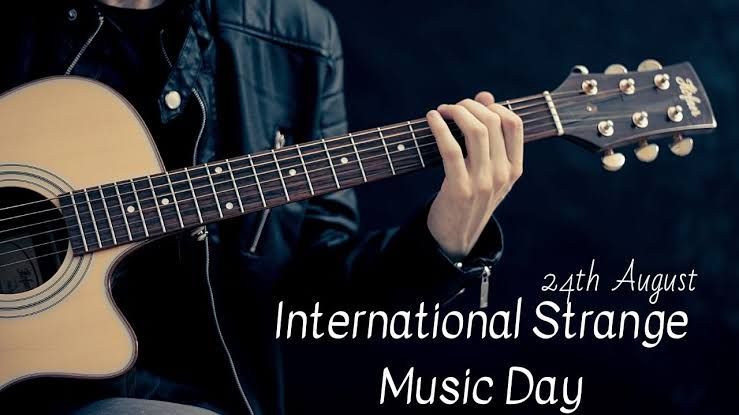
August 24 — Celebrating Unusual Sounds, Musical Creativity and Open-Minded Listening
International Strange Music Day is an unusual and unofficial musical observance celebrated every year on August 24. The day encourages people to step outside their normal musical preferences and explore music that may sound unfamiliar, unconventional, experimental, bizarre or simply different.
Rather than asking, “Is this music good or bad?”, the celebration encourages listeners to ask, “What can I discover if I listen with an open mind?”
The central philosophy behind the observance is often expressed as “listening without prejudice.”
🎶 What Is International Strange Music Day?
International Strange Music Day is a day dedicated to exploring music outside the boundaries of familiar genres and conventional expectations.
“Strange music” does not necessarily mean bad music. It can mean music that is:
- Unfamiliar
- Experimental
- Unconventional
- Avant-garde
- Unusual in structure
- Created with unexpected instruments
- From a culture or tradition unfamiliar to the listener
- A fusion of several musical styles
- Electronically or digitally produced
- Based on unusual rhythms, scales or sounds
The purpose is not simply to find the strangest song possible. Instead, the day encourages curiosity, experimentation and a willingness to listen to something different.
👤 Who Created International Strange Music Day?
The observance was created by Patrick Grant, a Detroit-born American composer and musician who has worked in New York.
There is some variation among secondary sources regarding the exact founding year. Grant’s own account says that he declared August 24 as Strange Music Day in 1999, while other sources commonly give 1998. Grant later explained that the observance began as a way to promote his musical work and to communicate his belief that listening to unfamiliar music keeps our ears and outlook fresh.
Grant chose August 24 because it was the birthday of his then-girlfriend’s father, whom he regarded as an important musical mentor.
As the idea spread beyond its original setting and began appearing in Europe, Grant adopted the name International Strange Music Day. He has described the observance as an opportunity to encourage people to explore music outside their normal habits.
🌎 How Did It Become International?
What began as an individual musical idea gradually attracted attention from musicians, music schools, venues and listeners.
Grant recalled noticing around 2002 that summer schools and other groups had begun adopting the day, and later seeing celebrations and references from Europe. This encouraged him to use the name International Strange Music Day.
Unlike official international observances established by organizations such as the United Nations or UNESCO, International Strange Music Day is an unofficial cultural observance. There is no central international authority that controls its celebrations.
Its appeal comes largely from its simple idea: listen to something you would normally ignore.
🎼 What Makes Music “Strange”?
The definition of strange music is deliberately broad.
A song might sound strange because of its unusual rhythm. Another might use unfamiliar instruments. A third might combine musical traditions that listeners would not normally associate with one another.
Examples include:
🎧 Avant-Garde Music
Avant-garde composers deliberately challenge established musical conventions. They may experiment with unusual harmonies, structures, rhythms and performance techniques.
🎛️ Electronic and Experimental Music
Electronic instruments, synthesizers, computer-generated sounds and manipulated recordings have opened enormous possibilities for musical experimentation.
🎹 Microtonal Music
Most Western music traditionally divides the octave into twelve semitones. Microtonal music uses intervals that fall outside that familiar system, producing sounds that can seem unusual to listeners accustomed to conventional Western scales.
Patrick Grant’s own musical work has included experimentation with microtonality, gamelan-inspired music, post-punk, ambient music and electronic soundscapes.
🌏 World and Traditional Music
Music from another country or culture can initially sound strange simply because its rhythms, instruments, scales or vocal techniques are unfamiliar.
African polyrhythms, Indonesian gamelan, Indian classical music, Mongolian throat singing and many other traditions can introduce listeners to completely different concepts of musical expression.
🎸 Genre Fusion
Artists sometimes combine styles that traditionally belong to different musical worlds—for example:
- Jazz + rock
- Classical + electronic
- Metal + folk
- Hip-hop + orchestral music
- Reggae + electronic music
- Traditional music + contemporary pop
Such combinations can create sounds that challenge familiar definitions of genre.
🧠 Why Is Listening to Unfamiliar Music Important?
The central idea behind the day goes beyond entertainment.
Music is strongly connected with culture, identity, memory and emotion. When we encounter unfamiliar music, we are also encountering a different way of organizing sound and expressing human experience.
International Strange Music Day therefore encourages curiosity rather than immediate judgment.
Listening to unfamiliar music can encourage people to:
- Discover new artists
- Learn about other cultures
- Challenge personal assumptions
- Develop broader musical tastes
- Appreciate different artistic traditions
- Become more comfortable with unfamiliar experiences
- Encourage creativity
- Discover new forms of artistic expression
The observance’s philosophy is that an open mind toward music can also encourage an open mind toward other aspects of life.
🎵 “Listening Without Prejudice”
One of the most important ideas associated with International Strange Music Day is listening without prejudice.
People often decide very quickly whether they like a song. A new sound may be rejected simply because it does not resemble anything familiar.
The day challenges that instinct.
Instead of immediately switching off unfamiliar music, listeners are encouraged to give it time.
Ask:
What is the musician trying to communicate?
What makes this sound different?
What culture or tradition does it come from?
What instruments or techniques are being used?
Why might someone else find this beautiful?
These questions can transform the experience from simply hearing music into actively listening to it.
🎼 Strange Music and Musical Innovation
Much of today’s familiar music was once considered unusual.
Throughout history, musicians and composers have challenged established conventions.
New instruments, recording technologies, unusual harmonies, unconventional rhythms and new combinations of genres have repeatedly changed the musical landscape.
What sounds strange today may become influential tomorrow.
This is one reason experimentation is important to the development of music. Artists need freedom to explore ideas that may initially seem unconventional.
🎹 Patrick Grant’s Musical Philosophy
Patrick Grant’s own career reflects the philosophy behind the observance.
His musical work has crossed boundaries between classical, popular and world music. His projects have incorporated elements of post-punk, post-minimalism, Balinese-inspired gamelan, microtonality, ambient music and electronic soundscapes.
This makes the creator of the day himself an example of the musical experimentation he encourages others to explore.
🎤 International Strange Music Day Events
Celebrations have included concerts and performance events featuring musicians presenting unusual compositions, unconventional instruments and music outside their normal styles.
Grant organized an International Strange Music Day Performance Soirée in New York, bringing together composers and performers for experimental performances. His official site describes the event as an opportunity for musicians to explore unfamiliar musical territory and reveal unusual musical interests.
A 2014 event at Spectrum NYC similarly featured composers and performers presenting unusual sounds, instrumentation and compositions.
Today, however, participation does not require attending a concert. Anyone with access to music can celebrate.
🌐 How to Celebrate International Strange Music Day
1. Listen to a completely unfamiliar genre
Choose something you have never seriously listened to before.
For example:
- Free jazz
- Gamelan
- Drone
- Musique concrète
- Experimental electronic music
- Noise music
- Tuvan throat singing
- Contemporary classical music
- Afrobeat
- Reggaeton
- Gabber
- Nintendocore
- Microtonal music
Several of these and other niche genres have been highlighted in discussions of International Strange Music Day.
2. Listen to music from another culture
Choose music from a country whose musical traditions you know little about.
Try to learn something about the instruments, language, history and cultural background behind the music.
3. Create your own strange music
You do not need professional instruments.
Try:
- Recording household sounds
- Combining different rhythms
- Creating an unusual percussion pattern
- Mixing natural sounds with music
- Experimenting with electronic sounds
- Writing an unconventional melody
- Combining two completely different genres
The objective is experimentation, not perfection.
4. Make a “strange music” playlist
Create a playlist containing songs that are unusual, experimental or outside your normal taste.
Give the playlist a creative name such as:
“Sounds Beyond the Ordinary”
or
“My Strange Music Journey.”
5. Introduce someone else to unfamiliar music
Ask a friend to recommend a song from a genre you have never explored.
Then recommend something unfamiliar in return.
6. Attend an experimental performance
Look for local concerts featuring contemporary, experimental or independent musicians.
Small independent venues can be particularly good places to discover unusual music.
👨🎓 International Strange Music Day for Students
Schools and colleges can use the day as an interesting educational opportunity.
Students can:
- Research unusual musical instruments
- Explore music from different countries
- Prepare presentations about experimental composers
- Create unconventional musical instruments
- Record environmental sounds
- Organize a world-music listening session
- Compare musical traditions
- Create original compositions
- Discuss the relationship between music and culture
A classroom activity could be called “Five Minutes of Unfamiliar Music.”
Each student chooses a piece of music unfamiliar to the class and explains:
- Where it comes from
- What instruments are used
- What makes it unusual
- What emotions it creates
- Whether their opinion changed after listening carefully
🌱 The Deeper Message
The most interesting aspect of International Strange Music Day is that its message extends beyond music.
Human beings naturally tend to prefer what is familiar.
We often judge unfamiliar foods, languages, cultures, ideas, art forms and people according to what we already know.
Music provides a relatively safe way to practice overcoming that instinct.
When we learn to listen patiently to an unfamiliar piece of music, we practice curiosity, tolerance and openness.
That is why the phrase “listening without prejudice” captures the spirit of the observance so well.
❓ Interesting Facts
- Date: August 24 every year.
- Founder: Composer and musician Patrick Grant.
- Origin: New York musical community.
- Type: Unofficial cultural and musical observance.
- Main purpose: Encouraging people to explore unfamiliar music.
- Central philosophy: Listening without prejudice.
- International development: The observance spread beyond the United States and gained recognition in Europe in the early 2000s.
- 2026 date: Monday, August 24, 2026.
🎧 A Simple Challenge for August 24
Try the 3–3–3 Strange Music Challenge:
3 minutes — Listen to a genre you have never tried.
3 questions — Ask yourself what sounds unusual, what you understand and what you appreciate.
3 discoveries — Find three new artists, instruments or musical traditions.
You may discover that something you initially considered “strange” is actually fascinating.
🌟 Conclusion
International Strange Music Day, celebrated every August 24, is a playful but meaningful invitation to step outside our musical comfort zones.
Created by composer Patrick Grant, the observance encourages people to explore unfamiliar sounds, unconventional compositions and musical traditions from around the world. Its underlying philosophy is simple: listen before judging.
Music does not have to sound familiar to be beautiful. It does not have to follow conventional rules to be creative. And something that sounds strange to one person may be deeply meaningful to another.
So, on August 24, put aside your usual playlist for a while.
Put on something unusual. Listen carefully. Explore. Experiment. And discover the wonderful world of music beyond the familiar. 🎶🌍
🎵 Happy International Strange Music Day!
August 24 — Listen Without Prejudice.
Leave a Reply