

August 31
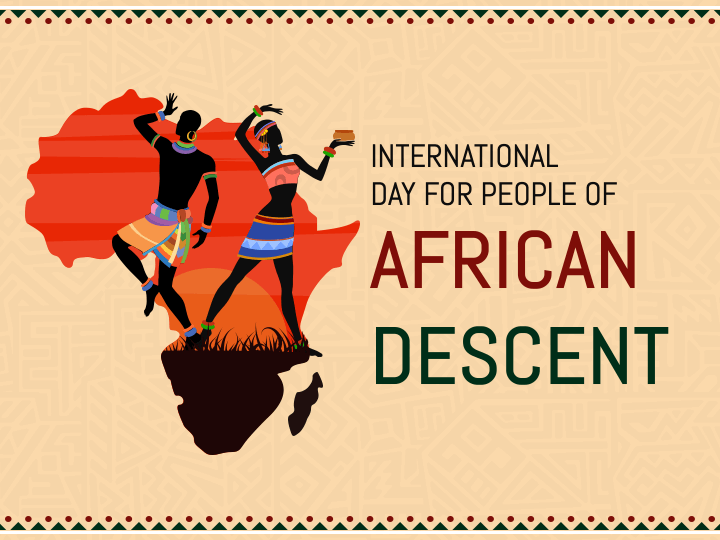
International Day for People of African Descent is observed annually on August 31. It celebrates the history, culture, achievements and contributions of people of African descent around the world while drawing attention to racism, discrimination, inequality and the continuing effects of slavery and colonialism. The United Nations established the observance through General Assembly Resolution 75/170 on December 16, 2020, with the first observance taking place on August 31, 2021. (Digital Library)
The day is both a celebration and a call to action: celebration of the extraordinary contributions of the African diaspora, and action to ensure that people of African descent enjoy their full human rights, equality and opportunities.
What Does “People of African Descent” Mean?
The term refers broadly to people whose ancestry originates in Africa and who live both within Africa and throughout the African diaspora.
Large African-descendant populations live in countries across:
- The Caribbean
- North and South America
- Europe
- The Middle East
- Asia
- The Pacific
- Other parts of the world
People of African descent have shaped societies through their contributions to science, medicine, literature, philosophy, music, art, politics, business, sports, education, technology and social movements.
The World Health Organization has noted that more than 200 million people in the Americas alone identify as being of African descent, with millions more living elsewhere outside Africa. (World Health Organization)
Why Is This Day Important?
The International Day has several interconnected purposes.
1. Celebrating African Heritage
The day recognizes the extraordinary cultural richness of Africa and its diaspora.
African and African-descendant cultures have contributed enormously to world civilization through:
- Music and dance
- Literature and oral traditions
- Visual arts
- Food and cuisine
- Languages
- Fashion
- Philosophy
- Religion and spirituality
- Science and technology
- Political thought
- Community traditions
UNESCO has highlighted the importance of African and Afro-descendant cultural heritage, including traditions such as capoeira, which reflects histories of resistance and cultural survival. (UNESCO)
2. Recognizing Contributions
People of African descent have made outstanding contributions across virtually every field of human endeavor.
Among the many internationally recognized figures are:
- George Washington Carver – agricultural scientist
- Madam C. J. Walker – entrepreneur and philanthropist
- W. E. B. Du Bois – sociologist and civil-rights thinker
- Katherine Johnson – mathematician and NASA pioneer
- Martin Luther King Jr. – civil-rights leader
- Nelson Mandela – South African anti-apartheid leader and president
- Maya Angelou – writer and poet
- Toni Morrison – Nobel Prize-winning author
- James Baldwin – writer and social critic
- Chinua Achebe – Nigerian novelist
- Wangari Maathai – Kenyan environmentalist and Nobel Peace Prize laureate
- Usain Bolt – Jamaican athlete
- Oprah Winfrey – media entrepreneur and philanthropist
Their achievements form part of the shared heritage of humanity.
Remembering a Difficult History
The observance also encourages the world to confront difficult chapters of history.
For centuries, millions of Africans were forcibly captured, transported and enslaved through systems that profoundly affected Africa, the Americas, Europe and other regions.
The transatlantic slave trade separated families, destroyed communities and subjected human beings to brutal exploitation. Its consequences did not disappear when slavery was abolished. The United Nations emphasizes that the legacies of slavery and colonialism continue to influence inequalities and discrimination today. (United Nations)
Remembering this history is therefore not about dwelling exclusively on the past. It is about understanding how historical systems can shape present-day inequalities and using that understanding to build a more just future.
Racism and Discrimination
A major objective of the International Day is combating racism and racial discrimination.
People of African descent continue to experience discrimination in different parts of the world, including barriers related to:
- Education
- Employment
- Healthcare
- Housing
- Political participation
- Economic opportunity
- Access to justice
- Representation
- Social inclusion
The United Nations has also drawn attention to structural and institutional racism, racial profiling, hate speech and discrimination that can be reinforced by modern technologies and social systems. (United Nations)
The message of the day is that racial equality should not remain merely an aspiration—it must be reflected in laws, institutions and everyday life.
The International Decade for People of African Descent
The International Day is closely connected with the International Decade for People of African Descent.
The first International Decade covered 2015–2024 and was built around the principles of:
Recognition
Recognizing the contributions of people of African descent and acknowledging their history and heritage.
Justice
Addressing discrimination and promoting equal access to justice and human rights.
Development
Promoting equal opportunities and inclusive social and economic development.
The United Nations General Assembly subsequently launched a Second International Decade for People of African Descent, covering 2025–2034, with the theme:
“People of African Descent: Recognition, Justice, and Development.”
The second decade seeks to build on earlier efforts and accelerate action against systemic racism and inequality. (United Nations)
2026 Theme: “Expanding the Human Rights of People of African Descent”
For 2026, the International Day is being observed under the theme:
“Expanding the Human Rights of People of African Descent”
The theme is part of the Second International Decade and emphasizes the need to strengthen legal, political and institutional measures that protect the rights of people of African descent.
The United Nations highlights equal access to:
- Education
- Employment
- Healthcare
- Housing
- Economic opportunities
- Political participation
- Cultural and social rights
The 2026 observance also addresses reparatory justice, the return of cultural artefacts, youth of African descent and the 25th anniversary of the Durban Declaration and Programme of Action. (United Nations)
Reparatory Justice
An important contemporary discussion connected with the observance is reparatory justice.
This involves examining how societies can address the continuing consequences of slavery, colonialism and other historical injustices.
Possible approaches include:
- Recognition of historical wrongs
- Preservation of historical memory
- Educational reform
- Addressing discriminatory institutions
- Returning cultural objects and heritage materials
- Economic and social measures to address entrenched inequalities
- Strengthening participation and representation
The United Nations’ 2026 observance specifically identifies reparatory justice and the return of cultural artefacts as important areas of discussion. (United Nations)
Young People and the Future
Young people of African descent are an important focus of the international movement for equality.
Youth can contribute through:
- Education
- Research
- Entrepreneurship
- Arts and culture
- Technology
- Community leadership
- Human-rights advocacy
- Environmental action
- Political participation
The 2026 UN observance particularly highlights the human-rights situation of youth of African descent and the importance of ensuring that young people have opportunities to participate fully in society. (United Nations)
African Diaspora and Global Culture
The African diaspora has had an enormous influence on global culture.


Music
African musical traditions profoundly influenced:
- Jazz
- Blues
- Gospel
- Reggae
- Hip-hop
- R&B
- Afrobeat
- Samba
- Caribbean musical traditions
Literature
African and Afro-diasporic writers have transformed world literature by exploring identity, freedom, colonialism, migration, race and human dignity.
Food
African culinary traditions influenced cuisines throughout the Caribbean, the Americas and other parts of the world.
Sports
Athletes of African descent have achieved extraordinary success in athletics, football, basketball, boxing, cricket and many other sports.
Fashion and Art
African and Afro-diasporic artistic traditions continue to influence contemporary fashion, design, photography, cinema and visual arts.
The Connection with Human Rights
The International Day is fundamentally a human-rights observance.
The Universal Declaration of Human Rights states that all human beings are born free and equal in dignity and rights. The United Nations uses the August 31 observance to reinforce this principle and to oppose racial superiority, discrimination and exclusion. (United Nations)
The objective is not special privilege for one group. It is equal dignity, equal rights and equal opportunity for everyone.
International Day for People of African Descent and India
The observance is also relevant to India because India is home to communities with African ancestry, including historically established groups such as the Siddi community.
India also has a long history of cultural interaction with Africa through the Indian Ocean, trade, migration and political movements.
The broader message of the International Day—respect for human dignity, rejection of racism and appreciation of cultural diversity—is therefore relevant to multicultural societies throughout the world.
How Is the Day Observed?
Governments, schools, universities, NGOs, cultural organizations and communities may mark the day through:
🎓 Educational Programmes
Lectures, seminars, classroom activities and discussions about African history and the African diaspora.
🎭 Cultural Events
Music, dance, theatre, art exhibitions, film screenings and cultural festivals.
📚 History Programmes
Activities examining slavery, colonialism, migration, resistance and African civilizations.
🗣️ Public Discussions
Conversations about racism, equality, human rights and social justice.
🧑🎓 Youth Activities
Essay competitions, debates, research projects and leadership programmes.
🤝 Community Events
Celebrations bringing together African and Afro-descendant communities with the wider public.
UN resolutions specifically encourage governments, international organizations, civil society, academia and individuals to observe the day through education and public-awareness activities. (Digital Library)
What Can We Do on August 31?
Everyone can contribute to the spirit of the observance by:
- Learning about African history and civilizations.
- Learning about the history of the African diaspora.
- Reading works by African and Afro-descendant authors.
- Celebrating African and Afro-diasporic culture.
- Teaching children about equality and human dignity.
- Speaking out against racism and discrimination.
- Supporting inclusive education and workplaces.
- Listening to the experiences of people of African descent.
- Supporting museums, cultural institutions and historical projects.
- Recognizing the contributions of African-descendant communities.
- Challenging stereotypes and racist misinformation.
- Promoting equal rights and opportunities for everyone.
2026: A Call for Action
The UN Secretary-General’s 2026 message emphasizes that the world must continue recognizing the contributions of people of African descent while confronting persistent systemic racism, inequality and the continuing effects of slavery and colonialism. It also calls attention to growing discussions about reparatory justice. (The United Nations in Bangladesh)
This makes the 2026 observance particularly significant: it is not simply a celebration of cultural heritage, but a reminder that recognition must be accompanied by justice and meaningful change.
International Day for People of African Descent — Quick Facts
| Fact | Details |
|---|---|
| Date | August 31 |
| Established by | United Nations General Assembly |
| Resolution | A/RES/75/170 |
| Resolution adopted | December 16, 2020 |
| First observed | August 31, 2021 |
| 2026 theme | Expanding the Human Rights of People of African Descent |
| Second International Decade | 2025–2034 |
| Decade theme | People of African Descent: Recognition, Justice, and Development |
| Main objectives | Recognition, equality, human rights, justice and development |
| Major concerns | Racism, discrimination, inequality, historical injustice and exclusion |
Conclusion
International Day for People of African Descent is a celebration of heritage, a recognition of achievement and a call for justice.
August 31 invites the world to recognize the enormous contributions of African-descendant peoples to human civilization while honestly confronting the history and continuing consequences of slavery, colonialism and racism.
The day reminds us that diversity is not a weakness—it is part of humanity’s richness. A truly inclusive society is one in which every person, regardless of ancestry or skin colour, can enjoy dignity, equality, freedom, opportunity and full human rights.
As the world enters the second International Decade for People of African Descent, the message is clear:
Recognize the past. Celebrate the heritage. Confront discrimination. Protect human rights. Build equality.
International Day for People of African Descent — August 31
A day to celebrate heritage, honor contributions, confront racism and advance human dignity for all. (United Nations)
Leave a Reply