

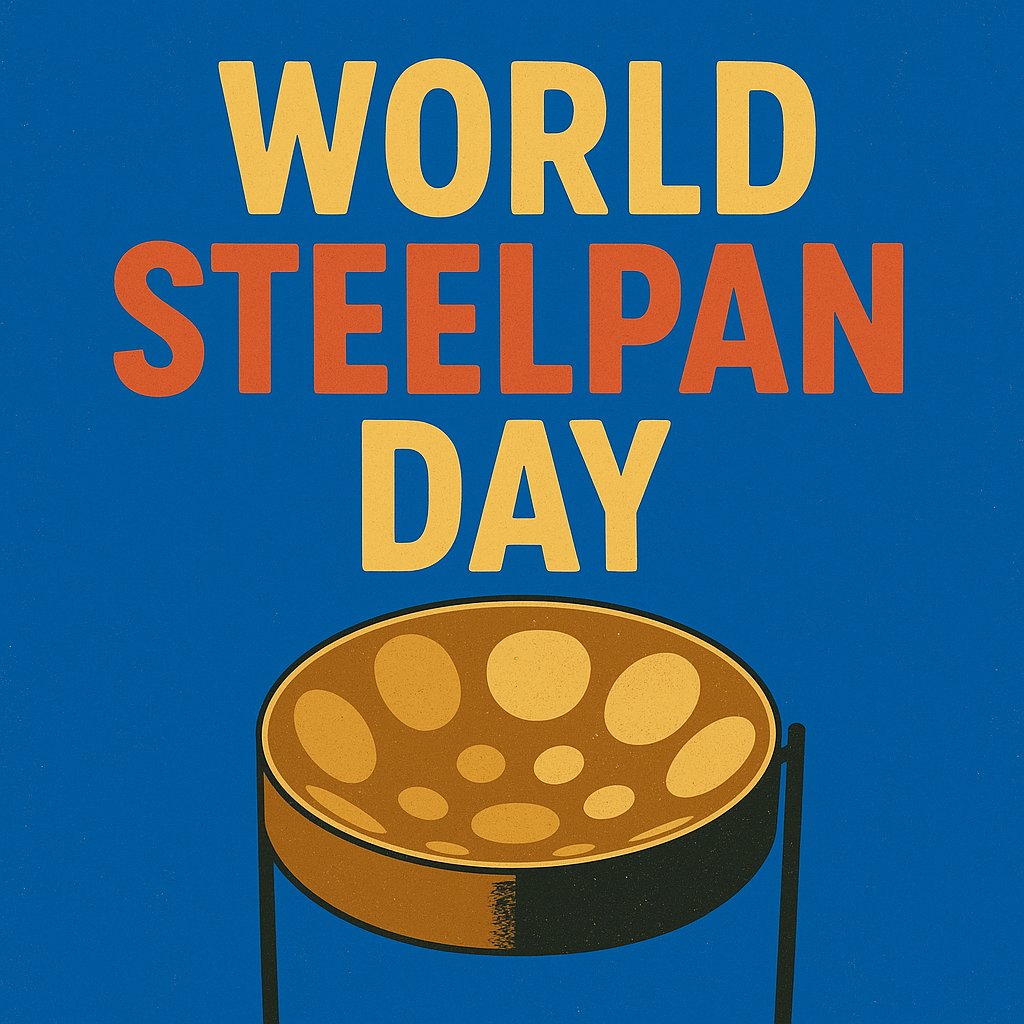
World Steelpan Day, observed annually on August 11, celebrates one of the world’s most remarkable musical inventions—the steelpan, a musical instrument created in Trinidad and Tobago from discarded metal containers.
More than simply a musical instrument, the steelpan represents creativity, resilience, cultural identity and community. Born in the Caribbean and developed from humble materials, it has grown into an internationally recognized instrument used in orchestras, schools, concerts, festivals and popular music around the world.
The United Nations officially proclaimed August 11 as World Steelpan Day in 2023, recognizing the steelpan’s contribution to the cultural heritage of Trinidad and Tobago and its growing influence internationally.
🥁 What Is a Steelpan?
The steelpan, commonly called a steel drum, is a percussion instrument made from steel.
Unlike many traditional percussion instruments, the steelpan produces definite musical pitches. Different areas of the metal surface are carefully shaped and tuned so that striking them with specially designed sticks produces different notes.
A steel orchestra may contain several types of pans, allowing musicians to perform melodies, harmonies, bass lines and complex arrangements.
Although it is sometimes called a “steel drum,” steelpan is the preferred name of the instrument and its musical tradition.
🇹🇹 A Musical Invention from Trinidad and Tobago
The story of the steelpan is closely connected with the history of Trinidad and Tobago.
During the colonial period, African cultural traditions—including drumming—played an important role in Trinidad’s communities. Colonial authorities at various times restricted or prohibited the use of drums and other forms of traditional expression.
Communities responded creatively.
People began experimenting with alternative materials and objects that could produce musical sounds. Bamboo percussion instruments known as tamboo bamboo became particularly important.
Eventually, experimentation with metal containers led to the development of the steelpan.
What began as an improvised form of musical expression eventually developed into a sophisticated musical instrument.
🎶 The Birth of the Modern Steelpan
The development of the steelpan was not the work of one single inventor.
It emerged through decades of experimentation by musicians, tuners, craftsmen and communities in Trinidad.
Among the important pioneers was Tobias “Toby” Philander, while other figures such as Winston “Spree” Simon, Elli Mannette and Anthony Williams made major contributions to the development and tuning of the instrument.
Winston “Spree” Simon is widely remembered for demonstrating the musical potential of the early pan.
Elli Mannette made major advances in shaping and tuning the playing surface and is often described as one of the fathers of the modern steelpan.
Later innovations transformed the instrument into increasingly sophisticated forms capable of producing complete musical scales and complex harmonies.
🎭 Carnival and the Steelpan
The development of the steelpan is inseparable from the history of Trinidad Carnival.
Carnival provided an important cultural space in which communities could express themselves through music, dance, costumes and performance.
Steelbands gradually became central to Carnival celebrations.
Large groups of musicians playing different types of pans could perform elaborate arrangements of popular songs, calypso and other musical styles.
The steelband became not merely a musical group but a powerful expression of community identity and cultural pride.
🎼 From Street Music to Concert Halls
One of the extraordinary achievements of the steelpan tradition is its transformation from a grassroots musical form into a sophisticated concert instrument.
Modern steel orchestras can perform:
- Classical compositions
- Calypso
- Soca
- Jazz
- Popular music
- Gospel
- Film music
- Traditional Caribbean music
- Contemporary experimental music
Composers and arrangers around the world have written specifically for steelpan ensembles.
The instrument can now be heard in concert halls, universities, schools, festivals and international music competitions.
🌎 A Truly Global Instrument
Although the steelpan was created in Trinidad and Tobago, its popularity has spread far beyond the Caribbean.
Steelbands and steelpan programs can now be found in countries including:
- United States
- United Kingdom
- Canada
- Japan
- Germany
- France
- Switzerland
- Australia
- New Zealand
- South Africa
- Jamaica
- Barbados
- Grenada
- Guyana
- and many other countries.
Universities and schools in several countries have established steelpan ensembles and educational programs.
The instrument has therefore become an important example of how a local cultural tradition can develop into a global musical language.
🇺🇳 Why the United Nations Created World Steelpan Day
The United Nations General Assembly proclaimed August 11 as World Steelpan Day in 2023.
The resolution recognized the steelpan’s contribution to the cultural heritage of Trinidad and Tobago and its role in promoting creativity, cultural diversity and sustainable development.
The designation also acknowledges the important economic and social contribution of the steelpan industry.
World Steelpan Day provides an opportunity to recognize not only the instrument itself but also the musicians, craftsmen, composers, educators and communities who keep the tradition alive.
🌱 Steelpan and Sustainable Creativity
One of the most fascinating aspects of the steelpan’s history is its connection with resourcefulness and reuse.
The instrument developed from discarded metal containers, particularly oil drums.
This historical connection gives the steelpan an interesting modern message.
It demonstrates how creativity can transform an ordinary or discarded object into something capable of producing extraordinary beauty.
The story of the steelpan therefore resonates with contemporary ideas about:
- Recycling
- Reuse
- Sustainable creativity
- Community innovation
- Local craftsmanship
The instrument is a remarkable example of turning limited resources into cultural wealth.
👥 Steelpan and Community
Steelbands have traditionally been strongly connected with communities.
Young people can learn musical skills by joining steel orchestras, often gaining not only musical knowledge but also lessons in:
- Discipline
- Teamwork
- Cooperation
- Leadership
- Creativity
- Responsibility
- Cultural pride
A large steel orchestra requires musicians to listen carefully to one another and work together.
No single player creates the entire musical experience.
The result is a powerful example of collective creativity.
🎓 Steelpan in Education
Steelpan programs have become increasingly popular in educational institutions.
Students can learn music through an instrument that is both culturally distinctive and accessible.
Steelpan education can introduce young people to:
- Musical notation
- Rhythm
- Melody
- Harmony
- Ensemble performance
- Caribbean history
- Cultural diversity
It also demonstrates that music education does not have to be limited to traditional European instruments.
The steelpan provides students with an opportunity to explore a unique musical heritage while developing practical performance skills.
🏆 Panorama and Steelband Competition
One of the most important steelpan events is Panorama, Trinidad and Tobago’s famous steelband competition associated with Carnival.
Large steel orchestras compete by performing complex arrangements before audiences and judges.
The performances demonstrate the extraordinary technical possibilities of the instrument.
What began as community music has evolved into a highly sophisticated art form involving:
- Arranging
- Orchestration
- Advanced tuning
- Percussion techniques
- Musical interpretation
- Large-scale ensemble coordination
Panorama has helped establish steelpan music as one of the defining cultural expressions of Trinidad and Tobago.
🎵 The Sound of the Steelpan
The sound of a steelpan is immediately distinctive.
It can be:
Bright.
Warm.
Rhythmic.
Melodic.
Joyful.
A skilled steelpan player can move rapidly between notes, creating melodies that seem to float above the rhythmic foundation of the ensemble.
In a full steel orchestra, different pans cover different musical ranges.
The higher pans often carry melodies, while lower pans provide harmony and bass.
Together they create a remarkably rich sound.
🧑🎨 The Art of Steelpan Making
Creating a professional steelpan is far more complicated than simply cutting and shaping a metal container.
Pan makers—often called tuners—must carefully shape the playing surface, create individual note areas, and tune them accurately.
The process may involve:
- Selecting suitable steel.
- Shaping the surface.
- Sinking and stretching the metal.
- Marking the notes.
- Cutting or separating note areas.
- Carefully hammering each note.
- Heat treatment and finishing.
- Fine tuning.
- Testing the instrument in an ensemble.
The skill of the tuner is crucial.
A high-quality steelpan is the product of considerable craftsmanship, patience and musical knowledge.
🌍 Steelpan as Intangible Cultural Heritage
The steelpan is much more than an object.
Its heritage includes:
- Musical knowledge
- Tuning techniques
- Performance traditions
- Carnival culture
- Community practices
- Oral traditions
- Craftsmanship
- Teaching methods
- Composition and arrangement
Preserving steelpan culture therefore means preserving an entire ecosystem of knowledge and community traditions.
World Steelpan Day helps draw international attention to this cultural heritage.
💡 What the Steelpan Teaches the World
The story of the steelpan carries lessons that extend beyond music.
Creativity Can Come from Unexpected Places
The steelpan demonstrates that great ideas do not always originate in laboratories or expensive workshops.
Sometimes innovation begins with ordinary people experimenting with the materials available to them.
Culture Can Survive Adversity
The instrument emerged from communities that had experienced restrictions on traditional forms of expression.
Music became a way of maintaining identity and creating something new.
Communities Can Create Extraordinary Things
The development of the steelpan was a collective achievement.
Musicians, craftsmen, communities and generations of innovators contributed to its evolution.
Local Traditions Can Become Global
An instrument born in Trinidad and Tobago is now played on several continents.
The steelpan shows how cultural traditions can cross borders without losing their roots.
🎉 How to Celebrate World Steelpan Day
People around the world can celebrate World Steelpan Day in many ways.
🎧 Listen to Steelpan Music
Discover recordings by steel orchestras and individual pan musicians.
🎥 Watch a Steelband Performance
Video performances provide a wonderful introduction to the energy and complexity of steelpan music.
🥁 Learn About Trinidad and Tobago
Explore the history, Carnival traditions and cultural heritage of the country where the steelpan originated.
🎼 Introduce Steelpan in Schools
Music teachers can use the day to introduce students to Caribbean music and the history of musical innovation.
🌎 Attend a Cultural Event
Local Caribbean cultural organizations often organize concerts, workshops and educational events.
📚 Share Its History
Tell others how ordinary metal containers were transformed into a sophisticated musical instrument.
📌 Quick Facts About World Steelpan Day
| Fact | Details |
|---|---|
| Date | August 11 |
| Established by | United Nations General Assembly |
| Proclaimed | 2023 |
| Instrument | Steelpan |
| Country of origin | Trinidad and Tobago |
| Also called | Steel drum (although “steelpan” is preferred) |
| Main cultural association | Trinidad Carnival and steelband culture |
| Musical family | Percussion |
| Global significance | Caribbean cultural heritage and international musical innovation |
🌺 A Celebration of Caribbean Creativity
World Steelpan Day is ultimately a celebration of human creativity.
The steelpan’s journey—from discarded metal containers in Trinidad to concert stages around the world—is extraordinary.
It tells a story of people who transformed limitations into possibilities, hardship into creativity and community traditions into an internationally admired art form.
The instrument’s cheerful and distinctive sound has travelled far beyond its Caribbean birthplace, carrying with it the history and cultural identity of Trinidad and Tobago.
On August 11, the world is invited to listen—not simply to the sound of steel, but to the story behind it.
🥁 Let the Music of Steelpan Resound
The steelpan reminds us that music can emerge from unexpected places and that culture can turn ordinary materials into extraordinary expressions of human imagination.
World Steelpan Day celebrates the musicians who play it, the artisans who create it, the communities that nurture it and the generations that continue to carry its sound into the future.
From the streets and communities of Trinidad and Tobago to concert halls across the globe, the steelpan has become a powerful symbol of creativity, resilience, cultural identity and unity.
Happy World Steelpan Day!
Leave a Reply