

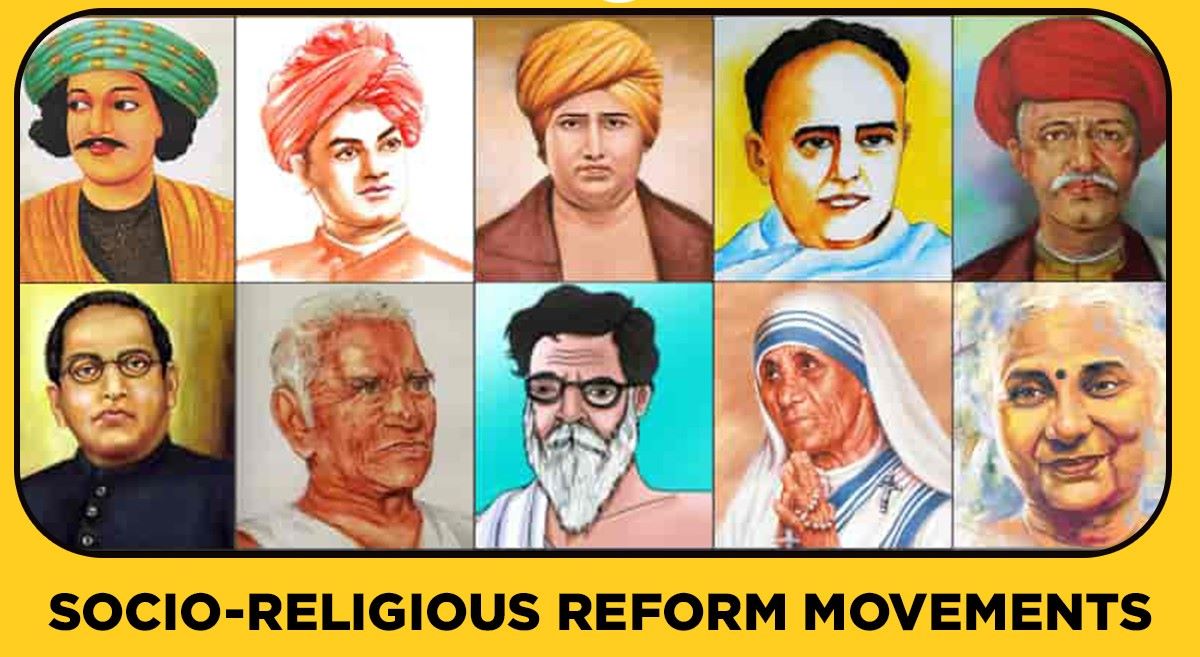
120 General Knowledge Questions on India’s Great Social Reformers, Religious Reform Movements, Women Empowerment, Education, Caste Reform, Social Justice and Contributions to Modern Indian Society
India has a rich history of social reform movements that challenged discrimination, caste inequalities, untouchability, child marriage, gender inequality and other social injustices. Many great thinkers, philosophers, educators and reformers dedicated their lives to creating a more equal, educated and progressive society.
From Raja Ram Mohan Roy and Jyotirao Phule to Sree Narayana Guru, Mahatma Gandhi, Dr. B. R. Ambedkar and Periyar, Indian social reformers played a significant role in transforming the country’s social and cultural landscape.
This GK collection explores the lives, contributions, organisations, movements and ideas of 120 important Indian social reformers.
Instructions: Read each question carefully and select the correct answer from the four options. Try to answer all questions without referring to the answer key. The complete answer key is provided at the end.
Section 1: Early Indian Social Reformers
1. Who is popularly known as the Father of the Indian Renaissance?
A) Swami Vivekananda
B) Raja Ram Mohan Roy
C) Ishwar Chandra Vidyasagar
D) Dayananda Saraswati
2. Who founded the Brahmo Samaj in 1828?
A) Raja Ram Mohan Roy
B) Keshab Chandra Sen
C) Debendranath Tagore
D) Swami Vivekananda
3. Which social evil did Raja Ram Mohan Roy strongly campaign against?
A) Dowry
B) Sati
C) Untouchability
D) Child labour
4. Who played a significant role in the abolition of Sati in British India?
A) Jyotirao Phule
B) Raja Ram Mohan Roy
C) Bal Gangadhar Tilak
D) Gopal Krishna Gokhale
5. In which year was Sati legally abolished in British India?
A) 1829
B) 1857
C) 1872
D) 1905
6. Who was responsible for the Hindu Widows’ Remarriage Act of 1856 through his reform efforts?
A) Swami Dayananda Saraswati
B) Ishwar Chandra Vidyasagar
C) Keshab Chandra Sen
D) Ramakrishna Paramahamsa
7. Who founded the Prarthana Samaj in 1867?
A) Atmaram Pandurang
B) Jyotirao Phule
C) Mahadev Govind Ranade
D) Gopal Hari Deshmukh
8. Who was a prominent leader of the Prarthana Samaj?
A) Mahadev Govind Ranade
B) Subhas Chandra Bose
C) Bhagat Singh
D) Dadabhai Naoroji
9. Which reformer founded the Arya Samaj in 1875?
A) Swami Vivekananda
B) Swami Dayananda Saraswati
C) Raja Ram Mohan Roy
D) Ramakrishna Paramahamsa
10. What was the central slogan of the Arya Samaj?
A) Jai Hind
B) Back to the Vedas
C) Do or Die
D) Swaraj is my birthright
Section 2: Jyotirao Phule and Savitribai Phule
11. Who founded the Satyashodhak Samaj in 1873?
A) Jyotirao Phule
B) Dr. B. R. Ambedkar
C) Periyar
D) Narayana Guru
12. What was the primary objective of the Satyashodhak Samaj?
A) Promoting British rule
B) Fighting caste discrimination and social inequality
C) Promoting military education
D) Establishing princely states
13. Who was Savitribai Phule?
A) A freedom fighter and queen
B) A pioneering woman educator and social reformer
C) A famous classical dancer
D) A political ruler
14. Who is widely recognised as India’s first woman teacher?
A) Sarojini Naidu
B) Savitribai Phule
C) Pandita Ramabai
D) Annie Besant
15. In which year did Savitribai and Jyotirao Phule establish their pioneering girls’ school in Pune?
A) 1828
B) 1848
C) 1873
D) 1885
16. Who was the husband of Savitribai Phule?
A) Jyotirao Phule
B) Gopal Krishna Gokhale
C) Mahadev Govind Ranade
D) Bal Gangadhar Tilak
17. Which book was written by Jyotirao Phule to expose caste oppression?
A) Gulamgiri
B) Hind Swaraj
C) The Discovery of India
D) Annihilation of Caste
18. In which year was Gulamgiri published?
A) 1848
B) 1873
C) 1885
D) 1927
19. Which social group did Jyotirao Phule particularly work to uplift?
A) Privileged landlords only
B) Women and oppressed castes
C) British administrators
D) Foreign merchants
20. What was the name of the organisation established by Jyotirao and Savitribai Phule to support vulnerable women and children?
A) Balhatya Pratibandhak Griha
B) Brahmo Samaj
C) Arya Samaj
D) Servants of India Society
Section 3: Sree Narayana Guru and Kerala Social Reformers
21. Who was the famous Kerala social reformer associated with the message “One Caste, One Religion, One God for Man”?
A) Ayyankali
B) Sree Narayana Guru
C) Chattampi Swamikal
D) Sahodaran Ayyappan
22. In which year did Sree Narayana Guru consecrate a Shiva idol at Aruvippuram?
A) 1857
B) 1888
C) 1903
D) 1924
23. Which organisation was established to promote the teachings of Sree Narayana Guru?
A) SNDP Yogam
B) Indian National Congress
C) Arya Samaj
D) Brahmo Samaj
24. In which year was the SNDP Yogam established?
A) 1885
B) 1903
C) 1919
D) 1924
25. Who was a prominent disciple of Sree Narayana Guru and a leader of the Kerala renaissance?
A) Kumaran Asan
B) Vallathol Narayana Menon
C) Ulloor S. Parameswara Iyer
D) Changampuzha Krishna Pillai
26. Who founded the Sadhu Jana Paripalana Sangham?
A) Chattampi Swamikal
B) Ayyankali
C) Sree Narayana Guru
D) K. Kelappan
27. Which Kerala social reformer led the historic Villuvandi Samaram?
A) Ayyankali
B) Sahodaran Ayyappan
C) V. T. Bhattathiripad
D) Mannathu Padmanabhan
28. Which social reformer was popularly known as the leader of the Misra Bhojanam movement in Kerala?
A) Sahodaran Ayyappan
B) Ayyankali
C) Chattampi Swamikal
D) Kuriakose Elias Chavara
29. Who organised the Vaikom Satyagraha in Kerala as part of the struggle against caste-based restrictions?
A) Leaders of the Kerala Congress movement
B) Kerala social reformers and national leaders
C) British military officers
D) Portuguese missionaries
30. Which Kerala reformer founded the Nair Service Society in 1914?
A) Mannathu Padmanabhan
B) K. Kelappan
C) T. K. Madhavan
D) Ayyankali
Section 4: Dr. B. R. Ambedkar and Social Justice
31. Who is popularly known as the chief architect of the Indian Constitution?
A) Jawaharlal Nehru
B) Dr. B. R. Ambedkar
C) Sardar Patel
D) Rajendra Prasad
32. Which social evil did Dr. B. R. Ambedkar fight against throughout his life?
A) Industrialisation
B) Untouchability and caste discrimination
C) Urbanisation
D) Foreign trade
33. Which newspaper was started by Dr. B. R. Ambedkar in 1920?
A) Mooknayak
B) Kesari
C) Young India
D) Harijan
34. In which year did Dr. Ambedkar launch the Mahad Satyagraha?
A) 1919
B) 1927
C) 1932
D) 1942
35. What was the main objective of the Mahad Satyagraha?
A) Access to public water sources for oppressed castes
B) Demand for separate states
C) Opposition to industrial development
D) Demand for British rule
36. Which agreement was signed between Mahatma Gandhi and Dr. Ambedkar in 1932?
A) Gandhi-Irwin Pact
B) Poona Pact
C) Lucknow Pact
D) Delhi Pact
37. Which book was written by Dr. Ambedkar to criticise the caste system?
A) Gulamgiri
B) Annihilation of Caste
C) Hind Swaraj
D) India Wins Freedom
38. Which political organisation was founded by Dr. Ambedkar in 1936?
A) Independent Labour Party
B) Forward Bloc
C) Swaraj Party
D) Justice Party
39. In which year did Dr. B. R. Ambedkar embrace Buddhism?
A) 1947
B) 1950
C) 1956
D) 1960
40. Where did Dr. Ambedkar embrace Buddhism in 1956?
A) Mumbai
B) Nagpur
C) Delhi
D) Pune
Section 5: Religious and Spiritual Reformers
41. Who founded the Ramakrishna Mission in 1897?
A) Ramakrishna Paramahamsa
B) Swami Vivekananda
C) Swami Dayananda Saraswati
D) Aurobindo Ghosh
42. Who was the spiritual teacher of Swami Vivekananda?
A) Sree Narayana Guru
B) Ramakrishna Paramahamsa
C) Dayananda Saraswati
D) Kabir
43. In which year did Swami Vivekananda deliver his famous speech at the Parliament of the World’s Religions in Chicago?
A) 1885
B) 1893
C) 1901
D) 1915
44. Which famous statement is associated with Swami Vivekananda’s Chicago address?
A) Sisters and Brothers of America
B) Do or Die
C) Jai Hind
D) Inquilab Zindabad
45. Who founded the Theosophical Society in India?
A) Annie Besant
B) Helena Petrovna Blavatsky and Henry Steel Olcott
C) Sarojini Naidu
D) Pandita Ramabai
46. Who became a prominent leader of the Theosophical Society in India?
A) Annie Besant
B) Savitribai Phule
C) Rani Lakshmibai
D) Kasturba Gandhi
47. Who founded the Brahmo Samaj?
A) Raja Ram Mohan Roy
B) Swami Vivekananda
C) Jyotirao Phule
D) Ramakrishna Paramahamsa
48. Which organisation was founded by Swami Dayananda Saraswati?
A) Brahmo Samaj
B) Arya Samaj
C) Prarthana Samaj
D) Ramakrishna Mission
49. Which spiritual reformer founded the Divine Life Society?
A) Swami Sivananda
B) Swami Vivekananda
C) Ramana Maharshi
D) Aurobindo Ghosh
50. Who was the famous philosopher and spiritual teacher associated with the teachings of Advaita Vedanta and the Ramakrishna movement?
A) Swami Vivekananda
B) Raja Ram Mohan Roy
C) Ishwar Chandra Vidyasagar
D) Jyotirao Phule
Section 6: Women Social Reformers of India
51. Who founded the Arya Mahila Samaj?
A) Pandita Ramabai
B) Savitribai Phule
C) Sarojini Naidu
D) Annie Besant
52. Who wrote the book The High-Caste Hindu Woman?
A) Sarojini Naidu
B) Pandita Ramabai
C) Kamala Nehru
D) Aruna Asaf Ali
53. Who established the Sharada Sadan institution for women?
A) Pandita Ramabai
B) Savitribai Phule
C) Annie Besant
D) Ramabai Ranade
54. Who was a prominent social reformer and advocate of women’s education in Maharashtra?
A) Ramabai Ranade
B) Rani Lakshmibai
C) Kasturba Gandhi
D) Begum Hazrat Mahal
55. Who founded the Seva Sadan movement for women’s welfare?
A) Ramabai Ranade
B) Annie Besant
C) Sarojini Naidu
D) Kamaladevi Chattopadhyay
56. Which reformer worked for the education and rehabilitation of widows in India?
A) Pandita Ramabai
B) Rani Lakshmibai
C) Sucheta Kripalani
D) Vijayalakshmi Pandit
57. Who established the Hindu Widows’ Home Association in 1896?
A) Dhondo Keshav Karve
B) Jyotirao Phule
C) Raja Ram Mohan Roy
D) Gopal Krishna Gokhale
58. Which social reformer was awarded the Bharat Ratna for his contributions to women’s education and social reform?
A) Dhondo Keshav Karve
B) Ishwar Chandra Vidyasagar
C) Gopal Krishna Gokhale
D) Keshab Chandra Sen
59. Who founded the SNDT Women’s University?
A) Savitribai Phule
B) Dhondo Keshav Karve
C) Pandita Ramabai
D) Annie Besant
60. Who was popularly known as the Mother of the Indian Revolution and also supported women’s participation in public life?
A) Bhikaji Cama
B) Kasturba Gandhi
C) Aruna Asaf Ali
D) Sarojini Naidu
Section 7: Social Reform Movements and Organisations
61. Which organisation was founded by Raja Ram Mohan Roy in 1828?
A) Arya Samaj
B) Brahmo Samaj
C) Prarthana Samaj
D) Ramakrishna Mission
62. Which organisation was founded by Jyotirao Phule in 1873?
A) Satyashodhak Samaj
B) Brahmo Samaj
C) Servants of India Society
D) Arya Samaj
63. Which organisation was established by Swami Vivekananda?
A) Ramakrishna Mission
B) Prarthana Samaj
C) Theosophical Society
D) SNDP Yogam
64. Which organisation was founded by Gopal Krishna Gokhale in 1905?
A) Servants of India Society
B) Arya Samaj
C) Satyashodhak Samaj
D) Forward Bloc
65. Which organisation worked for the social and educational upliftment of the depressed classes in South India and was associated with the Justice Party?
A) South Indian Liberal Federation
B) Ramakrishna Mission
C) Brahmo Samaj
D) Arya Samaj
66. The Self-Respect Movement was founded by which social reformer?
A) Periyar E. V. Ramasamy
B) Jyotirao Phule
C) Raja Ram Mohan Roy
D) Swami Vivekananda
67. In which year was the Self-Respect Movement launched?
A) 1905
B) 1925
C) 1935
D) 1947
68. Which movement was associated with the campaign against caste discrimination and untouchability in Kerala?
A) Vaikom Satyagraha
B) Indigo Revolt
C) Swadeshi Movement
D) Khilafat Movement
69. Who founded the Bahishkrit Hitakarini Sabha in 1924?
A) Dr. B. R. Ambedkar
B) Mahatma Gandhi
C) Jyotirao Phule
D) Periyar
70. Which organisation was established to promote the welfare and education of oppressed communities?
A) Bahishkrit Hitakarini Sabha
B) East India Company
C) Muslim League
D) Forward Bloc
Section 8: Social Reformers from Different Regions of India
71. Who was the famous social reformer of Maharashtra associated with the movement against caste discrimination?
A) Jyotirao Phule
B) Raja Ram Mohan Roy
C) Swami Vivekananda
D) Ishwar Chandra Vidyasagar
72. Who was the famous social reformer from Bengal associated with widow remarriage and women’s education?
A) Ishwar Chandra Vidyasagar
B) Bal Gangadhar Tilak
C) Gopal Krishna Gokhale
D) Dadabhai Naoroji
73. Who was the famous social reformer from Tamil Nadu known as Periyar?
A) E. V. Ramasamy
B) C. Rajagopalachari
C) K. Kamaraj
D) Subramania Bharati
74. Who was known as the Kerala Gandhi?
A) K. Kelappan
B) Ayyankali
C) Mannathu Padmanabhan
D) T. K. Madhavan
75. Who founded the Atmiya Sabha in 1815?
A) Raja Ram Mohan Roy
B) Debendranath Tagore
C) Keshab Chandra Sen
D) Swami Vivekananda
76. Which social reformer from Assam worked for social and religious reform and is associated with the neo-Vaishnavite movement?
A) Srimanta Sankardev
B) Lakshminath Bezbaroa
C) Gopinath Bordoloi
D) Kanaklata Barua
77. Who was the famous reformer and educationist from Kerala associated with the struggle for women’s education and social reform?
A) V. T. Bhattathiripad
B) K. Kelappan
C) K. P. Kesava Menon
D) C. Kesavan
78. Who was the famous social reformer associated with the upliftment of tribal communities in Odisha?
A) Laxman Nayak
B) Gopal Krishna Gokhale
C) Jyotirao Phule
D) Narayana Guru
79. Who was the prominent social reformer from Andhra Pradesh known for his campaign against social evils and support for widow remarriage?
A) Kandukuri Veeresalingam
B) Tanguturi Prakasam
C) Alluri Sitarama Raju
D) Potti Sreeramulu
80. Who was the famous reformer from Punjab associated with the Singh Sabha Movement?
A) Singh Sabha reformers
B) Raja Ram Mohan Roy
C) Jyotirao Phule
D) Periyar
Section 9: Education and Social Transformation
81. Who is regarded as one of the pioneers of modern women’s education in India?
A) Savitribai Phule
B) Rani Lakshmibai
C) Sarojini Naidu
D) Annie Besant
82. Which reformer promoted modern scientific education and the study of English and Western knowledge in India?
A) Raja Ram Mohan Roy
B) Tantia Tope
C) Bhagat Singh
D) Lala Lajpat Rai
83. Who founded the Banaras Hindu University with the support of several national leaders?
A) Madan Mohan Malaviya
B) Jawaharlal Nehru
C) Mahatma Gandhi
D) Gopal Krishna Gokhale
84. Who founded the Aligarh Movement to promote modern education among Muslims?
A) Sir Syed Ahmad Khan
B) Maulana Abul Kalam Azad
C) Muhammad Ali Jinnah
D) Hakim Ajmal Khan
85. Which institution was established by Sir Syed Ahmad Khan in 1875?
A) Muhammadan Anglo-Oriental College
B) Banaras Hindu University
C) Visva-Bharati University
D) Fergusson College
86. Which university was established by Rabindranath Tagore?
A) Visva-Bharati University
B) Delhi University
C) Madras University
D) Aligarh Muslim University
87. Who was a prominent advocate of basic education and Nai Talim?
A) Mahatma Gandhi
B) Subhas Chandra Bose
C) Bhagat Singh
D) Bal Gangadhar Tilak
88. Who founded the Deccan Education Society in 1884 along with other associates?
A) Bal Gangadhar Tilak and his associates
B) Mahatma Gandhi
C) Raja Ram Mohan Roy
D) Swami Vivekananda
89. Which Indian social reformer founded the Hindu College in Calcutta along with other supporters?
A) Raja Ram Mohan Roy
B) Jyotirao Phule
C) Periyar
D) Ayyankali
90. Who was the famous educationist and social reformer known as Mahamana?
A) Madan Mohan Malaviya
B) Gopal Krishna Gokhale
C) Dadabhai Naoroji
D) Ishwar Chandra Vidyasagar
Section 10: Social Justice, Caste Reform and Equality
91. Who led the Self-Respect Movement in Tamil Nadu?
A) Periyar E. V. Ramasamy
B) Jyotirao Phule
C) Dr. B. R. Ambedkar
D) Swami Dayananda Saraswati
92. Which reformer gave the message “Educate, Agitate, Organise”?
A) Mahatma Gandhi
B) Dr. B. R. Ambedkar
C) Swami Vivekananda
D) Raja Ram Mohan Roy
93. Which social reformer advocated the eradication of untouchability and promoted social equality through spiritual teachings in Kerala?
A) Sree Narayana Guru
B) Chattampi Swamikal
C) Mannathu Padmanabhan
D) K. Kelappan
94. Who was the founder of the Harijan Sevak Sangh in 1932?
A) Mahatma Gandhi
B) Dr. B. R. Ambedkar
C) Jyotirao Phule
D) Periyar
95. Which reformer was associated with the campaign against the caste system and promoted inter-dining in Kerala?
A) Sahodaran Ayyappan
B) Ayyankali
C) K. Kelappan
D) V. T. Bhattathiripad
96. Which social reformer worked for the rights of oppressed communities in Kerala and fought for access to public roads and schools?
A) Ayyankali
B) Kumaran Asan
C) Vallathol Narayana Menon
D) Ulloor S. Parameswara Iyer
97. Who founded the Adi Dharma movement in Bengal?
A) Harichand Thakur and Guruchand Thakur’s religious-social tradition
B) Swami Vivekananda
C) Raja Ram Mohan Roy
D) Dayananda Saraswati
98. Who was the famous tribal leader associated with the Ulgulan movement?
A) Birsa Munda
B) Sidhu Murmu
C) Kanhu Murmu
D) Alluri Sitarama Raju
99. Which social reformer worked for the upliftment of the Mahar community and other oppressed groups?
A) Dr. B. R. Ambedkar
B) Gopal Krishna Gokhale
C) Bal Gangadhar Tilak
D) Dadabhai Naoroji
100. Which principle was central to the social reform movements of modern India?
A) Social inequality
B) Equality and human dignity
C) Religious intolerance
D) Caste discrimination
Section 11: Books, Writings and Contributions of Reformers
101. Who wrote the book “Satyarth Prakash”?
A) Swami Dayananda Saraswati
B) Swami Vivekananda
C) Raja Ram Mohan Roy
D) Ishwar Chandra Vidyasagar
102. Who wrote “The Life Divine”?
A) Sri Aurobindo
B) Rabindranath Tagore
C) Mahatma Gandhi
D) Jawaharlal Nehru
103. Who wrote “Hind Swaraj”?
A) Jawaharlal Nehru
B) Mahatma Gandhi
C) Dr. B. R. Ambedkar
D) Subhas Chandra Bose
104. Which book was written by Swami Vivekananda?
A) Raja Yoga
B) Gulamgiri
C) Annihilation of Caste
D) Satyarth Prakash
105. Who wrote the famous book “Why I Am an Atheist”?
A) Bhagat Singh
B) Periyar
C) Dr. B. R. Ambedkar
D) Jawaharlal Nehru
106. Who wrote “Stri Purush Tulana”, an important work on gender inequality?
A) Tarabai Shinde
B) Savitribai Phule
C) Pandita Ramabai
D) Ramabai Ranade
107. Who wrote the book “Stree Dharma Neeti”?
A) Savitribai Phule
B) Tarabai Shinde
C) Pandita Ramabai
D) Annie Besant
108. Which famous literary work was written by Rabindranath Tagore?
A) Gitanjali
B) Gulamgiri
C) Hind Swaraj
D) Satyarth Prakash
109. Who wrote “India Wins Freedom”?
A) Maulana Abul Kalam Azad
B) Mahatma Gandhi
C) Jawaharlal Nehru
D) Rajendra Prasad
110. Who wrote the book “Annihilation of Caste”?
A) Jyotirao Phule
B) Dr. B. R. Ambedkar
C) Periyar
D) Raja Ram Mohan Roy
Section 12: Important Facts and Legacy of Indian Social Reformers
111. Which social reformer was associated with the movement for widow remarriage in Bengal?
A) Ishwar Chandra Vidyasagar
B) Swami Vivekananda
C) Dayananda Saraswati
D) Gopal Krishna Gokhale
112. Who was the first Indian woman to become the president of the Indian National Congress and also worked for social reform?
A) Sarojini Naidu
B) Annie Besant
C) Savitribai Phule
D) Pandita Ramabai
113. Which reformer established the Seva Sadan institution for women’s welfare and education?
A) Ramabai Ranade
B) Rani Lakshmibai
C) Sarojini Naidu
D) Aruna Asaf Ali
114. Who was the founder of the Young Bengal Movement?
A) Henry Louis Vivian Derozio
B) Raja Ram Mohan Roy
C) Ishwar Chandra Vidyasagar
D) Debendranath Tagore
115. Which reformer is associated with the campaign against child marriage and the promotion of women’s education in India?
A) Behramji Malabari
B) Bhagat Singh
C) Subhas Chandra Bose
D) Chandrashekhar Azad
116. Who was the famous reformer associated with the Aligarh Movement?
A) Sir Syed Ahmad Khan
B) Maulana Abul Kalam Azad
C) Muhammad Ali Jinnah
D) Khan Abdul Ghaffar Khan
117. Which social reformer was popularly known as Lokhitwadi?
A) Gopal Hari Deshmukh
B) Gopal Krishna Gokhale
C) Bal Gangadhar Tilak
D) Mahadev Govind Ranade
118. Which Indian reformer was associated with the campaign against caste discrimination and the promotion of education among the oppressed?
A) Jyotirao Phule
B) Lord Curzon
C) Lord Dalhousie
D) Robert Clive
119. What was the main objective of the Indian social reform movements of the 19th and 20th centuries?
A) To strengthen social discrimination
B) To promote equality, education and social justice
C) To abolish modern education
D) To encourage untouchability
120. What is the most important legacy of India’s great social reformers?
A) Promotion of inequality
B) Establishment of social divisions
C) A lasting contribution to equality, education and human dignity
D) Opposition to social progress
Answer Key
Correct answers for all 120 questions
| No. | Answer | No. | Answer | No. | Answer | No. | Answer |
|---|---|---|---|---|---|---|---|
| 1 | B | 31 | B | 61 | B | 91 | A |
| 2 | A | 32 | B | 62 | A | 92 | B |
| 3 | B | 33 | A | 63 | A | 93 | A |
| 4 | B | 34 | B | 64 | A | 94 | A |
| 5 | A | 35 | A | 65 | A | 95 | A |
| 6 | B | 36 | B | 66 | A | 96 | A |
| 7 | A | 37 | B | 67 | B | 97 | A |
| 8 | A | 38 | A | 68 | A | 98 | A |
| 9 | B | 39 | C | 69 | A | 99 | A |
| 10 | B | 40 | B | 70 | A | 100 | B |
| 11 | A | 41 | B | 71 | A | 101 | A |
| 12 | B | 42 | B | 72 | A | 102 | A |
| 13 | B | 43 | B | 73 | A | 103 | B |
| 14 | B | 44 | A | 74 | A | 104 | A |
| 15 | B | 45 | B | 75 | A | 105 | A |
| 16 | A | 46 | A | 76 | A | 106 | A |
| 17 | A | 47 | A | 77 | A | 107 | B |
| 18 | B | 48 | B | 78 | A | 108 | A |
| 19 | B | 49 | A | 79 | A | 109 | A |
| 20 | A | 50 | A | 80 | A | 110 | B |
| 21 | B | 51 | A | 81 | A | 111 | A |
| 22 | B | 52 | B | 82 | A | 112 | A |
| 23 | A | 53 | A | 83 | A | 113 | A |
| 24 | B | 54 | A | 84 | A | 114 | A |
| 25 | A | 55 | A | 85 | A | 115 | A |
| 26 | B | 56 | A | 86 | A | 116 | A |
| 27 | A | 57 | A | 87 | A | 117 | A |
| 28 | A | 58 | A | 88 | A | 118 | A |
| 29 | B | 59 | B | 89 | A | 119 | B |
| 30 | A | 60 | A | 90 | A | 120 | C |
Concluding Comment
Indian social reformers played an extraordinary role in shaping modern India. They challenged deeply rooted social inequalities, fought against discrimination, promoted education and worked tirelessly for the dignity and rights of every individual.
Their contributions remind us that real progress is not measured only by economic growth or technological development but also by how fairly and respectfully society treats every human being.
From Raja Ram Mohan Roy to Dr. B. R. Ambedkar, from Savitribai Phule to Sree Narayana Guru, their ideas continue to inspire people to build a more educated, inclusive and compassionate society.
A Note for the Public
Social reform is not merely a chapter in history; it is an ongoing responsibility.
Even today, society faces challenges such as discrimination, gender inequality, poverty, lack of educational opportunities and social exclusion. Remembering our great reformers should inspire us to question injustice, respect human dignity, promote equality and work for the welfare of all.
Education, compassion, mutual respect and social responsibility are essential foundations of a progressive nation. Let us carry forward the ideals of our great reformers and contribute towards building a society where everyone enjoys equal rights, opportunities and dignity.
Disclaimer: This GK collection is prepared for general educational and knowledge-sharing purposes. Historical dates, institutional associations and interpretations may vary slightly across historical sources.
Nelsapy – Knowledge for Everyone
Learn from the past. Understand society. Inspire positive change.
Leave a Reply