

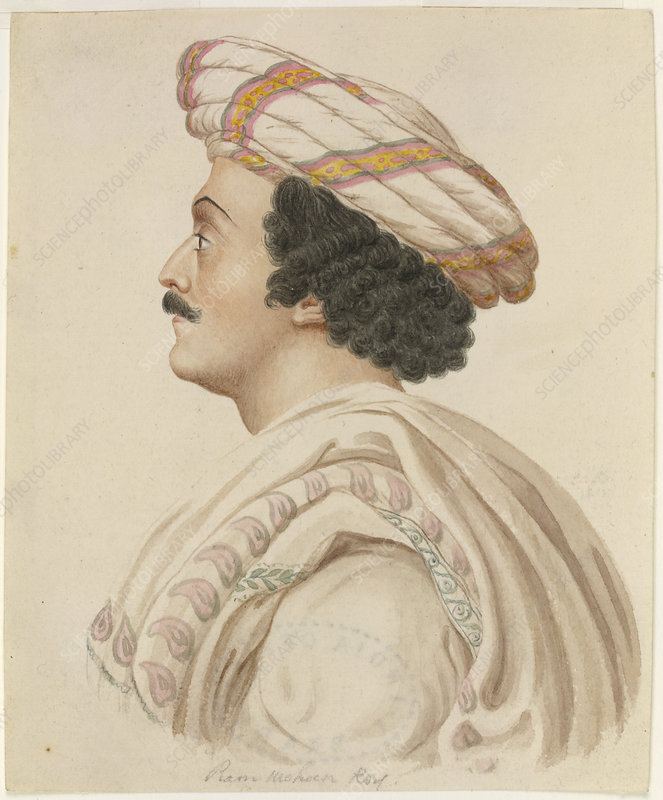
Among the great reformers who shaped modern India, Raja Ram Mohan Roy occupies a place of exceptional importance. Often called the “Father of Modern India” and the “Father of the Indian Renaissance,” he was a visionary thinker, social reformer, religious scholar, educator, and advocate of human rights.
At a time when Indian society was burdened by various social evils and rigid customs, Raja Ram Mohan Roy courageously championed reforms that promoted justice, education, women’s rights, and religious tolerance. His efforts laid the foundation for many of the social and intellectual movements that transformed India in the nineteenth and twentieth centuries.
Early Life
Raja Ram Mohan Roy was born on May 22, 1772, in Radhanagar, a village in present-day West Bengal, India.
He was born into a respected and religious family. His father, Ramakanta Roy, was a devout Hindu, and his mother, Tarini Devi, played an important role in his upbringing.
From an early age, Roy displayed remarkable intelligence and a deep curiosity about religion, philosophy, and society. He received a broad education and became proficient in several languages, including:
- Sanskrit
- Persian
- Arabic
- Bengali
- Hindi
- English
His study of diverse religious and philosophical traditions greatly influenced his later ideas and reforms.
Intellectual Development
As a young man, Roy explored the teachings of Hinduism, Islam, Christianity, and various philosophical traditions.
He was particularly drawn to the monotheistic teachings found in ancient Hindu scriptures such as the Upanishads. He believed that the essence of religion lay in the worship of one God and in the practice of moral living.
His broad knowledge allowed him to engage in meaningful dialogue with scholars from different faiths and cultures. This exposure helped him develop a spirit of religious tolerance and intellectual openness that would characterize his life’s work.
Opposition to Social Evils
Raja Ram Mohan Roy is best remembered for his courageous struggle against harmful social practices.
Campaign Against Sati
One of the most significant reforms associated with Roy was his campaign against the practice of Sati, in which widows were expected or pressured to immolate themselves on their husbands’ funeral pyres.
Roy strongly condemned the practice as inhumane and contrary to the true teachings of Hindu scriptures.
He wrote extensively, organized public campaigns, and appealed to British authorities to prohibit the practice.
His efforts played a major role in persuading Governor-General Lord William Bentinck to outlaw Sati in 1829.
The abolition of Sati remains one of the most important milestones in the history of social reform in India.
Advocate for Women’s Rights
Raja Ram Mohan Roy believed that women deserved dignity, education, and equal treatment.
He advocated:
- Women’s education.
- Property rights for women.
- Improved social status for widows.
- Opposition to child marriage.
- Greater opportunities for women in society.
At a time when women’s rights received little attention, his views were revolutionary and far ahead of their time.
Educational Reforms
Roy recognized that education was essential for national progress.
He supported the introduction of modern scientific and secular education while also valuing India’s classical traditions.
He encouraged the study of:
- Science
- Mathematics
- Philosophy
- Literature
- Modern languages
In 1817, he helped support the establishment of Hindu College in Calcutta, which later became one of India’s most influential educational institutions.
He believed that education would empower individuals to think critically and contribute to society.
Founder of the Brahmo Samaj
One of Roy’s most enduring achievements was the establishment of the Brahmo Samaj in 1828.
The organization sought to reform Hindu religious practices and promote:
- Worship of one God.
- Rejection of idol worship.
- Social equality.
- Rational thinking.
- Moral living.
- Religious tolerance.
The Brahmo Samaj became one of the most influential reform movements in modern Indian history and inspired future generations of social reformers.
Champion of Religious Tolerance
Raja Ram Mohan Roy believed that all religions contained valuable moral teachings.
Rather than promoting division, he sought understanding and dialogue among different faiths.
He studied Christian theology, Islamic philosophy, and Hindu scriptures with equal seriousness and encouraged mutual respect among religious communities.
His commitment to religious harmony remains relevant in today’s diverse and multicultural world.
Contributions to Journalism
Roy was also a pioneer of Indian journalism.
He recognized the importance of a free press in promoting public awareness and social reform.
He founded and supported several newspapers and journals, including:
- Sambad Kaumudi (Bengali)
- Mirat-ul-Akbar (Persian)
Through these publications, he advocated social reform, education, and freedom of expression.
His work helped establish journalism as an important force for public discourse and national development.
Political and Economic Views
Although primarily remembered as a social reformer, Roy was also interested in political and economic issues.
He advocated:
- Freedom of speech.
- Freedom of the press.
- Administrative reforms.
- Protection of civil rights.
- Greater participation of Indians in governance.
His writings reflected a deep concern for justice, good governance, and the welfare of ordinary people.
Journey to England
In 1831, Raja Ram Mohan Roy traveled to England as a representative of the Mughal Emperor Akbar II.
During his visit, he engaged with political leaders, intellectuals, and reformers. He continued promoting Indian interests and advocating reforms.
His presence in England attracted considerable attention, and he was widely respected for his intelligence, eloquence, and progressive ideas.
Death
Raja Ram Mohan Roy passed away on September 27, 1833, in Bristol, England.
He was 61 years old.
His death was mourned by admirers in both India and Britain, who recognized him as one of the most remarkable reformers of his age.
Today, his tomb in Bristol remains an important historical site visited by people from around the world.
Legacy
The influence of Raja Ram Mohan Roy extends far beyond his own lifetime.
His contributions include:
- The abolition of Sati.
- Advancement of women’s rights.
- Promotion of modern education.
- Religious reform through the Brahmo Samaj.
- Development of Indian journalism.
- Advocacy of freedom of expression.
- Promotion of religious tolerance.
Because of these achievements, he is widely regarded as one of the founding figures of modern India.
Why Raja Ram Mohan Roy is Called the Father of Modern India
Raja Ram Mohan Roy earned the title “Father of Modern India” because he helped bridge the gap between traditional Indian society and modern ideas.
He encouraged Indians to:
- Embrace education.
- Challenge social injustices.
- Promote equality.
- Think rationally.
- Respect religious diversity.
- Work toward social progress.
His vision helped prepare India for the social, intellectual, and political transformations that followed in the nineteenth and twentieth centuries.
Lessons from His Life
The life of Raja Ram Mohan Roy teaches several enduring lessons:
Courage to Challenge Injustice
He spoke against harmful practices even when doing so invited criticism and opposition.
Education as a Tool of Progress
He believed that knowledge and learning could transform society.
Respect for All Religions
He encouraged dialogue and understanding among different faith communities.
Commitment to Human Dignity
His work consistently defended the rights and welfare of the vulnerable.
Reform Through Reason
He promoted thoughtful and peaceful reform based on moral principles and rational inquiry.
Conclusion
Raja Ram Mohan Roy was one of the greatest reformers in Indian history. Through his efforts to abolish Sati, promote women’s rights, advance education, encourage religious tolerance, and reform society, he helped usher India into the modern age.
His vision, courage, and commitment to human dignity continue to inspire generations. More than two centuries after his birth, Raja Ram Mohan Roy remains a symbol of enlightenment, progress, and social justice.
His life reminds us that true reform begins with the courage to question injustice and the determination to work for a better society for all.
Leave a Reply