

Nelsapy – General Knowledge Series
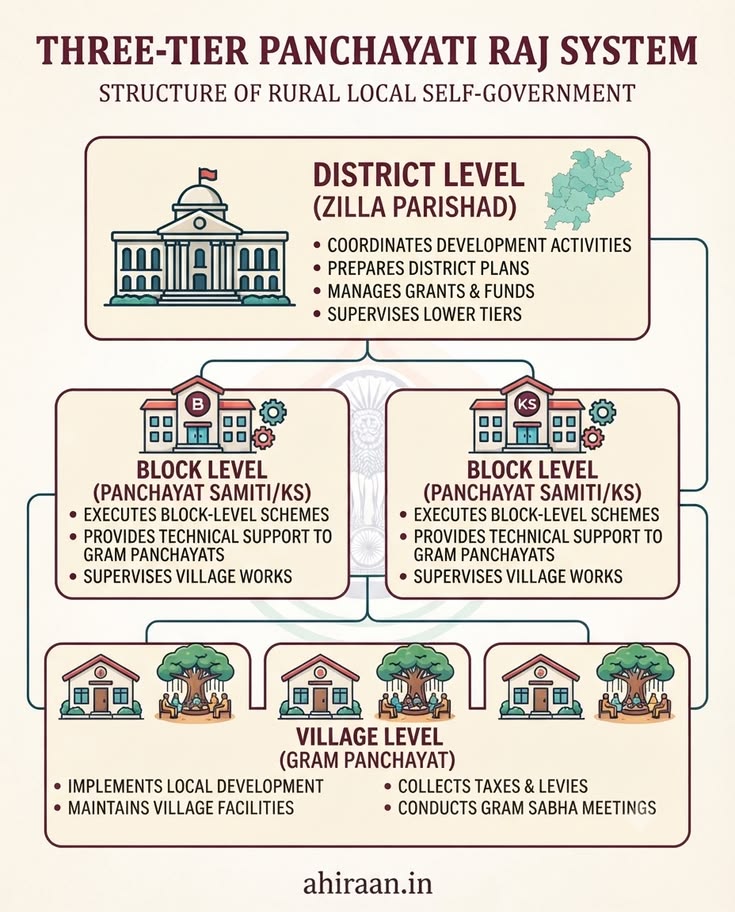
Panchayati Raj is the system of rural local self-government in India. It provides people in villages with an opportunity to participate directly in local administration and decision-making. Through Gram Sabhas, Gram Panchayats, Panchayat Samitis and Zilla Parishads, this system promotes democratic decentralisation and rural development.
The 73rd Constitutional Amendment Act, 1992, gave constitutional status to Panchayati Raj institutions and introduced Part IX of the Indian Constitution.
Instructions: Choose the correct answer from the four options. Attempt all the questions before checking the answer key at the end.
Section 1: Introduction to Panchayati Raj
1. What is Panchayati Raj?
- A) A system of urban administration
- B) A system of rural local self-government
- C) A system of central government
- D) A system of state courts
2. What is the primary objective of Panchayati Raj?
- A) Centralisation of power
- B) Democratic decentralisation
- C) Expansion of the armed forces
- D) Administration of national highways
3. Which level of government is closest to the people in rural India?
- A) Central Government
- B) State Government
- C) Panchayati Raj institutions
- D) Supreme Court
4. Which constitutional amendment gave constitutional status to Panchayati Raj institutions?
- A) 42nd Amendment
- B) 44th Amendment
- C) 73rd Amendment
- D) 74th Amendment
5. In which year was the 73rd Constitutional Amendment passed?
- A) 1989
- B) 1991
- C) 1992
- D) 1995
6. When did the 73rd Constitutional Amendment come into force?
- A) 26 January 1993
- B) 24 April 1993
- C) 15 August 1993
- D) 2 October 1993
7. Which day is observed as National Panchayati Raj Day in India?
- A) 24 April
- B) 2 October
- C) 15 August
- D) 26 January
8. Which part of the Indian Constitution deals with Panchayati Raj institutions?
- A) Part VI
- B) Part VII
- C) Part IX
- D) Part X
9. Which Articles of the Constitution deal with Panchayati Raj?
- A) Articles 124–147
- B) Articles 243–243O
- C) Articles 280–290
- D) Articles 324–329
10. Which Schedule of the Constitution contains the subjects assigned to Panchayats?
- A) Seventh Schedule
- B) Eighth Schedule
- C) Tenth Schedule
- D) Eleventh Schedule
11. How many subjects are listed in the Eleventh Schedule?
- A) 18
- B) 25
- C) 29
- D) 35
12. Panchayati Raj is mainly associated with which concept?
- A) Judicial review
- B) Democratic decentralisation
- C) Military administration
- D) Parliamentary privilege
13. Which of the following best describes local self-government?
- A) Administration by foreign authorities
- B) Administration by elected local representatives
- C) Administration only by the central government
- D) Administration by the judiciary
14. What is the basic unit of the Panchayati Raj system?
- A) Zilla Parishad
- B) Panchayat Samiti
- C) Gram Panchayat
- D) Parliament
15. Which institution provides a platform for direct participation of village voters in local governance?
- A) Gram Sabha
- B) Rajya Sabha
- C) Lok Sabha
- D) Legislative Council
Section 2: History and Development of Panchayati Raj
16. Which committee recommended the establishment of a three-tier Panchayati Raj system in India?
- A) Ashok Mehta Committee
- B) Balwant Rai Mehta Committee
- C) Sarkaria Commission
- D) Mandal Commission
17. In which year was the Balwant Rai Mehta Committee appointed?
- A) 1952
- B) 1955
- C) 1957
- D) 1962
18. What was the main purpose of the Balwant Rai Mehta Committee?
- A) To examine community development programmes
- B) To reorganise the Indian Army
- C) To reform the judiciary
- D) To introduce banking reforms
19. Which state first introduced the Panchayati Raj system in India?
- A) Kerala
- B) Rajasthan
- C) Maharashtra
- D) Gujarat
20. Where was Panchayati Raj formally inaugurated in Rajasthan in 1959?
- A) Jaipur
- B) Jodhpur
- C) Nagaur
- D) Udaipur
21. On which date was Panchayati Raj inaugurated in Rajasthan?
- A) 2 October 1959
- B) 24 April 1959
- C) 26 January 1959
- D) 15 August 1959
22. Who inaugurated the Panchayati Raj system at Nagaur in Rajasthan?
- A) Sardar Vallabhbhai Patel
- B) Jawaharlal Nehru
- C) Dr. Rajendra Prasad
- D) Lal Bahadur Shastri
23. Which committee recommended a two-tier Panchayati Raj structure?
- A) Balwant Rai Mehta Committee
- B) Ashok Mehta Committee
- C) Kothari Commission
- D) Mandal Commission
24. In which year was the Ashok Mehta Committee appointed?
- A) 1967
- B) 1972
- C) 1977
- D) 1985
25. Which committee recommended constitutional recognition for Panchayati Raj institutions?
- A) L. M. Singhvi Committee
- B) Mandal Commission
- C) Shah Commission
- D) Kothari Commission
26. In which year was the L. M. Singhvi Committee appointed?
- A) 1977
- B) 1983
- C) 1986
- D) 1992
27. Which committee was appointed in 1985 to review rural development and poverty alleviation programmes?
- A) G. V. K. Rao Committee
- B) Balwant Rai Mehta Committee
- C) Ashok Mehta Committee
- D) Sarkaria Commission
28. Which committee recommended strengthening the role of Panchayati Raj institutions in rural development administration?
- A) G. V. K. Rao Committee
- B) Mandal Commission
- C) Kothari Commission
- D) Dinesh Goswami Committee
29. Which Prime Minister inaugurated Panchayati Raj in Rajasthan in 1959?
- A) Indira Gandhi
- B) Jawaharlal Nehru
- C) Morarji Desai
- D) Rajiv Gandhi
30. Which Prime Minister strongly supported constitutional recognition of Panchayati Raj institutions during the 1980s?
- A) Rajiv Gandhi
- B) Charan Singh
- C) V. P. Singh
- D) P. V. Narasimha Rao
Section 3: Three-Tier Structure of Panchayati Raj
31. What are the three traditional levels of Panchayati Raj?
- A) Village, block and district
- B) State, district and national
- C) Village, town and city
- D) Ward, municipality and state
32. What is the village-level Panchayati Raj institution called?
- A) Zilla Parishad
- B) Gram Panchayat
- C) Panchayat Samiti
- D) Municipal Corporation
33. What is the intermediate-level Panchayati Raj institution generally called?
- A) Gram Sabha
- B) Panchayat Samiti
- C) Zilla Parishad
- D) Lok Sabha
34. What is the district-level Panchayati Raj institution called?
- A) Gram Panchayat
- B) Gram Sabha
- C) Zilla Parishad
- D) Ward Committee
35. Which institution generally coordinates rural development activities at the block level?
- A) Gram Panchayat
- B) Panchayat Samiti
- C) Zilla Parishad
- D) Rajya Sabha
36. Which institution operates at the village level?
- A) Gram Panchayat
- B) Zilla Parishad
- C) State Assembly
- D) Municipal Corporation
37. Which institution generally operates at the district level?
- A) Gram Sabha
- B) Gram Panchayat
- C) Zilla Parishad
- D) Panchayat Samiti
38. Which level of Panchayati Raj is also commonly known as the block or intermediate level?
- A) Village level
- B) District level
- C) Intermediate level
- D) National level
39. Is the intermediate-level Panchayat compulsory in every state?
- A) Yes, without exception
- B) No, states with a population not exceeding 20 lakh are exempt
- C) Only in Union Territories
- D) Only in metropolitan areas
40. Which institution is directly elected by voters at the village level?
- A) Gram Panchayat
- B) Supreme Court
- C) Rajya Sabha
- D) State Finance Commission
Section 4: Gram Sabha and Gram Panchayat
41. What is the Gram Sabha?
- A) A meeting of village officials only
- B) A body consisting of registered voters in a village
- C) A committee of state ministers
- D) A district-level court
42. Who are the members of the Gram Sabha?
- A) All government employees in the village
- B) All registered voters in the village area
- C) Only elected Panchayat members
- D) Only village elders
43. Who is generally elected to head a Gram Panchayat?
- A) Governor
- B) Sarpanch or Pradhan
- C) District Collector
- D) Chief Secretary
44. What is the main function of the Gram Sabha?
- A) To appoint the Governor
- B) To participate in village-level decision-making and review local development
- C) To make national laws
- D) To conduct parliamentary elections
45. Which institution can discuss and review the development plans of a village?
- A) Gram Sabha
- B) Supreme Court
- C) Rajya Sabha
- D) Union Cabinet
46. What is the elected body responsible for village-level administration?
- A) Gram Panchayat
- B) Parliament
- C) Legislative Council
- D) High Court
47. Who is commonly known as the Sarpanch?
- A) Head of the Gram Panchayat
- B) Head of the Zilla Parishad in every state
- C) Governor of a state
- D) District Judge
48. Which of the following is generally a responsibility of a Gram Panchayat?
- A) Maintaining village roads and sanitation
- B) Controlling the armed forces
- C) Conducting foreign affairs
- D) Printing currency
49. Which institution may approve village development priorities through public participation?
- A) Gram Sabha
- B) Supreme Court
- C) Union Cabinet
- D) Election Commission of India
50. What is social auditing in the context of Panchayati Raj?
- A) A review of public programmes and expenditure by the community
- B) A private company audit only
- C) An examination of court judgments
- D) A national population census
Section 5: Constitutional Provisions and Amendments
51. Which Article defines the Gram Sabha?
- A) Article 243A
- B) Article 243B
- C) Article 243C
- D) Article 243D
52. Which Article deals with the constitution of Panchayats?
- A) Article 243A
- B) Article 243B
- C) Article 243E
- D) Article 243G
53. Which Article deals with the composition of Panchayats?
- A) Article 243C
- B) Article 243D
- C) Article 243F
- D) Article 243I
54. Which Article provides for reservation of seats in Panchayats?
- A) Article 243A
- B) Article 243C
- C) Article 243D
- D) Article 243K
55. Which Article deals with the duration of Panchayats?
- A) Article 243E
- B) Article 243F
- C) Article 243G
- D) Article 243H
56. What is the normal duration of a Panchayat?
- A) Three years
- B) Four years
- C) Five years
- D) Six years
57. Which Article deals with the powers, authority and responsibilities of Panchayats?
- A) Article 243D
- B) Article 243E
- C) Article 243G
- D) Article 243K
58. Which Article deals with the power of Panchayats to levy taxes and collect funds, as provided by state law?
- A) Article 243F
- B) Article 243G
- C) Article 243H
- D) Article 243J
59. Which Article provides for the State Finance Commission?
- A) Article 243I
- B) Article 243K
- C) Article 243L
- D) Article 243M
60. Which Article deals with elections to Panchayats?
- A) Article 243G
- B) Article 243H
- C) Article 243I
- D) Article 243K
61. Who is responsible for supervising, directing and controlling Panchayat elections?
- A) Election Commission of India
- B) State Election Commission
- C) Union Public Service Commission
- D) State Public Service Commission
62. Which Article provides for the State Election Commission?
- A) Article 243I
- B) Article 243J
- C) Article 243K
- D) Article 243O
63. Which Article deals with the audit of Panchayat accounts?
- A) Article 243H
- B) Article 243I
- C) Article 243J
- D) Article 243K
64. Which Article deals with the application of Part IX to Union Territories?
- A) Article 243L
- B) Article 243M
- C) Article 243N
- D) Article 243O
65. Which Article contains exceptions to the application of Part IX to certain areas?
- A) Article 243K
- B) Article 243L
- C) Article 243M
- D) Article 243N
66. Which Article prevents courts from interfering in Panchayat electoral matters except through election petitions as provided by law?
- A) Article 243M
- B) Article 243N
- C) Article 243O
- D) Article 244
67. Which amendment is associated with urban local self-government?
- A) 42nd Amendment
- B) 44th Amendment
- C) 73rd Amendment
- D) 74th Amendment
68. Which amendment introduced Part IXA of the Constitution?
- A) 52nd Amendment
- B) 61st Amendment
- C) 73rd Amendment
- D) 74th Amendment
69. Which constitutional amendment introduced the Eleventh Schedule?
- A) 42nd Amendment
- B) 73rd Amendment
- C) 74th Amendment
- D) 86th Amendment
70. Which constitutional amendment introduced the Twelfth Schedule?
- A) 44th Amendment
- B) 52nd Amendment
- C) 73rd Amendment
- D) 74th Amendment
Section 6: Elections, Reservations and Representation
71. What is the minimum age required to contest a Panchayat election?
- A) 18 years
- B) 21 years
- C) 25 years
- D) 30 years
72. What is the minimum constitutional reservation for women in Panchayats?
- A) One-fourth
- B) One-third
- C) One-half
- D) Two-thirds
73. Reservation for women in Panchayats includes reservation of seats for:
- A) Only ordinary members
- B) Only chairperson positions
- C) Both elected seats and chairperson positions
- D) Neither elected seats nor chairperson positions
74. Seats in Panchayats are reserved for which communities?
- A) Scheduled Castes and Scheduled Tribes
- B) Only religious minorities
- C) Only government employees
- D) Only landowners
75. Reservation for Scheduled Castes and Scheduled Tribes in Panchayats is generally based on:
- A) Their population in the Panchayat area
- B) Their income alone
- C) Their educational qualifications
- D) Their land ownership
76. Can states provide more than one-third reservation for women in Panchayats?
- A) No, it is prohibited
- B) Yes, under state law
- C) Only with Supreme Court permission
- D) Only during emergencies
77. Which authority conducts Panchayat elections?
- A) State Election Commission
- B) Union Public Service Commission
- C) Parliament
- D) Finance Commission
78. Within what period must elections generally be held after a Panchayat is dissolved before the end of its term?
- A) Three months
- B) Six months
- C) One year
- D) Two years
79. If a Panchayat is dissolved and the remainder of its term is less than six months, is it compulsory to hold an election for that short remainder?
- A) Yes, always
- B) No
- C) Only with Governor’s permission
- D) Only with Parliament’s approval
80. What is the normal term of an elected Panchayat?
- A) Three years
- B) Four years
- C) Five years
- D) Six years
Section 7: Finance and Rural Development
81. Which body recommends the distribution of financial resources between a state government and its Panchayats?
- A) Union Public Service Commission
- B) State Finance Commission
- C) Election Commission
- D) Supreme Court
82. How often is a State Finance Commission generally constituted?
- A) Every two years
- B) Every three years
- C) Every five years
- D) Every ten years
83. Which Article provides for the constitution of a State Finance Commission?
- A) Article 243G
- B) Article 243H
- C) Article 243I
- D) Article 243K
84. Which of the following can be a source of income for a Gram Panchayat?
- A) Local taxes and fees authorised by state law
- B) Printing currency
- C) Customs duties
- D) Income tax on foreign countries
85. Which government provides many grants and funds for rural development programmes?
- A) Union and State Governments
- B) Only foreign governments
- C) Only municipal corporations
- D) Only the judiciary
86. Which programme guarantees wage employment to rural households, subject to its provisions?
- A) MGNREGA
- B) Make in India
- C) Digital India
- D) Smart Cities Mission
87. What is the main objective of MGNREGA?
- A) To provide guaranteed wage employment in rural areas
- B) To promote international trade
- C) To build airports in cities
- D) To provide university scholarships only
88. Which rural development programme aims to provide housing assistance to eligible rural households?
- A) Pradhan Mantri Awaas Yojana–Gramin
- B) Smart Cities Mission
- C) AMRUT
- D) UDAN
89. Which initiative focuses on improving sanitation and eliminating open defecation?
- A) Swachh Bharat Mission
- B) Digital India
- C) Startup India
- D) Skill India
90. Which programme promotes village-level planning and development through local participation?
- A) Gram Panchayat Development Plan
- B) National Defence Plan
- C) Foreign Trade Plan
- D) National Highway Plan
Section 8: Panchayati Raj and Rural Administration
91. Which institution generally operates at the block level?
- A) Gram Sabha
- B) Panchayat Samiti
- C) Zilla Parishad
- D) Municipal Corporation
92. Which institution is responsible for coordinating development activities at the district level?
- A) Gram Panchayat
- B) Gram Sabha
- C) Zilla Parishad
- D) Ward Committee
93. Which of the following is a subject included in the Eleventh Schedule?
- A) Agriculture
- B) Foreign affairs
- C) Defence
- D) Currency
94. Which of the following is NOT a subject in the Eleventh Schedule?
- A) Minor irrigation
- B) Rural housing
- C) Drinking water
- D) National defence
95. Which of the following is a typical responsibility of Panchayats?
- A) Rural roads and sanitation
- B) International diplomacy
- C) National monetary policy
- D) Supreme Court appointments
96. Which institution helps identify local needs and development priorities?
- A) Gram Sabha
- B) Rajya Sabha
- C) Supreme Court
- D) Union Cabinet
97. What is the main purpose of a Gram Panchayat Development Plan?
- A) To identify and plan local development activities
- B) To prepare national defence policy
- C) To regulate international trade
- D) To appoint state Governors
98. Which of the following is an important principle of Panchayati Raj?
- A) People’s participation
- B) Absolute centralisation
- C) Hereditary administration
- D) Military rule
99. Which of the following helps improve transparency in Panchayat administration?
- A) Social audits and public disclosure
- B) Secret decision-making
- C) Removal of public records
- D) Avoiding Gram Sabha meetings
100. Which official generally provides administrative support to a Gram Panchayat?
- A) Panchayat Secretary
- B) Governor
- C) Chief Justice
- D) President of India
Section 9: Special Provisions and Important Initiatives
101. What is the full form of PESA?
- A) Panchayat Extension to Scheduled Areas
- B) Public Election System Act
- C) People’s Economic Security Authority
- D) Panchayat Education and Social Act
102. In which year was the PESA Act enacted?
- A) 1992
- B) 1993
- C) 1996
- D) 2000
103. PESA extends Panchayati Raj provisions to which areas?
- A) Scheduled Areas under the Fifth Schedule
- B) All metropolitan cities
- C) All Union Territories only
- D) International border areas only
104. What is the main purpose of the PESA Act?
- A) To strengthen self-governance in Scheduled Areas
- B) To abolish village councils
- C) To establish municipal corporations
- D) To centralise tribal administration
105. Which constitutional schedule deals with the administration of Scheduled Areas and Scheduled Tribes in states other than certain northeastern tribal areas?
- A) Third Schedule
- B) Fifth Schedule
- C) Seventh Schedule
- D) Eleventh Schedule
106. Which schedule provides for the administration of tribal areas in certain northeastern states?
- A) Fourth Schedule
- B) Fifth Schedule
- C) Sixth Schedule
- D) Tenth Schedule
107. Which initiative aims to strengthen Panchayats through training, capacity-building and institutional support?
- A) Rashtriya Gram Swaraj Abhiyan
- B) Make in India
- C) National Health Mission only
- D) Bharatmala
108. Which day is celebrated as National Panchayati Raj Day to mark the commencement of the 73rd Amendment?
- A) 24 April
- B) 1 May
- C) 5 June
- D) 11 July
109. Which portal is associated with online monitoring and accounting of Panchayat activities and finances?
- A) eGramSwaraj
- B) DigiLocker
- C) Passport Seva
- D) GeM only
110. Which programme encourages villages to achieve and maintain development goals through local governance and community participation?
- A) Mission Antyodaya
- B) Operation Flood
- C) Green Revolution
- D) Blue Revolution
Section 10: Advanced and Application-Based Questions
111. Which committee is associated with the recommendation that the district should be the basic unit of planning for rural development?
- A) G. V. K. Rao Committee
- B) Mandal Commission
- C) Kothari Commission
- D) Shah Commission
112. Which committee recommended that Panchayati Raj institutions should have a constitutional status?
- A) L. M. Singhvi Committee
- B) Balwant Rai Mehta Committee
- C) Mandal Commission
- D) Sarkaria Commission
113. Which system was recommended by the Balwant Rai Mehta Committee?
- A) One-tier system
- B) Two-tier system
- C) Three-tier system
- D) Four-tier system
114. Which system was recommended by the Ashok Mehta Committee?
- A) One-tier system
- B) Two-tier system
- C) Three-tier system
- D) Four-tier system
115. Which of the following best describes the relationship between the Gram Sabha and Gram Panchayat?
- A) Gram Sabha is the broader body of registered voters; Gram Panchayat is the elected village institution
- B) They are both state-level courts
- C) Gram Panchayat appoints all voters to the Gram Sabha
- D) They are institutions of the Union Government
116. Can the State Legislature give Panchayats powers and responsibilities relating to the subjects in the Eleventh Schedule?
- A) Yes, through state law
- B) No, under any circumstances
- C) Only the Supreme Court can do so
- D) Only the President can do so
117. Does the Eleventh Schedule automatically transfer all 29 subjects to every Panchayat?
- A) Yes, automatically
- B) No, devolution depends on state legislation
- C) Only during emergencies
- D) Only in Union Territories
118. Which institution is responsible for preparing electoral rolls and conducting Panchayat elections under the constitutional framework?
- A) State Election Commission
- B) Union Public Service Commission
- C) Finance Commission
- D) National Human Rights Commission
119. Which of the following is a key feature of democratic decentralisation?
- A) Transferring decision-making powers closer to the people
- B) Concentrating all power in the capital
- C) Removing elected local bodies
- D) Ending public participation
120. What is the broader democratic significance of Panchayati Raj?
- A) It encourages grassroots democracy and citizen participation
- B) It replaces Parliament
- C) It abolishes state governments
- D) It transfers judicial powers to villages
Answer Key
| No. | Correct answer | No. | Correct answer |
|---|---|---|---|
| 1 | B – Rural local self-government | 2 | B – Democratic decentralisation |
| 3 | C – Panchayati Raj institutions | 4 | C – 73rd Amendment |
| 5 | C – 1992 | 6 | B – 24 April 1993 |
| 7 | A – 24 April | 8 | C – Part IX |
| 9 | B – Articles 243–243O | 10 | D – Eleventh Schedule |
| 11 | C – 29 | 12 | B – Democratic decentralisation |
| 13 | B – Elected local representatives | 14 | C – Gram Panchayat |
| 15 | A – Gram Sabha | 16 | B – Balwant Rai Mehta Committee |
| 17 | C – 1957 | 18 | A – Community development programmes |
| 19 | B – Rajasthan | 20 | C – Nagaur |
| 21 | A – 2 October 1959 | 22 | B – Jawaharlal Nehru |
| 23 | B – Ashok Mehta Committee | 24 | C – 1977 |
| 25 | A – L. M. Singhvi Committee | 26 | C – 1986 |
| 27 | A – G. V. K. Rao Committee | 28 | A – G. V. K. Rao Committee |
| 29 | B – Jawaharlal Nehru | 30 | A – Rajiv Gandhi |
| 31 | A – Village, block and district | 32 | B – Gram Panchayat |
| 33 | B – Panchayat Samiti | 34 | C – Zilla Parishad |
| 35 | B – Panchayat Samiti | 36 | A – Gram Panchayat |
| 37 | C – Zilla Parishad | 38 | C – Intermediate level |
| 39 | B – States with population not exceeding 20 lakh are exempt | 40 | A – Gram Panchayat |
| 41 | B – Registered voters in a village | 42 | B – All registered voters |
| 43 | B – Sarpanch or Pradhan | 44 | B – Village-level decision-making |
| 45 | A – Gram Sabha | 46 | A – Gram Panchayat |
| 47 | A – Head of the Gram Panchayat | 48 | A – Village roads and sanitation |
| 49 | A – Gram Sabha | 50 | A – Community review of public programmes |
| 51 | A – Article 243A | 52 | B – Article 243B |
| 53 | A – Article 243C | 54 | C – Article 243D |
| 55 | A – Article 243E | 56 | C – Five years |
| 57 | C – Article 243G | 58 | C – Article 243H |
| 59 | A – Article 243I | 60 | D – Article 243K |
| 61 | B – State Election Commission | 62 | C – Article 243K |
| 63 | C – Article 243J | 64 | A – Article 243L |
| 65 | C – Article 243M | 66 | C – Article 243O |
| 67 | D – 74th Amendment | 68 | D – 74th Amendment |
| 69 | B – 73rd Amendment | 70 | D – 74th Amendment |
| 71 | B – 21 years | 72 | B – One-third |
| 73 | C – Both elected seats and chairperson positions | 74 | A – Scheduled Castes and Scheduled Tribes |
| 75 | A – Population in the Panchayat area | 76 | B – Yes, under state law |
| 77 | A – State Election Commission | 78 | B – Six months |
| 79 | B – No | 80 | C – Five years |
| 81 | B – State Finance Commission | 82 | C – Every five years |
| 83 | C – Article 243I | 84 | A – Local taxes and fees |
| 85 | A – Union and State Governments | 86 | A – MGNREGA |
| 87 | A – Guaranteed rural wage employment | 88 | A – PMAY-Gramin |
| 89 | A – Swachh Bharat Mission | 90 | A – Gram Panchayat Development Plan |
| 91 | B – Panchayat Samiti | 92 | C – Zilla Parishad |
| 93 | A – Agriculture | 94 | D – National defence |
| 95 | A – Rural roads and sanitation | 96 | A – Gram Sabha |
| 97 | A – Local development planning | 98 | A – People’s participation |
| 99 | A – Social audits and public disclosure | 100 | A – Panchayat Secretary |
| 101 | A – Panchayat Extension to Scheduled Areas | 102 | C – 1996 |
| 103 | A – Fifth Schedule Scheduled Areas | 104 | A – Strengthening self-governance in Scheduled Areas |
| 105 | B – Fifth Schedule | 106 | C – Sixth Schedule |
| 107 | A – Rashtriya Gram Swaraj Abhiyan | 108 | A – 24 April |
| 109 | A – eGramSwaraj | 110 | A – Mission Antyodaya |
| 111 | A – G. V. K. Rao Committee | 112 | A – L. M. Singhvi Committee |
| 113 | C – Three-tier system | 114 | B – Two-tier system |
| 115 | A – Gram Sabha is the broader voters’ body; Gram Panchayat is elected | 116 | A – Yes, through state law |
| 117 | B – Devolution depends on state legislation | 118 | A – State Election Commission |
| 119 | A – Decision-making closer to the people | 120 | A – Grassroots democracy and participation |
Important Facts to Remember
- 73rd Constitutional Amendment Act: Passed in 1992 and came into force on 24 April 1993.
- National Panchayati Raj Day: Celebrated every year on 24 April.
- Part IX: Contains the constitutional provisions relating to Panchayats.
- Eleventh Schedule: Contains 29 subjects that may be entrusted to Panchayats.
- Three-tier system: Gram Panchayat at village level, Panchayat Samiti at intermediate level and Zilla Parishad at district level.
- Gram Sabha: Consists of all persons registered in the electoral rolls relating to a village within the Gram Sabha area.
- Normal tenure: Five years for every Panchayat.
- Women’s reservation: At least one-third of the seats and chairperson positions are constitutionally reserved for women. States may provide higher reservation.
- Minimum age: 21 years to contest Panchayat elections.
- State Election Commission: Conducts and supervises Panchayat elections.
- State Finance Commission: Recommends financial arrangements between the state and local bodies, including Panchayats.
- PESA Act, 1996: Extends Panchayati Raj provisions to Fifth Schedule areas, with special provisions.
- Balwant Rai Mehta Committee (1957): Recommended the three-tier Panchayati Raj system.
- Ashok Mehta Committee (1977): Recommended a two-tier system.
- L. M. Singhvi Committee (1986): Recommended constitutional recognition for Panchayati Raj institutions.
Major Committees on Panchayati Raj
| Committee | Year | Major recommendation or contribution |
|---|---|---|
| Balwant Rai Mehta Committee | 1957 | Three-tier Panchayati Raj |
| Ashok Mehta Committee | 1977 | Two-tier Panchayati Raj |
| G. V. K. Rao Committee | 1985 | Strengthening Panchayati Raj in rural development |
| L. M. Singhvi Committee | 1986 | Constitutional recognition of Panchayats |
The 29 Subjects in the Eleventh Schedule
The Eleventh Schedule identifies 29 areas that may be entrusted to Panchayats by state legislatures.
- Agriculture, including agricultural extension
- Land improvement and land reforms
- Minor irrigation, water management and watershed development
- Animal husbandry, dairying and poultry
- Fisheries
- Social forestry and farm forestry
- Minor forest produce
- Small-scale industries, including food-processing industries
- Khadi, village and cottage industries
- Rural housing
- Drinking water
- Fuel and fodder
- Roads, culverts, bridges, ferries, waterways and other means of communication
- Rural electrification, including distribution of electricity
- Non-conventional energy sources
- Poverty alleviation programmes
- Education, including primary and secondary schools
- Technical training and vocational education
- Adult and non-formal education
- Libraries
- Cultural activities
- Markets and fairs
- Health and sanitation, including hospitals, primary health centres and dispensaries
- Family welfare
- Women and child development
- Social welfare, including the welfare of persons with disabilities
- Welfare of weaker sections, particularly Scheduled Castes and Scheduled Tribes
- Public distribution system
- Maintenance of community assets
Conclusion
Panchayati Raj is one of the most important foundations of Indian democracy. It gives rural citizens an opportunity to participate in governance, identify their community’s needs and influence decisions affecting their everyday lives.
A strong Panchayati Raj system promotes transparency, accountability, women’s participation, social justice and balanced rural development. It makes democracy meaningful not only at the national and state levels but also at the grassroots.
Note for the Public
Panchayati Raj is not merely an administrative arrangement; it is an instrument of people’s empowerment. Every eligible citizen should understand the role of the Gram Sabha, participate in village meetings, question the use of public funds and contribute to local development.
Nelsapy – Learn Something New Every Day!
Leave a Reply