

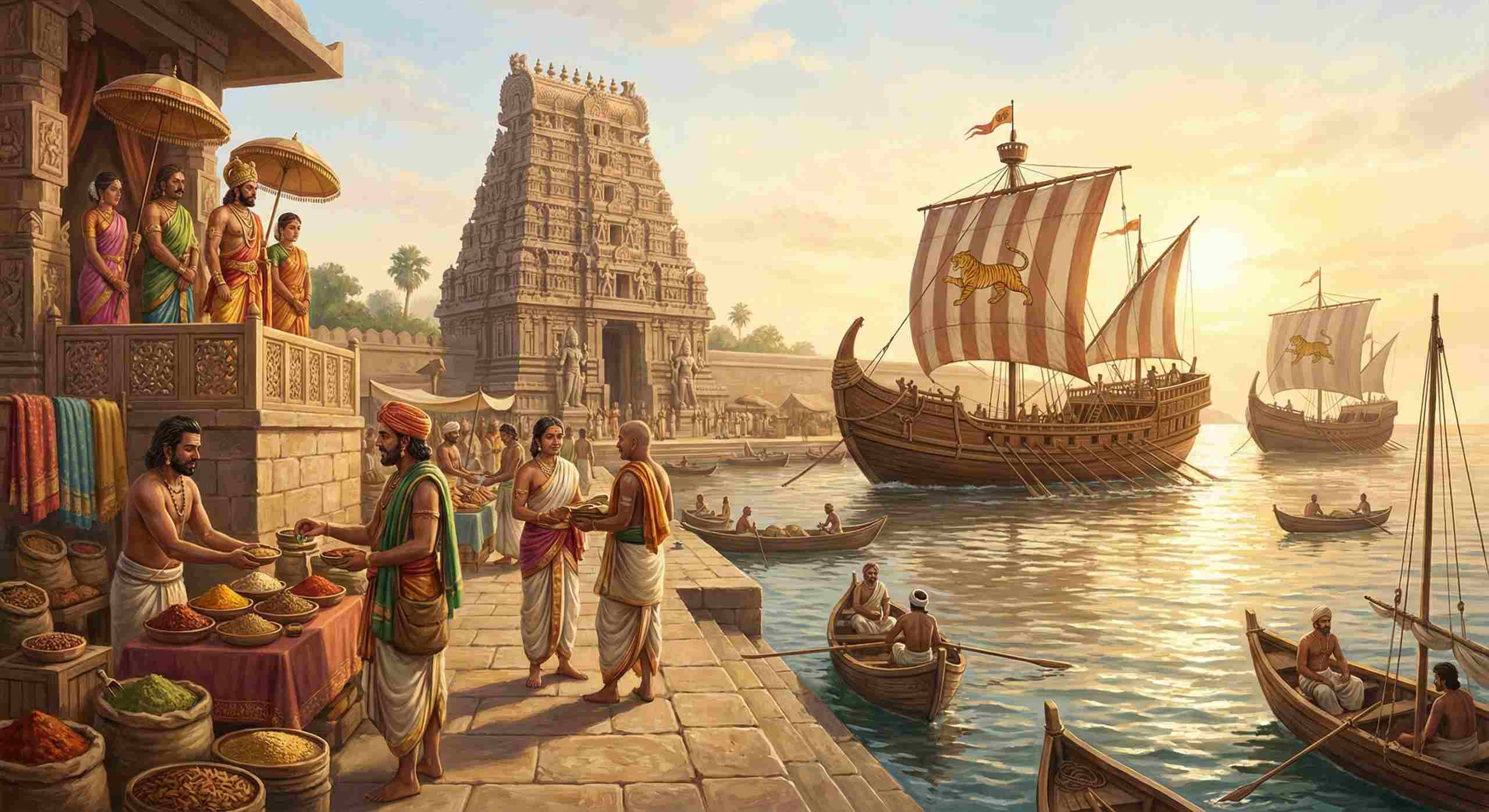
A General Knowledge Quiz on the History, Kings, Administration, Architecture, Military Achievements, Art, Culture and Legacy of the Chola Empire
The Chola Dynasty was one of the most powerful and influential dynasties in Indian history. Originating in Tamil Nadu, the Cholas established a vast empire that extended across South India and influenced parts of Southeast Asia. Famous rulers such as Rajaraja Chola I and Rajendra Chola I contributed significantly to Indian history through military conquests, naval expeditions, temple architecture, trade and administration.
This GK collection contains 120 questions covering important facts and historical developments associated with the Chola Dynasty.
Instructions: Read each question carefully and choose the correct answer from the four options. Try to answer all the questions without looking at the answer key. The complete answer key is provided at the end.
Section 1: Introduction to the Chola Dynasty
1. In which present-day Indian state did the Chola Dynasty originate?
A) Kerala
B) Tamil Nadu
C) Karnataka
D) Andhra Pradesh
2. Which river valley formed the heartland of the Chola Empire?
A) Godavari
B) Krishna
C) Kaveri
D) Tungabhadra
3. What was the emblem of the Chola Dynasty?
A) Lion
B) Tiger
C) Elephant
D) Fish
4. Which three dynasties were known as the three crowned kings of ancient Tamilakam?
A) Cholas, Cheras and Pandyas
B) Cholas, Pallavas and Chalukyas
C) Cheras, Pallavas and Rashtrakutas
D) Pandyas, Hoysalas and Chalukyas
5. What was the traditional early capital of the Cholas?
A) Madurai
B) Kanchipuram
C) Uraiyur
D) Thanjavur
6. Which language was predominantly used in Chola inscriptions?
A) Sanskrit
B) Tamil
C) Telugu
D) Kannada
7. Which sea was important for Chola maritime trade?
A) Mediterranean Sea
B) Arabian Sea
C) Red Sea
D) South China Sea
8. Which historical period witnessed the greatest expansion of Chola power?
A) Early medieval period
B) Mughal period
C) Gupta period
D) Mauryan period
9. Which dynasty was one of the major rivals of the Cholas in South India?
A) Pandyas
B) Guptas
C) Mauryas
D) Palas
10. Which religious tradition received significant royal patronage under many Chola rulers?
A) Jainism
B) Buddhism
C) Shaivism
D) Zoroastrianism
Section 2: Important Chola Rulers
11. Who is regarded as the founder of the Imperial Chola Dynasty?
A) Rajaraja Chola I
B) Vijayalaya Chola
C) Rajendra Chola I
D) Kulottunga Chola I
12. Which Chola ruler captured Thanjavur around 850 CE?
A) Vijayalaya Chola
B) Aditya I
C) Parantaka I
D) Rajadhiraja I
13. Who succeeded Vijayalaya Chola?
A) Rajendra Chola I
B) Aditya I
C) Rajaraja Chola I
D) Kulottunga I
14. Who was the father of Rajaraja Chola I?
A) Parantaka I
B) Aditya I
C) Sundara Chola
D) Rajendra Chola I
15. Who was the most famous son of Rajaraja Chola I?
A) Rajadhiraja I
B) Rajendra Chola I
C) Kulottunga I
D) Vikrama Chola
16. Which Chola ruler was popularly known as Rajaraja the Great?
A) Rajaraja Chola I
B) Rajaraja Chola II
C) Rajendra Chola II
D) Parantaka Chola I
17. During which years did Rajaraja Chola I rule?
A) 850–871 CE
B) 907–955 CE
C) 985–1014 CE
D) 1014–1044 CE
18. Who succeeded Rajaraja Chola I?
A) Rajadhiraja I
B) Rajendra Chola I
C) Kulottunga I
D) Rajendra Chola II
19. Which Chola ruler assumed the title Gangaikonda Chola?
A) Vijayalaya Chola
B) Rajaraja Chola I
C) Rajendra Chola I
D) Kulottunga Chola I
20. Which Chola ruler died in the Battle of Koppam?
A) Rajadhiraja Chola I
B) Rajendra Chola I
C) Rajaraja Chola II
D) Aditya I
Section 3: Rajaraja Chola I and His Achievements
21. Which famous temple was constructed by Rajaraja Chola I?
A) Meenakshi Temple
B) Brihadisvara Temple
C) Shore Temple
D) Jagannath Temple
22. Where is the Brihadisvara Temple built by Rajaraja Chola I located?
A) Madurai
B) Kanchipuram
C) Thanjavur
D) Tiruchirappalli
23. To which deity is the Brihadisvara Temple dedicated?
A) Vishnu
B) Shiva
C) Brahma
D) Murugan
24. Around which year was the Brihadisvara Temple completed?
A) 850 CE
B) 950 CE
C) 1010 CE
D) 1200 CE
25. What was the original name of the Brihadisvara Temple?
A) Rajarajesvaram
B) Gangaikondacholesvaram
C) Airavatesvaram
D) Kailasanathar
26. Which island kingdom was invaded by Rajaraja Chola I?
A) Maldives
B) Sri Lanka
C) Java
D) Sumatra
27. Which dynasty ruled parts of Kerala during the period of Chola expansion?
A) Chera dynasty
B) Gupta dynasty
C) Pala dynasty
D) Sena dynasty
28. Which naval and maritime region became important under Rajaraja Chola I?
A) Bay of Bengal
B) Black Sea
C) Caspian Sea
D) Baltic Sea
29. Which title was associated with Rajaraja Chola I?
A) Devanampiya
B) Mummudi Chola
C) Vikramaditya
D) Samudragupta
30. Which administrative strength helped Rajaraja Chola I maintain his vast empire?
A) A centralised and organised administration
B) Complete absence of taxation
C) Rule through foreign governors only
D) Abolition of village assemblies
Section 4: Rajendra Chola I and Overseas Expeditions
31. In which year did Rajendra Chola I become king?
A) 985 CE
B) 1000 CE
C) 1014 CE
D) 1044 CE
32. Which great river did Rajendra Chola I’s northern expedition reach?
A) Yamuna
B) Ganges
C) Narmada
D) Godavari
33. Which city was founded by Rajendra Chola I?
A) Madurai
B) Gangaikonda Cholapuram
C) Kanchipuram
D) Uraiyur
34. What does the name Gangaikonda Cholapuram commemorate?
A) Victory over the Pallavas
B) Conquest of the Ganges region
C) Conquest of Sri Lanka
D) Victory over the Pandyas
35. Which Southeast Asian empire was attacked by Rajendra Chola I?
A) Khmer Empire
B) Srivijaya Empire
C) Majapahit Empire
D) Pagan Empire
36. Around which year did Rajendra Chola I launch his famous naval expedition against Srivijaya?
A) 985 CE
B) 1000 CE
C) 1025 CE
D) 1100 CE
37. Srivijaya was primarily based in which present-day country?
A) Indonesia
B) Thailand
C) Vietnam
D) Cambodia
38. Which ocean was crossed during the Chola naval expedition to Southeast Asia?
A) Atlantic Ocean
B) Arctic Ocean
C) Indian Ocean
D) Southern Ocean
39. Which Chola ruler expanded the empire’s influence into northern India?
A) Vijayalaya Chola
B) Rajendra Chola I
C) Aditya I
D) Parantaka I
40. What was one of the main objectives of Chola naval expeditions?
A) Controlling maritime trade routes
B) Conquering Europe
C) Establishing colonies in Africa
D) Controlling the Mediterranean Sea
Section 5: Chola Administration and Governance
41. What was the principal source of revenue for the Chola government?
A) Mining
B) Land revenue
C) Foreign donations
D) Hunting
42. What was the basic administrative unit of Chola local government?
A) Village
B) Empire
C) Province
D) Kingdom
43. What was the village assembly in Brahmin settlements called?
A) Sabha
B) Nagaram
C) Sena
D) Mandalam
44. What was the general village assembly known as?
A) Ur
B) Sabha
C) Rajya
D) Samiti
45. What was the assembly of merchants in Chola towns commonly called?
A) Nagaram
B) Ur
C) Sabha
D) Nadu
46. Which inscriptions provide important information about Chola village administration?
A) Allahabad inscriptions
B) Uttaramerur inscriptions
C) Hathigumpha inscriptions
D) Junagadh inscriptions
47. Which Chola ruler’s reign is associated with the famous Uttaramerur inscriptions?
A) Rajaraja Chola I
B) Parantaka Chola I
C) Rajendra Chola I
D) Kulottunga Chola I
48. What was the Kudavolai system?
A) A land measurement system
B) A method of selecting village committee members by lot
C) A military recruitment system
D) A temple construction technique
49. What was a Mandalam in Chola administration?
A) A large territorial division
B) A village market
C) A military weapon
D) A religious festival
50. Which institution played an important role in managing village affairs?
A) Village assemblies
B) Foreign traders
C) Royal armies alone
D) Religious pilgrims
Section 6: Chola Art and Architecture
51. Which architectural style is associated with Chola temples?
A) Nagara
B) Dravidian
C) Indo-Islamic
D) Vesara exclusively
52. Which temple is popularly known as the Big Temple?
A) Brihadisvara Temple
B) Meenakshi Temple
C) Jagannath Temple
D) Somnath Temple
53. Who built the Brihadisvara Temple at Gangaikonda Cholapuram?
A) Rajaraja Chola I
B) Rajendra Chola I
C) Vijayalaya Chola
D) Kulottunga Chola I
54. Which Chola ruler commissioned the Airavatesvara Temple at Darasuram?
A) Rajaraja Chola I
B) Rajendra Chola I
C) Rajaraja Chola II
D) Parantaka I
55. Where is the Airavatesvara Temple situated?
A) Darasuram
B) Madurai
C) Chennai
D) Kumbakonam town centre
56. Which three temples are collectively known as the Great Living Chola Temples?
A) Brihadisvara at Thanjavur, Brihadisvara at Gangaikonda Cholapuram and Airavatesvara at Darasuram
B) Meenakshi, Shore Temple and Kailasanathar
C) Srirangam, Tirupati and Rameswaram
D) Konark, Khajuraho and Brihadisvara
57. In which year was the Brihadisvara Temple at Thanjavur first inscribed as a UNESCO World Heritage Site?
A) 1972
B) 1987
C) 1995
D) 2004
58. Which material was commonly used in Chola bronze sculptures?
A) Marble
B) Bronze
C) Granite
D) Sandstone
59. Which technique was used to produce traditional Chola bronze sculptures?
A) Wood carving
B) Lost-wax casting
C) Glass blowing
D) Stone polishing
60. Which Hindu deity is particularly famous in Chola bronze sculptures?
A) Indra
B) Shiva as Nataraja
C) Varuna
D) Surya only
Section 7: Chola Economy, Trade and Agriculture
61. Which river was central to Chola agricultural development?
A) Kaveri
B) Indus
C) Ganga
D) Brahmaputra
62. Which agricultural product was particularly important in the Chola region?
A) Wheat
B) Rice
C) Barley
D) Coffee
63. Which irrigation methods were used during the Chola period?
A) Canals and tanks
B) Underground pipelines only
C) Modern electric pumps
D) Desalination plants
64. Which merchant guild was famous during the Chola period?
A) Ayyavole 500
B) East India Company
C) Dutch East India Company
D) Portuguese Trading Company
65. What was Manigramam?
A) A merchant organisation
B) A military regiment
C) A temple festival
D) A royal palace
66. Which region was an important destination for Chola maritime trade?
A) Southeast Asia
B) Northern Europe
C) South America
D) Central Africa
67. Which goods were commonly traded by South Indian merchants?
A) Spices and textiles
B) Petroleum and automobiles
C) Aircraft and machinery
D) Plastic products
68. Which port was an important centre of Chola maritime activity?
A) Nagapattinam
B) Mumbai
C) Surat
D) Kolkata
69. What was one of the major economic strengths of the Chola Empire?
A) Agricultural production and international trade
B) Complete dependence on hunting
C) Absence of commercial activity
D) Exclusive dependence on foreign aid
70. Which group played a significant role in overseas commercial networks?
A) Merchant guilds
B) Nomadic hunters
C) Foreign armies
D) Royal prisoners
Section 8: Chola Religion, Literature and Culture
71. Which religious tradition received considerable support from many Chola rulers?
A) Shaivism
B) Zoroastrianism
C) Judaism
D) Shintoism
72. Which Tamil devotional movement influenced Chola religious culture?
A) Bhakti movement
B) Sufi movement
C) Protestant Reformation
D) Renaissance movement
73. Who were the Nayanars?
A) Tamil Shaivite saints
B) Buddhist kings
C) Jain merchants
D) Foreign travellers
74. Who were the Alvars?
A) Shaivite saints
B) Vaishnavite saints
C) Jain monks
D) Buddhist teachers
75. Which famous Tamil devotional collection is associated with the Shaivite Nayanars?
A) Tevaram
B) Arthashastra
C) Ramcharitmanas
D) Rajatarangini
76. Who was Nambi Andar Nambi?
A) A compiler of Shaivite devotional hymns
B) A Chola naval commander
C) A foreign ambassador
D) A Pallava king
77. Which language flourished under Chola cultural patronage?
A) Tamil
B) Persian
C) Arabic
D) Portuguese
78. Which famous Tamil epic describes the story of Kannagi?
A) Manimekalai
B) Silappatikaram
C) Kamba Ramayanam
D) Periyapuranam
79. Which poet composed the Tamil epic Kalingattuparani?
A) Jayamkondar
B) Kamban
C) Thiruvalluvar
D) Ilango Adigal
80. Which famous Tamil poet is associated with the Chola period and the composition of Kamba Ramayanam?
A) Kamban
B) Kalidasa
C) Banabhatta
D) Bharavi
Section 9: Chola Military and Naval Achievements
81. Which military force contributed significantly to Chola overseas expansion?
A) Navy
B) Air Force
C) Armoured divisions
D) Modern artillery
82. Which dynasty was a major rival of the Cholas in the Deccan region?
A) Western Chalukyas
B) Guptas
C) Mauryas
D) Palas
83. Which Chola ruler defeated the Pallavas and helped expand Chola power?
A) Aditya I
B) Rajendra Chola II
C) Kulottunga III
D) Rajaraja Chola II
84. Which battle resulted in the death of Rajadhiraja Chola I?
A) Battle of Talikota
B) Battle of Koppam
C) Battle of Panipat
D) Battle of Plassey
85. Which kingdom was conquered by Rajaraja Chola I in parts of present-day Sri Lanka?
A) Anuradhapura Kingdom
B) Vijayanagara Empire
C) Mughal Empire
D) Pala Kingdom
86. Which Chola ruler conducted a successful expedition against the Maldives?
A) Rajaraja Chola I
B) Vijayalaya Chola
C) Kulottunga III
D) Rajadhiraja II
87. Which region was a major target of Rajendra Chola I’s naval expedition?
A) Srivijaya
B) Persia
C) Egypt
D) Greece
88. Which body of water separates southern India from Sri Lanka?
A) Palk Strait
B) Strait of Malacca
C) Bering Strait
D) Strait of Gibraltar
89. What does the Chola navy demonstrate about the empire?
A) Its maritime strength and overseas ambitions
B) Its isolation from foreign trade
C) Its dependence on European military forces
D) Its lack of coastal influence
90. Which major trade route benefited from Chola maritime activity?
A) Indian Ocean trade routes
B) Trans-Siberian Railway
C) Silk Road through Central Asia only
D) Atlantic slave trade routes
Section 10: Decline and Legacy of the Chola Dynasty
91. Which dynasty gradually replaced Chola dominance in much of Tamil Nadu?
A) Pandyas
B) Guptas
C) Mauryas
D) Palas
92. Which Chola ruler is generally regarded as the last significant ruler of the dynasty?
A) Rajaraja Chola III
B) Rajendra Chola I
C) Kulottunga III
D) Vijayalaya Chola
93. Around which year did Chola political power finally come to an end?
A) 1000 CE
B) 1150 CE
C) 1279 CE
D) 1500 CE
94. Which Pandya ruler is associated with the final defeat of the Cholas?
A) Maravarman Kulasekara Pandyan I
B) Jatavarman Sundara Pandyan I
C) Nedunjeliyan
D) Varaguna Pandyan
95. Which dynasty benefited from the weakening of the Chola Empire in the later medieval period?
A) Pandya dynasty
B) Maurya dynasty
C) Gupta dynasty
D) Kushana dynasty
96. What is one of the greatest lasting contributions of the Cholas to Indian heritage?
A) Monumental temples and bronze sculptures
B) Mughal miniature paintings
C) Indo-Islamic architecture
D) European Gothic churches
97. Which organisation recognises the Great Living Chola Temples as a World Heritage property?
A) UNICEF
B) UNESCO
C) WHO
D) IMF
98. Which present-day Indian state contains most of the major Chola monuments?
A) Tamil Nadu
B) Maharashtra
C) Gujarat
D) Rajasthan
99. Which aspect of Chola administration is especially admired by historians?
A) Local self-government
B) Complete absence of local institutions
C) Rule without written records
D) Abolition of village communities
100. What does the Chola Dynasty represent in Indian history?
A) A major age of South Indian imperial power, art and maritime trade
B) The beginning of British colonial rule
C) The establishment of the Mughal Empire
D) The decline of all South Indian culture
Section 11: Advanced GK and Interesting Facts
101. Which Chola ruler was associated with the construction of the Koranganatha Temple at Srinivasanallur?
A) Parantaka I
B) Rajendra Chola I
C) Kulottunga I
D) Rajaraja Chola II
102. Which Chola ruler was known for his campaigns against the Western Chalukyas and the Pandyas?
A) Rajendra Chola II
B) Vijayalaya Chola
C) Aditya I
D) Uttama Chola
103. Which Chola ruler was the father of Rajaraja Chola I?
A) Sundara Chola
B) Rajendra Chola I
C) Kulottunga I
D) Rajadhiraja I
104. What was the name of Rajaraja Chola I’s sister, who was an important royal patron?
A) Kundavai
B) Sembiyan Mahadevi
C) Andal
D) Mangayarkkarasiyar
105. Which Chola queen was particularly famous for her patronage of temples and bronze images?
A) Sembiyan Mahadevi
B) Rani Durgavati
C) Rudrama Devi
D) Ahilyabai Holkar
106. Which Chola ruler was associated with the construction of the Kampaharesvara Temple at Tribhuvanam?
A) Kulottunga III
B) Vijayalaya Chola
C) Rajendra Chola I
D) Aditya I
107. Which Chola ruler’s reign is associated with the development of the Chidambaram temple complex?
A) Kulottunga I
B) Ashoka
C) Harsha
D) Samudragupta
108. What is the significance of Chola temple inscriptions?
A) They provide information about land grants, administration, taxes and donations
B) They contain only fictional stories
C) They record only foreign invasions
D) They provide no historical information
109. Which deity is worshipped at the famous Chidambaram Nataraja Temple?
A) Shiva
B) Vishnu
C) Brahma
D) Indra
110. Which famous temple town was an important religious and cultural centre during the Chola period?
A) Chidambaram
B) Ajmer
C) Amritsar
D) Delhi
111. Which architectural element is the towering structure above the main sanctum in a Dravidian temple?
A) Vimana
B) Minaret
C) Dome
D) Stupa
112. Which Chola ruler was associated with the construction of the Airavatesvara Temple?
A) Rajaraja Chola II
B) Rajaraja Chola I
C) Rajendra Chola I
D) Vijayalaya Chola
113. Which Chola ruler was the son of Rajendra Chola I and succeeded him?
A) Rajadhiraja Chola I
B) Rajaraja Chola II
C) Kulottunga III
D) Parantaka I
114. Which famous medieval Indian text contains information about South Indian political and cultural history?
A) Kalingattuparani
B) Akbarnama
C) Baburnama
D) Ain-i-Akbari
115. What was an important function of Chola temples besides religious worship?
A) Economic and social activities
B) Military aviation
C) Modern industrial manufacturing
D) International banking only
116. Which Chola ruler adopted the title Sungam Tavirtta Cholan?
A) Kulottunga Chola I
B) Rajaraja Chola I
C) Rajendra Chola I
D) Vijayalaya Chola
117. What does the title Sungam Tavirtta Cholan mean?
A) The Chola who abolished tolls
B) The Chola who conquered Sri Lanka
C) The Chola who built the Big Temple
D) The Chola who crossed the Ganges
118. Which dynasty preceded the rise of Imperial Chola dominance in the Kaveri region?
A) Muttaraiyars
B) Mughals
C) Lodis
D) Tughlaqs
119. Which historical source is particularly valuable for studying Chola political and social history?
A) Temple inscriptions
B) Modern newspapers
C) European colonial censuses
D) Television broadcasts
120. Which statement best describes the historical importance of the Chola Dynasty?
A) It developed a powerful empire with achievements in administration, architecture, trade and naval warfare
B) It ruled only a small village
C) It had no international commercial relations
D) It made no significant contribution to Indian art
Answer Key
Correct answers for all 120 questions
| No. | Answer | No. | Answer | No. | Answer | No. | Answer |
|---|---|---|---|---|---|---|---|
| 1 | B | 31 | C | 61 | A | 91 | A |
| 2 | C | 32 | B | 62 | B | 92 | A |
| 3 | B | 33 | B | 63 | A | 93 | C |
| 4 | A | 34 | B | 64 | A | 94 | B |
| 5 | C | 35 | B | 65 | A | 95 | A |
| 6 | B | 36 | C | 66 | A | 96 | A |
| 7 | B | 37 | A | 67 | A | 97 | B |
| 8 | A | 38 | C | 68 | A | 98 | A |
| 9 | A | 39 | B | 69 | A | 99 | A |
| 10 | C | 40 | A | 70 | A | 100 | A |
| 11 | B | 41 | B | 71 | A | 101 | A |
| 12 | A | 42 | A | 72 | A | 102 | A |
| 13 | B | 43 | A | 73 | A | 103 | A |
| 14 | C | 44 | A | 74 | B | 104 | A |
| 15 | B | 45 | A | 75 | A | 105 | A |
| 16 | A | 46 | B | 76 | A | 106 | A |
| 17 | C | 47 | B | 77 | A | 107 | A |
| 18 | B | 48 | B | 78 | B | 108 | A |
| 19 | C | 49 | A | 79 | A | 109 | A |
| 20 | A | 50 | A | 80 | A | 110 | A |
| 21 | B | 51 | B | 81 | A | 111 | A |
| 22 | C | 52 | A | 82 | A | 112 | A |
| 23 | B | 53 | B | 83 | A | 113 | A |
| 24 | C | 54 | C | 84 | B | 114 | A |
| 25 | A | 55 | A | 85 | A | 115 | A |
| 26 | B | 56 | A | 86 | A | 116 | A |
| 27 | A | 57 | B | 87 | A | 117 | A |
| 28 | A | 58 | B | 88 | A | 118 | A |
| 29 | B | 59 | B | 89 | A | 119 | A |
| 30 | A | 60 | B | 90 | A | 120 | A |
Concluding Comment
The Chola Dynasty occupies a remarkable place in the history of India. Its rulers established a powerful empire, developed an effective system of local administration, encouraged international trade and expanded Indian maritime influence across the Indian Ocean. Their magnificent temples, remarkable bronze sculptures and contributions to Tamil literature continue to inspire generations.
The Great Living Chola Temples stand as enduring monuments to the artistic excellence, engineering knowledge and cultural achievements of medieval South India. Studying the Cholas helps us understand not only India’s glorious past but also its contributions to world civilisation.
A Note for the Public
History is more than a record of kings, battles and conquests. It is the story of human achievements, cultural traditions, knowledge, creativity and the development of societies.
Readers, students and history enthusiasts are encouraged to explore India’s rich historical heritage and learn about the contributions of different dynasties and civilisations. Historical knowledge helps us appreciate our shared past, respect cultural diversity and preserve valuable heritage for future generations.
Disclaimer: These questions are prepared for general educational and knowledge-sharing purposes. Historical dates and interpretations may vary slightly across historical sources.
Nelsapy – Knowledge for Everyone
Explore history, discover knowledge and learn something new every day.
Leave a Reply