

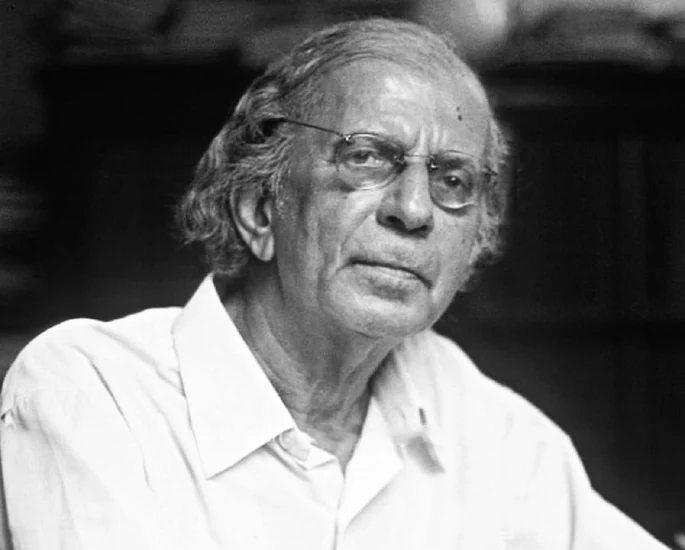
“Nissim Ezekiel transformed Indian English poetry through his wit, realism, and deep understanding of urban life. His works gave Indian English literature a distinct voice, combining simplicity of language with profound reflections on identity, society, and the human condition.”
Introduction
Nissim Ezekiel (1924–2004) was one of India’s most distinguished poets, playwrights, essayists, literary critics, and editors. Widely regarded as the father of modern Indian English poetry, he played a pivotal role in establishing Indian English literature as a respected and independent literary tradition.
Unlike many earlier Indian poets writing in English, Ezekiel moved away from romanticism and imitation of British literary styles. Instead, he wrote about contemporary Indian life with honesty, irony, humor, and psychological insight. His poetry explored everyday experiences, urban existence, personal identity, religion, love, loneliness, and the complexities of modern society.
Over a literary career spanning more than five decades, Ezekiel inspired generations of Indian writers and helped shape the evolution of Indian writing in English. His works remain central to the study of modern Indian literature.
Early Life
Nissim Ezekiel was born on 16 December 1924 in Bombay (now Mumbai), British India.
He belonged to a Bene Israel Jewish family, one of India’s oldest Jewish communities. His parents, Moses Ezekiel and Diana Ezekiel, were educators who deeply valued learning and intellectual development.
Growing up in cosmopolitan Bombay exposed Ezekiel to India’s cultural diversity, an influence that would later become a defining feature of his poetry.
Education
Ezekiel studied at Wilson College, Bombay, where he earned a degree in English literature.
His academic training introduced him to English literary traditions while reinforcing his interest in philosophy and psychology.
In 1948, he traveled to England, where he studied philosophy at Birkbeck College, University of London, while supporting himself through various jobs.
His stay abroad broadened his literary perspective but also strengthened his awareness of his Indian identity.
Return to India
After returning to Bombay in the early 1950s, Ezekiel devoted himself to literature, journalism, and education.
He worked in several capacities, including:
- Lecturer in English
- Literary editor
- Art critic
- Theatre enthusiast
- Broadcaster
- Magazine editor
He became actively involved in Mumbai’s vibrant literary and artistic circles, mentoring many young writers.
Literary Career
Nissim Ezekiel’s first poetry collection, A Time to Change, was published in 1952.
It marked the beginning of a new phase in Indian English poetry characterized by:
- Everyday language
- Urban themes
- Psychological realism
- Irony
- Self-examination
Over the following decades, he established himself as India’s leading English-language poet.
Major Poetry Collections
A Time to Change (1952)
His debut collection introduced readers to a fresh poetic voice that departed from conventional romanticism.
The poems reflect themes of personal growth, uncertainty, and the search for identity.
Sixty Poems (1953)
This volume strengthened Ezekiel’s reputation for technical precision and emotional honesty.
The Third (1959)
The poems reveal increasing confidence and philosophical maturity while examining modern relationships and urban life.
The Unfinished Man (1960)
One of his finest collections, it explores the imperfections of human existence, personal struggle, and moral uncertainty.
The Exact Name (1965)
This collection demonstrates Ezekiel’s growing mastery of irony, symbolism, and introspection.
Hymns in Darkness (1976)
Among his most acclaimed works, this collection reflects spiritual questioning, self-awareness, and the complexities of modern faith.
Latter-Day Psalms (1982)
His final major collection presents meditations on aging, mortality, and the search for meaning.
Famous Poems
Night of the Scorpion
Perhaps Ezekiel’s best-known poem, Night of the Scorpion recounts the experience of a village woman bitten by a scorpion.
The poem explores:
- Superstition and science
- Maternal love
- Rural traditions
- Human compassion
It concludes with the mother’s selfless gratitude that the scorpion had spared her children.
The Professor
This humorous poem presents a retired professor speaking in imperfect English.
Through gentle satire, Ezekiel comments on middle-class values, education, and social change.
Goodbye Party for Miss Pushpa T. S.
One of his most popular satirical poems, it humorously imitates the peculiar rhythms and expressions of Indian English while affectionately portraying office culture.
Enterprise
This philosophical poem describes a difficult journey that becomes a metaphor for human ambition, failure, and spiritual discovery.
It won the Sahitya Akademi Award in 1983.
The Patriot
Through irony and humor, Ezekiel examines nationalism and cultural identity while parodying stereotypical expressions of Indian English.
Themes in His Poetry
Urban Life
Unlike many earlier Indian poets who focused on nature or mythology, Ezekiel wrote about the realities of city life.
Bombay became one of the central “characters” in his poetry.
He explored:
- Crowded streets
- Middle-class existence
- Bureaucracy
- Loneliness
- Social relationships
Identity
As an Indian Jew writing in English, Ezekiel frequently reflected on questions of identity, belonging, and cultural heritage.
He embraced India’s diversity while acknowledging its contradictions.
Irony and Humor
Gentle irony is one of Ezekiel’s defining characteristics.
Rather than harsh criticism, he used humor to reveal human weaknesses with compassion and understanding.
Religion and Spirituality
Although deeply interested in religion, Ezekiel approached spiritual questions thoughtfully rather than dogmatically.
His poems often explore doubt, faith, and humanity’s search for meaning.
Human Imperfection
Many of his works emphasize that human beings are inherently imperfect.
Self-knowledge, humility, and acceptance become recurring themes.
Contributions Beyond Poetry
Nissim Ezekiel made important contributions as:
- Literary critic
- Editor
- Essayist
- Teacher
- Mentor
He edited influential literary journals and encouraged numerous young writers who later became leading figures in Indian English literature.
His critical writings helped establish high literary standards for Indian English writing.
Literary Style
Ezekiel’s poetry is admired for:
- Simplicity of language
- Precision of expression
- Conversational tone
- Intellectual clarity
- Subtle irony
- Psychological insight
- Controlled emotional depth
He demonstrated that profound ideas could be expressed through ordinary language without unnecessary ornamentation.
Awards and Honors
Nissim Ezekiel received many prestigious honors during his lifetime.
Among them are:
- Sahitya Akademi Award (1983) for Latter-Day Psalms (though the award recognized his contribution around this period, Enterprise from Latter-Day Psalms is often associated with his acclaim)
- Padma Shri (1988), one of India’s highest civilian honors
- Numerous literary fellowships and academic recognitions
His works remain widely studied in schools and universities across India.
Influence on Indian English Literature
Nissim Ezekiel fundamentally changed the course of Indian English poetry.
He inspired later generations of poets, including:
- Dom Moraes
- Kamala Das
- Jayanta Mahapatra
- A. K. Ramanujan
- Adil Jussawalla
- Gieve Patel
His insistence on authenticity encouraged writers to embrace Indian realities rather than imitate foreign literary models.
Final Years
In his later years, Ezekiel suffered from Alzheimer’s disease, which gradually affected his memory and health.
He passed away on 9 January 2004 in Mumbai at the age of seventy-nine.
His death marked the end of an extraordinary literary career, but his influence continues through his writings and the many writers he mentored.
Legacy
Today, Nissim Ezekiel is remembered as:
- The Father of Modern Indian English Poetry
- A pioneer of urban Indian literature
- A master of irony and realism
- A distinguished literary critic
- An inspiring teacher and mentor
His poetry remains an essential part of Indian literary studies and continues to resonate with readers because of its honesty, wit, and humanity.
Lessons from the Life of Nissim Ezekiel
Nissim Ezekiel’s life and works offer enduring lessons:
- Authenticity is the foundation of great literature.
- Everyday experiences can reveal profound truths.
- Humor and irony can illuminate society without bitterness.
- Cultural diversity enriches both literature and life.
- Self-awareness is essential for personal growth.
- Simplicity of language can convey deep philosophical insights.
- Writers have the responsibility to observe society honestly and compassionately.
Conclusion
Nissim Ezekiel occupies a unique place in the history of Indian literature as the pioneer who gave Indian English poetry its modern voice. Through his clear, thoughtful, and often humorous observations of everyday life, he transformed ordinary experiences into enduring works of art. His poems capture the complexities of urban existence, the search for identity, and the universal struggles of human beings with honesty, wit, and remarkable sensitivity.
More than two decades after his passing, Ezekiel’s legacy continues to shape Indian English literature. His commitment to authenticity, intellectual integrity, and artistic excellence has inspired generations of writers and readers alike, securing his place among the most influential literary figures of modern India.
Leave a Reply