

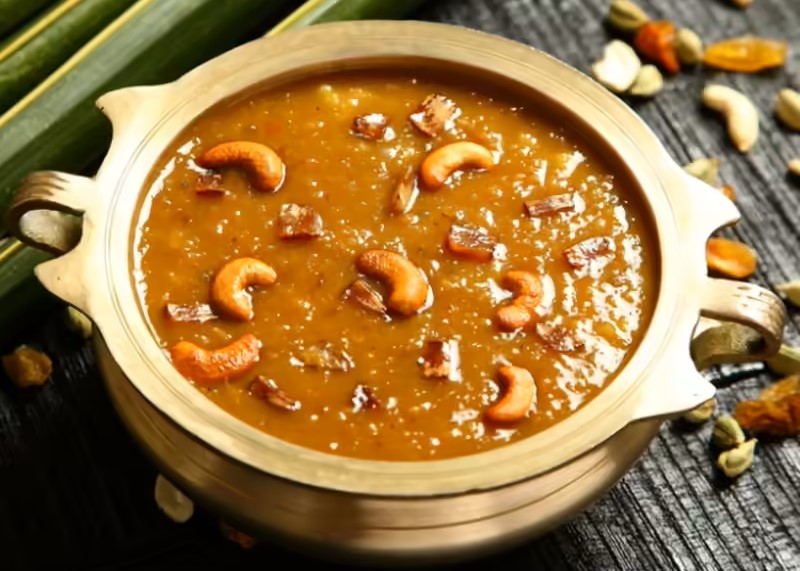
Parippu Payasam is one of the most cherished traditional desserts of Kerala. Made with moong dal (cherupayar parippu), jaggery and coconut milk, this rich and aromatic payasam is an important part of many traditional Onam Sadya menus.
Unlike Palada Payasam, which is primarily made with milk and sugar, Parippu Payasam gets its distinctive flavour from roasted lentils, jaggery and coconut milk. The addition of fried coconut pieces, cardamom and dry ginger gives it the unmistakable taste and aroma of a traditional Kerala pradhaman.
It is also known as Cherupayar Parippu Payasam when green gram dal is used, although recipes vary from household to household.
🌼 Recipe at a Glance
| Item | Details |
|---|---|
| Recipe | Parippu Payasam |
| Also known as | Cherupayar Parippu Payasam |
| Cuisine | Kerala |
| Category | Dessert / Payasam |
| Occasion | Onam, Vishu, weddings, temple festivals |
| Preparation Time | 10–15 minutes |
| Cooking Time | 35–45 minutes |
| Total Time | About 50–60 minutes |
| Serves | 6–8 people |
| Difficulty | Easy to Moderate |
| Main Dal | Moong dal / Cherupayar Parippu |
| Sweetener | Jaggery |
| Main Liquid | Coconut milk |
| Vegetarian | Yes |
| Vegan | Yes, when prepared with coconut oil instead of ghee |
🥥 Ingredients
Main Ingredients
- Yellow moong dal / Cherupayar parippu – 1 cup (approximately 180–200 g)
- Jaggery – 1½ to 2 cups (approximately 275–350 g), grated or powdered
- Thin coconut milk – 3 cups (750 ml)
- Thick coconut milk – 1 cup (250 ml)
- Water – approximately 3–4 cups, as required
- Ghee – 2 tablespoons
- Fresh coconut pieces – 2–3 tablespoons, cut into small pieces
- Cardamom powder – ½ teaspoon
- Dry ginger powder – ⅛ teaspoon or a small pinch
- Cumin powder – a small pinch, optional
- Salt – a tiny pinch
Optional Garnishing
- Cashews – 8–10
- Raisins – 1 tablespoon
- Extra fried coconut pieces
- A small pinch of roasted cumin powder
🌱 Choosing the Dal
The most commonly used dal for this payasam is split yellow moong dal.
Some Kerala households use cherupayar (whole green gram) or other locally preferred pulses, creating slightly different versions.
For the classic creamy Parippu Payasam:
Split yellow moong dal is an excellent choice.
👩🍳 Step-by-Step Preparation
Step 1: Clean the Dal
Take:
1 cup moong dal
Remove any stones or impurities.
Wash the dal 2–3 times under running water.
Drain well.
Step 2: Roast the Dal
Heat a heavy-bottomed pan over medium-low heat.
Add the washed and drained dal.
Dry roast for approximately 4–6 minutes, stirring continuously.
The dal should become lightly golden and fragrant.
Do not burn it.
The purpose of roasting is to:
- Enhance the flavour
- Bring out the natural nuttiness
- Improve the aroma
- Give the finished payasam greater depth
A light golden colour is sufficient.
Step 3: Cook the Dal
Transfer the roasted dal to a cooking vessel.
Add approximately:
3 cups water
Cook until the dal becomes completely soft.
Pressure cooker method
Cook for approximately 2–3 whistles, depending on the cooker and dal.
Allow the pressure to release naturally.
Stovetop method
Simmer over medium-low heat for approximately 20–30 minutes, or until soft.
The cooked dal should be tender enough to mash easily.
Step 4: Mash the Cooked Dal
Once the dal is cooked, mash it lightly using a ladle or potato masher.
Do not make it completely smooth.
A slightly textured consistency gives traditional Parippu Payasam a pleasant character.
Ideal texture
Soft + creamy + slightly grainy
Step 5: Prepare the Jaggery Syrup
Place:
1½–2 cups jaggery
in a saucepan.
Add approximately:
½–1 cup water
Heat gently until the jaggery completely dissolves.
Strain the syrup through a fine sieve to remove impurities.
Keep aside.
Why strain the jaggery?
Traditional jaggery can contain small particles or impurities. Straining gives the payasam a cleaner texture.
Step 6: Combine Dal and Jaggery
Add the strained jaggery syrup to the cooked dal.
Mix thoroughly.
Cook over medium-low heat for approximately 8–10 minutes.
Stir frequently.
The dal will gradually absorb the jaggery and develop a beautiful golden-brown colour.
Step 7: Add Thin Coconut Milk
Add:
3 cups thin coconut milk
Mix well.
Simmer over low to medium heat for approximately 8–12 minutes.
Stir occasionally.
The mixture should become smooth and moderately thick.
Important
Do not cook at excessively high heat.
Jaggery can cause the mixture to stick easily to the bottom of the vessel.
Step 8: Add Thick Coconut Milk
Reduce the flame to very low.
Add:
1 cup thick coconut milk
Mix gently.
Heat for only approximately 2–3 minutes.
⚠️ Do Not Boil
Once thick coconut milk is added, avoid vigorous boiling.
Excessive heat can cause the coconut milk to separate.
The aim is simply to heat it through and combine the flavours.
Step 9: Add the Spices
Add:
- ½ teaspoon cardamom powder
- A small pinch of dry ginger powder
- Tiny pinch of salt
Optional:
- A tiny pinch of roasted cumin powder
Mix gently.
Turn off the flame.
Step 10: Prepare the Fried Coconut
Heat:
2 tablespoons ghee
in a small pan.
Add the coconut pieces.
Fry over medium-low heat until they become golden brown.
The coconut pieces should be crisp on the outside but not burnt.
Step 11: Fry the Cashews and Raisins
If using them, add:
- Cashews
- Raisins
to the same pan.
Fry until:
- Cashews become golden
- Raisins puff up
Turn off the flame.
Step 12: Add the Garnish
Add the fried coconut pieces, cashews and raisins to the payasam.
Mix gently.
The aroma of roasted coconut and ghee will immediately enhance the dish.
Step 13: Allow the Payasam to Rest
Let the Parippu Payasam rest for approximately:
20–30 minutes
before serving.
This allows:
- The dal to absorb the flavours
- The jaggery to blend fully
- The coconut milk to settle
- The spices to release their aroma
The payasam will also become thicker as it cools.
🍮 Ideal Consistency
Parippu Payasam should not be excessively watery.
It should be:
Creamy + flowing + moderately thick
When you lift a spoon, the payasam should coat it lightly but still flow easily.
Remember:
Payasam should be slightly thinner in the cooking vessel than you want it on the serving table.
It thickens naturally as it cools.
🌼 Serving Suggestions
Parippu Payasam is traditionally served as part of a Kerala Sadya, especially during Onam and other important celebrations.
Suggested serving size
Approximately:
½–¾ cup per person
For an Onam Sadya, serve it toward the end of the meal.
It can be served:
- In a traditional steel bowl
- In a small brass vessel
- On a banana leaf
- In a traditional payasam cup
- Alongside pappadam and banana
🍌 Traditional Payasam Combination
One of the most enjoyable Kerala Sadya traditions is eating payasam with:
Payasam + Pappadam + Banana
Break a small piece of crispy pappadam into the payasam and combine it with a little ripe banana.
The combination of:
sweet + creamy + crisp + soft
creates a distinctive Kerala Sadya experience.
⭐ Tips for Perfect Parippu Payasam
1. Roast the dal properly
Light roasting makes a significant difference to the flavour.
Do not roast until dark brown.
2. Cook the dal until very soft
Undercooked dal will produce a coarse and unpleasant texture.
3. Don’t puree the dal completely
A slightly textured dal gives the payasam a more traditional character.
4. Use good-quality jaggery
Jaggery determines much of the colour, sweetness and flavour.
5. Always strain the jaggery
This helps remove unwanted impurities.
6. Use fresh coconut milk when possible
Freshly extracted coconut milk gives the best traditional flavour.
7. Add thick coconut milk at the end
It should never be subjected to vigorous boiling.
8. Don’t add too much water
Excess water can make the payasam thin and dilute the flavour.
9. Keep stirring
The combination of dal and jaggery can stick easily to the bottom.
10. Adjust sweetness after cooking
Jaggery varies considerably in sweetness.
Taste before adding additional jaggery.
11. Don’t overdo the spices
Cardamom, dry ginger and cumin should enhance the payasam—not dominate it.
12. Allow it to rest
The flavour becomes noticeably better after resting for a short time.
🥥 How to Prepare Fresh Coconut Milk
Fresh coconut milk gives Parippu Payasam its traditional character.
First Extraction – Thick Coconut Milk
- Grate fresh coconut.
- Add a small amount of warm water.
- Grind thoroughly.
- Squeeze through a clean strainer.
- Collect the thick milk.
Set it aside.
Second Extraction – Thin Coconut Milk
- Add more warm water to the coconut residue.
- Grind again.
- Squeeze and strain.
This produces thin coconut milk.
Traditional order
Thin coconut milk → used during cooking
Thick coconut milk → added near the end
🌴 Traditional Kerala Cooking Method
For a traditional Onam preparation, Parippu Payasam can be cooked in a uruli, the wide bronze cooking vessel associated with Kerala cuisine.
The broad base provides excellent heat distribution and allows the payasam to cook slowly.
For large quantities, a heavy-bottomed stainless-steel vessel can also be used successfully.
🌱 Vegetarian and Vegan Notes
Vegetarian
Parippu Payasam is naturally vegetarian.
Traditional recipes commonly use ghee for frying the coconut pieces.
Vegan Version
The recipe can easily be made vegan.
Simply replace:
Ghee → Coconut oil
All the principal ingredients are plant-based:
- Moong dal
- Jaggery
- Coconut milk
- Coconut
- Cardamom
- Dry ginger
- Cumin
Vegan tip
Use a good-quality coconut oil, but don’t use too much. Excess coconut oil can overpower the delicate flavour of the payasam.
🍯 Variations of Parippu Payasam
1. Cherupayar Parippu Payasam
Use lightly roasted split green gram or cherupayar parippu.
This is one of the most familiar traditional versions.
2. Whole Green Gram Payasam
Use cooked whole green gram instead of split moong dal.
The result has:
- More texture
- A stronger pulse flavour
- A rustic appearance
3. Extra Coconut Version
Increase the quantity of fried coconut pieces.
This produces a more intensely coconut-flavoured payasam.
4. Palm Jaggery Version
Replace ordinary jaggery with palm jaggery.
This produces a deeper, more complex sweetness.
5. Coconut Sugar Version
Jaggery can be replaced with coconut sugar for an alternative version.
The flavour will be somewhat different from traditional Kerala Parippu Payasam.
6. Cashew-Rich Version
Add roasted cashews generously for a richer festive preparation.
7. Banana Parippu Payasam
A small quantity of mashed ripe Kerala banana can be added for a naturally fruity variation.
Use a sweet, ripe banana and adjust the jaggery accordingly.
8. Saffron Variation
A few strands of saffron can be added for a modern festive presentation.
This is not necessary for a traditional Kerala version, but it gives an attractive aroma.
🍚 Parippu Payasam for a Large Onam Sadya
If you are preparing payasam for a large gathering, the following approximate quantities can be used.
| Servings | Moong Dal | Jaggery | Thin Coconut Milk | Thick Coconut Milk |
|---|---|---|---|---|
| 4 | ½ cup | ¾–1 cup | 1½ cups | ½ cup |
| 8 | 1 cup | 1½–2 cups | 3 cups | 1 cup |
| 15 | 2 cups | 3–4 cups | 6 cups | 2 cups |
| 25 | 3 cups | 4½–6 cups | 9 cups | 3 cups |
| 50 | 6 cups | 9–12 cups | 18 cups | 6 cups |
These are approximate quantities. Adjust jaggery and liquid according to the desired sweetness and consistency.
🥄 How to Fix Common Problems
Problem: Payasam is too thick
Add a little warm thin coconut milk or warm water.
Mix gently.
Problem: Payasam is too thin
Simmer over low heat for a few more minutes.
Do not add thick coconut milk and then boil aggressively.
Problem: Payasam is too sweet
Add a little additional thin coconut milk and a tiny pinch of salt.
Problem: Payasam is not sweet enough
Prepare a small quantity of jaggery syrup separately, strain it and add gradually.
Problem: Dal is still hard
Add a little hot water and continue cooking until completely soft before proceeding.
Problem: Coconut milk separated
The likely cause is excessive heat after adding thick coconut milk.
Reduce the heat and stir gently.
The texture may not completely recover, but the payasam can still be served.
Problem: Payasam tastes smoky or burnt
If the bottom has burned, do not scrape the burnt portion into the payasam.
Immediately transfer the unburnt upper portion to another vessel.
🧊 Storage
Allow the payasam to cool before storing.
Transfer it to a clean, covered container.
Refrigerator
For best quality, consume within approximately 2–3 days.
Because coconut milk is used, proper refrigeration is important.
Reheating
Reheat gently over low heat.
Add a little warm coconut milk or water if it has become too thick.
Avoid vigorous boiling.
❓ Frequently Asked Questions
Is Parippu Payasam the same as Ada Pradhaman?
No.
Both are traditional Kerala jaggery-based payasams, but the principal ingredient differs.
Ada Pradhaman: rice ada + jaggery + coconut milk
Parippu Payasam: moong dal + jaggery + coconut milk
Is Parippu Payasam the same as Payar Payasam?
They can refer to closely related preparations, but terminology varies across Kerala households and regions.
Payar generally refers to legumes, while parippu means dal.
Can I use chana dal?
Yes, but it will produce a substantially different flavour and texture.
For the classic version, moong dal is recommended.
Can I use canned coconut milk?
Yes.
Use full-fat canned coconut milk and dilute part of it with water to create thin coconut milk.
Reserve the thicker portion for the final stage.
Can I use coconut milk powder?
Yes.
Prepare it according to the manufacturer’s instructions.
For a traditional flavour, fresh coconut milk is preferable.
Can I use sugar instead of jaggery?
You can, but the resulting dessert will no longer have the characteristic taste of traditional Parippu Payasam.
Jaggery is strongly recommended.
Can I make Parippu Payasam without ghee?
Yes.
Simply omit the ghee or replace it with coconut oil for a vegan version.
Can I prepare it one day ahead?
Yes.
In fact, the flavour often develops further after resting.
However, refrigerate it promptly and adjust the consistency with a little warm coconut milk when serving.
🥇 Traditional vs. Quick Parippu Payasam
| Feature | Traditional Method | Quick Method |
|---|---|---|
| Dal | Roasted and cooked slowly | Pressure cooked |
| Coconut milk | Freshly extracted | Packaged |
| Jaggery | Melted and strained | Ready syrup |
| Cooking vessel | Uruli/heavy vessel | Pressure cooker + pan |
| Cooking time | Longer | Shorter |
| Flavour | Deep and traditional | Convenient and good |
| Best for | Onam Sadya / celebrations | Everyday preparation |
For a special Onam Sadya, the traditional method is worth the extra time.
🍽️ Suggested Onam Payasam Menu
If you are serving several desserts at an Onam Sadya, Parippu Payasam pairs particularly well with:
Payasam 1
Parippu Payasam
Jaggery + moong dal + coconut milk
Payasam 2
Palada Payasam
Milk + sugar + rice ada
Payasam 3
Ada Pradhaman
Jaggery + rice ada + coconut milk
These three provide three very different flavour profiles.
📋 Quick Recipe Card
PARIPPU PAYASAM
Traditional Kerala Moong Dal & Jaggery Payasam
Ingredients
- 1 cup moong dal
- 1½–2 cups jaggery
- 3 cups thin coconut milk
- 1 cup thick coconut milk
- 2 tbsp ghee
- 2–3 tbsp coconut pieces
- ½ tsp cardamom
- Pinch of dry ginger
- Pinch of salt
- Cashews and raisins, optional
Method
1. Wash and lightly roast the dal.
2. Cook until completely soft.
3. Mash lightly.
4. Melt and strain the jaggery.
5. Combine jaggery syrup with the cooked dal.
6. Add thin coconut milk.
7. Simmer gently for 8–12 minutes.
8. Add thick coconut milk.
9. Heat gently without boiling.
10. Add cardamom, dry ginger and salt.
11. Fry coconut pieces in ghee.
12. Add coconut, cashews and raisins.
13. Rest for 20–30 minutes.
14. Serve warm or at room temperature.
⏱️ Time
Preparation: 10–15 minutes
Cooking: 35–45 minutes
Total: 50–60 minutes
🍮 Serves
6–8 people
🌱 Dietary
Vegetarian: Yes
Vegan: Yes, when ghee is replaced with coconut oil
🌼 Cultural Significance
Parippu Payasam is deeply connected with the culinary heritage of Kerala. Its ingredients are simple and traditionally familiar—dal, coconut, jaggery and spices—yet their combination creates a dessert worthy of the most important celebrations.
During Onam, the payasam represents more than sweetness. It forms part of the abundance and hospitality of the Onasadya, a meal in which numerous dishes are brought together and shared.
The preparation also reflects a characteristic Kerala culinary philosophy:
Simple ingredients + careful cooking + patience = extraordinary flavour.
❤️ The Taste of Traditional Kerala
A well-made Parippu Payasam should bring together:
the nuttiness of roasted dal,
the deep sweetness of jaggery,
the richness of coconut milk,
the aroma of cardamom,
the warmth of dry ginger,
and the delicate crunch of fried coconut.
It is comforting, festive and unmistakably Kerala.
🌸 Parippu Payasam — A Sweet Tradition of Onam
From a family kitchen to a large Onam Sadya, Parippu Payasam continues to hold a special place in Kerala’s food culture.
ഓണസദ്യയുടെ മധുരത്തിൽ, പരിപ്പുപായസത്തിന് ഒരു പ്രത്യേക സ്ഥാനമുണ്ട്.
Happy Onam! 🌼
ഓണാശംസകൾ!
Leave a Reply