

World Rock Paper Scissors Day is observed annually on August 27, celebrating one of the world’s simplest, most recognizable, and surprisingly strategic hand games.
Known in many countries simply as Rock Paper Scissors (RPS), the game requires no equipment, no playing field, and only two players. With three hand gestures, players can make decisions, settle friendly disputes, play competitively, or simply enjoy a quick game.
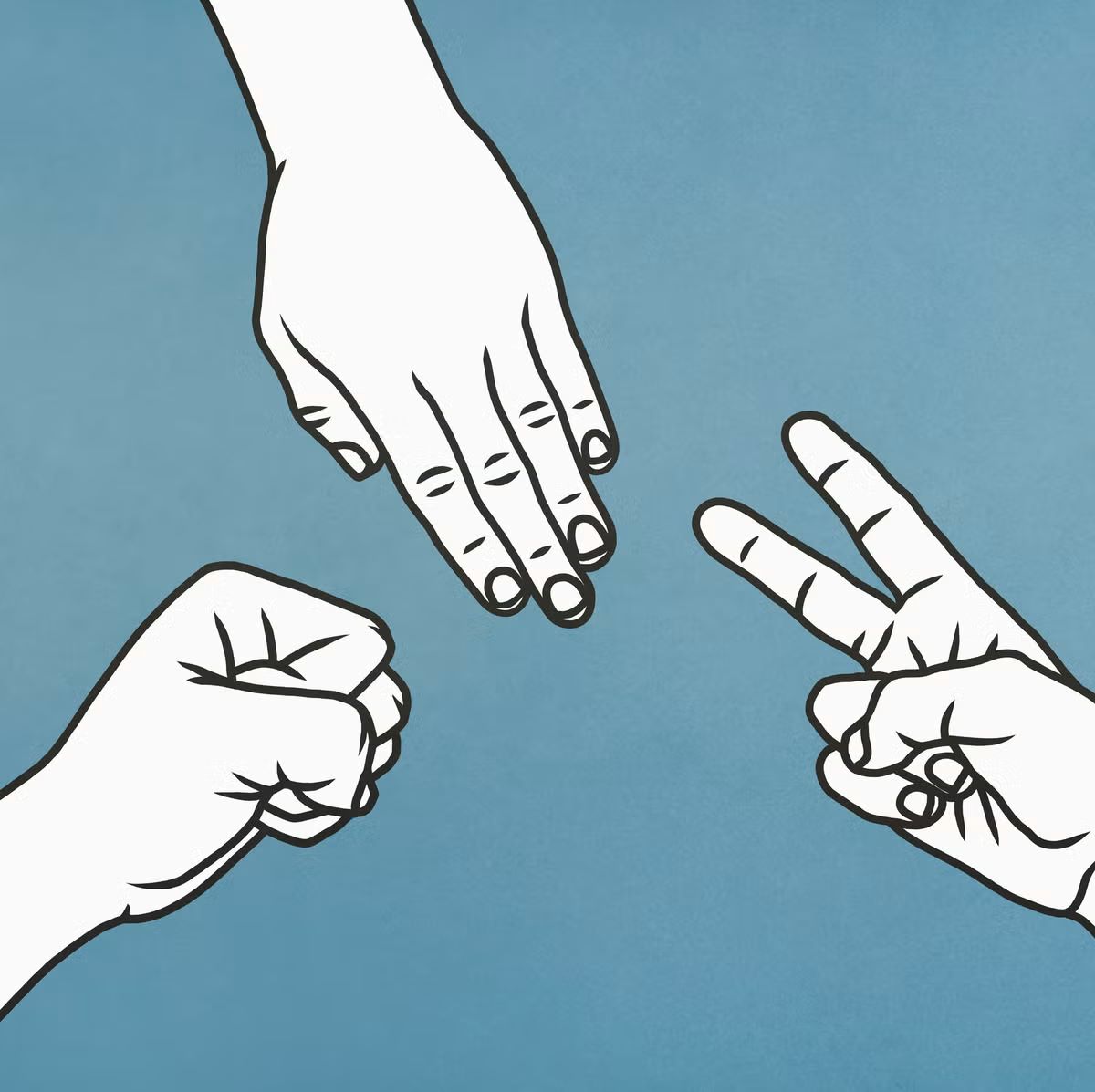
The three choices are:
- ✊ Rock — beats Scissors
- 📄 Paper — beats Rock
- ✂️ Scissors — beats Paper
The circular relationship makes the game balanced: Rock beats Scissors, Scissors beats Paper, and Paper beats Rock.
📅 What Is World Rock Paper Scissors Day?
World Rock Paper Scissors Day is a fun awareness day dedicated to this universally recognizable game.
It provides an opportunity to appreciate a game that combines:
- Chance
- Psychology
- Decision-making
- Observation
- Strategy
- Competition
- Social interaction
Although Rock Paper Scissors is often considered a children’s game, organized competitions demonstrate that adults can take it surprisingly seriously.
✊📄✂️ How to Play Rock Paper Scissors
The rules are extremely simple.
Two players stand or sit facing one another.
Together they count:
“Rock… Paper… Scissors… Shoot!”
On “Shoot,” both players simultaneously display one of the three gestures.
✊ Rock
Make a closed fist.
Rock beats Scissors.
📄 Paper
Hold your hand flat with the palm facing downward or toward the opponent.
Paper beats Rock.
✂️ Scissors
Extend the index and middle fingers in a V shape.
Scissors beats Paper.
🏆 The Three Rules
| Your Choice | Beats | Loses To |
|---|---|---|
| ✊ Rock | ✂️ Scissors | 📄 Paper |
| 📄 Paper | ✊ Rock | ✂️ Scissors |
| ✂️ Scissors | 📄 Paper | ✊ Rock |
If both players make the same gesture, the round is a tie and is normally played again.
🔺 The Secret of the Game: The Triangle
The genius of Rock Paper Scissors is its circular structure.
There is no universally strongest choice.
Rock → beats → Scissors
Scissors → beats → Paper
Paper → beats → Rock
This creates a simple three-way balance similar to a triangle.
If someone always chooses Rock, another player can counter with Paper.
If someone prefers Paper, Scissors can defeat it.
If someone repeatedly uses Scissors, Rock can defeat it.
This makes the game much more interesting than simply choosing the strongest object.
🧠 Is Rock Paper Scissors Really a Game of Chance?
Not entirely.
A single round between players who choose randomly is essentially a game of chance. However, when people play repeatedly, psychology and strategy become important.
Players may unconsciously develop patterns.
For example, someone might:
- Repeat a winning choice.
- Change after losing.
- Avoid repeating the same gesture.
- Choose Rock more often because it feels powerful.
- Assume an opponent will not choose the same gesture twice.
- Try to predict what the opponent expects them to do.
Experienced players therefore pay attention not only to the current choice but also to the opponent’s behavior and patterns.
🧠 The Psychology Behind Rock Paper Scissors
Rock Paper Scissors provides a surprisingly interesting example of human decision-making.
Suppose you win a round using Rock.
Your opponent may think:
“I’ll use Paper next time because Paper beats Rock.”
You might anticipate this and choose Scissors.
But your opponent may anticipate your thinking and choose Rock again.
This produces a fascinating chain of strategic reasoning.
The game can therefore become:
What will you choose?
↓
What do you think I will choose?
↓
What do you think I think you will choose?
And so on.
🎲 The Importance of Randomness
In serious Rock Paper Scissors competition, randomness is extremely important.
If your opponent can accurately predict your next move, they can exploit your strategy.
For example, if you choose:
- Rock 60% of the time
- Paper 30% of the time
- Scissors 10% of the time
your opponent could recognize the pattern and adjust accordingly.
An ideal strategy in a basic three-choice game is to select each option with approximately equal probability:
Rock — ⅓
Paper — ⅓
Scissors — ⅓
This makes your choice difficult to predict.
🌏 The History of Rock Paper Scissors
Rock Paper Scissors has a long history, although its modern international form developed relatively recently.
The game is generally associated with traditional Chinese hand games and later Japanese versions.
A Chinese game known as shoushiling and other related hand games involved gestures representing different objects or concepts.
The game became particularly established in Japan, where versions known as jan-ken developed.
The Japanese form eventually became widely known outside Japan and evolved into the familiar international version of:
Rock – Paper – Scissors.
🇯🇵 Rock Paper Scissors in Japan
In Japan, the game is commonly called Janken (じゃんけん).
Janken is much more than a children’s pastime.
It can be used to:
- Decide who goes first.
- Choose between alternatives.
- Settle minor disagreements.
- Select team members.
- Determine who performs a task.
- Make everyday decisions.
Japanese children commonly learn the game at an early age.
The familiar chant “Jan-ken-pon!” accompanies the simultaneous hand gestures.
🌎 Rock Paper Scissors Around the World
Different cultures have developed their own versions, names and gestures.
Some versions use objects or gestures beyond the traditional three.
Examples include games that incorporate:
- Well
- Fire
- Water
- Snake
- Gun
- Human
- Lightning
However, adding too many options can make the game more complicated.
The traditional three-choice version remains popular because of its elegant simplicity.
🏅 Competitive Rock Paper Scissors
Rock Paper Scissors has developed into a competitive activity.
Organized competitions have attracted players who study:
- Probability
- Human behavior
- Pattern recognition
- Game theory
- Bluffing
- Psychological tendencies
Competitive players may attempt to disguise their habits and introduce unpredictability into their choices.
Some competitions use several rounds, with the player winning the most rounds declared the winner.
📐 Rock Paper Scissors and Game Theory
Rock Paper Scissors is a classic example used to explain concepts from game theory.
The game demonstrates the concept of a mixed strategy.
Because each choice defeats one option and loses to another, there is no single dominant move.
If players behave rationally and have no information about their opponent’s future choice, a balanced strategy is to randomize equally among the three options.
This makes Rock Paper Scissors a simple but useful example of strategic interaction.
🤖 Rock Paper Scissors and Artificial Intelligence
Rock Paper Scissors has also become an interesting subject in computer science and artificial intelligence.
A computer can simply generate random choices.
But a more sophisticated program can attempt to analyze a player’s previous choices and predict their next move.
AI systems can examine:
- Frequency of choices
- Repetition patterns
- Responses to winning
- Responses to losing
- Timing
- Behavioral tendencies
This transforms a simple children’s game into a small laboratory for studying prediction and adaptive decision-making.
👧 Why Children Love Rock Paper Scissors
Rock Paper Scissors is especially suitable for children because it is:
Simple
The rules can be learned within seconds.
Cheap
No equipment is necessary.
Portable
It can be played almost anywhere.
Fast
A round takes only a few seconds.
Social
Children interact directly with one another.
Educational
It introduces basic ideas of probability, strategy and decision-making.
🎓 Educational Benefits
Teachers can use Rock Paper Scissors as a fun educational activity.
It can introduce students to:
Mathematics
Probability and statistics.
Psychology
Human decision-making and behavioral patterns.
Computer Science
Algorithms and prediction.
Game Theory
Strategic decision-making.
Social Skills
Taking turns, following rules and accepting outcomes.
Physical Coordination
Learning and producing specific hand gestures.
🎉 How to Celebrate World Rock Paper Scissors Day
There are many simple ways to celebrate.
1. Organize a Rock Paper Scissors Tournament
Create a knockout competition.
Players compete in pairs, and winners advance to the next round.
2. Classroom Challenge
Teachers can organize a short tournament among students.
The winner can receive a small certificate such as:
“Rock Paper Scissors Champion.”
3. Family Competition
Play Rock Paper Scissors with parents, brothers, sisters and friends.
Keep a scoreboard and see who becomes the family champion.
4. International Tournament
Schools or clubs can organize an online or in-person tournament involving participants from different locations.
5. Mathematics Activity
Ask students to calculate the probability of winning a single round when both players choose randomly.
There are nine equally likely combinations:
- Rock vs Rock
- Rock vs Paper
- Rock vs Scissors
- Paper vs Rock
- Paper vs Paper
- Paper vs Scissors
- Scissors vs Rock
- Scissors vs Paper
- Scissors vs Scissors
Three produce wins for the first player, three produce losses and three produce ties.
Therefore:
Probability of winning = 1/3
Probability of losing = 1/3
Probability of a tie = 1/3
when both players choose randomly and independently.
🧩 Fun Rock Paper Scissors Variations
The traditional game can be modified for additional fun.
Best of Three
The first player to win two rounds wins.
Best of Five
The first player to win three rounds becomes champion.
Giant Rock Paper Scissors
Teams compete against one another using large body movements.
Rock Paper Scissors Relay
Combine the game with a relay race.
Tournament Ladder
Players challenge the person above them on a classroom ranking ladder.
🌟 Interesting Facts
1. It needs no equipment
The entire game can be played with just your hands.
2. It works almost anywhere
You can play it at home, at school, outdoors or while traveling.
3. It can settle decisions
People sometimes use it to make quick choices when two alternatives seem equally attractive.
4. It has mathematical depth
Despite its simplicity, the game is a useful example of probability and game theory.
5. It has international variations
Different cultures have developed their own versions and names.
6. Humans can be predictable
People often develop unconscious patterns when making repeated choices.
7. Randomness matters
A player who becomes too predictable gives an opponent an advantage.
🤔 Can You Become a Rock Paper Scissors Expert?
You can certainly improve your play.
A few useful principles are:
Don’t become predictable.
If you repeatedly choose the same gesture, your opponent may notice.
Observe your opponent.
Look for repeated behavioral patterns.
Don’t assume complicated psychology always works.
Sometimes your opponent really is choosing randomly.
Mix strategy with unpredictability.
In repeated games, a balance between observation and randomness can be more effective than relying on a fixed pattern.
🌿 A Simple Lesson from a Simple Game
Rock Paper Scissors teaches an interesting lesson:
There is rarely one choice that is always best.
A strategy that succeeds in one situation may fail in another.
The game encourages us to:
- Think before acting.
- Observe others.
- Adapt to changing situations.
- Accept both winning and losing.
- Avoid becoming predictable.
- Understand that uncertainty is part of decision-making.
✊📄✂️ World Rock Paper Scissors Day Message
“Sometimes the simplest games teach us the most important lessons: think carefully, play fairly, adapt quickly, and accept the result with a smile.”
On World Rock Paper Scissors Day, challenge a friend, organize a tournament, teach a child the game, or simply enjoy a few rounds of this timeless pastime.
Rock. Paper. Scissors. Shoot!
✊ Rock beats Scissors.
📄 Paper beats Rock.
✂️ Scissors beats Paper.
And remember—the real winner is the person who plays fairly, has fun, and enjoys the moment!
Happy World Rock Paper Scissors Day! ✊📄✂️
:::
Leave a Reply