

Nelsapy – General Knowledge Question Bank
Introduction
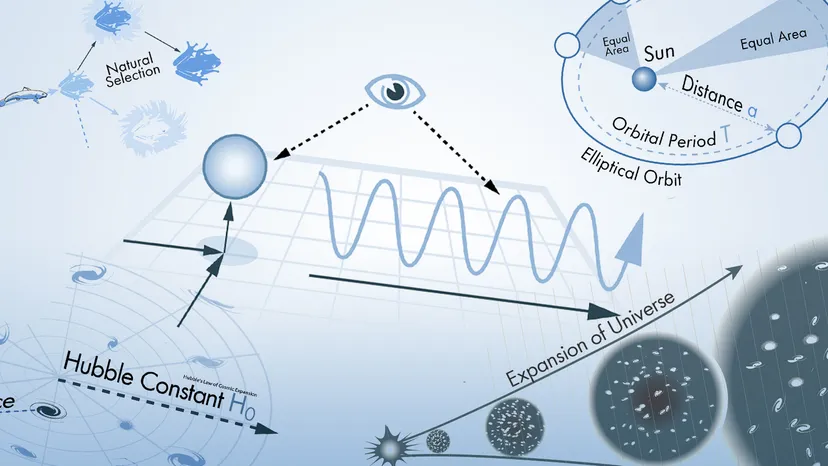
Scientific laws and principles explain the fundamental rules that govern the natural world. They help us understand how matter, energy, motion, gravity, electricity, light, heat and living organisms behave.
This collection of 125 general knowledge questions covers important scientific laws and principles from physics, chemistry, biology, astronomy and other branches of science. It is useful for students, competitive examinations, quiz programmes and general knowledge enthusiasts.
Instructions
- Read each question carefully.
- Try to answer all questions before checking the answer key.
- Each question has one correct answer.
- The complete answer key is provided at the end.
Section 1: Laws and Principles of Physics
1. Who formulated the three laws of motion?
2. Which law states that an object remains at rest or in uniform motion unless acted upon by an external force?
3. What is Newton’s First Law of Motion also known as?
4. Which law states that force equals mass multiplied by acceleration?
5. What does Newton’s Third Law of Motion state?
6. Who formulated the universal law of gravitation?
7. Which law explains the gravitational attraction between two masses?
8. What is the SI unit of force?
9. Which principle states that pressure applied to an enclosed fluid is transmitted equally in all directions?
10. Who formulated Pascal’s principle?
11. Which principle explains why objects float or sink in fluids?
12. Who discovered the principle of buoyancy?
13. What does Archimedes’ principle state?
14. Which law states that the pressure of a gas is inversely proportional to its volume at constant temperature?
15. Who formulated Boyle’s Law?
16. Which gas law states that the volume of a gas is directly proportional to its absolute temperature at constant pressure?
17. Which law states that equal volumes of gases at the same temperature and pressure contain equal numbers of molecules?
18. Who proposed Avogadro’s Law?
19. Which principle states that the total energy of an isolated system remains constant?
20. What is the principle of conservation of energy?
Section 2: Laws of Heat, Thermodynamics and Waves
21. Which law of thermodynamics states that energy cannot be created or destroyed?
22. Which law of thermodynamics introduces the concept of entropy?
23. What does the Zeroth Law of Thermodynamics establish?
24. Which law states that the entropy of a perfect crystal approaches zero at absolute zero temperature?
25. What is the SI unit of temperature?
26. Which law explains the relationship between heat energy and temperature change?
27. Who formulated the law of cooling?
28. What does Newton’s Law of Cooling describe?
29. Which principle states that the frequency of a wave remains unchanged when it passes from one medium to another?
30. What is the Doppler Effect?
31. Which phenomenon explains the bending of light when it passes from one medium to another?
32. What is the law of reflection?
33. Which law states that the angle of incidence equals the angle of reflection?
34. Who formulated the mathematical law of refraction known as Snell’s Law?
35. What is the principle of superposition of waves?
Section 3: Laws of Electricity and Magnetism
36. Who formulated Ohm’s Law?
37. What does Ohm’s Law state?
38. What is the SI unit of electrical resistance?
39. Which law states that the current induced in a circuit opposes the change that produces it?
40. Who formulated Lenz’s Law?
41. Which law explains the relationship between changing magnetic flux and induced electromotive force?
42. Who discovered electromagnetic induction?
43. Which law states that the force between two electric charges is proportional to the product of their charges and inversely proportional to the square of the distance between them?
44. Who formulated Coulomb’s Law?
45. What is the SI unit of electric charge?
46. Which law states that the total electric flux through a closed surface is proportional to the charge enclosed?
47. Who formulated Gauss’s Law for electricity?
48. Which principle explains the conservation of electric charge?
49. What does Kirchhoff’s Current Law state?
50. What does Kirchhoff’s Voltage Law state?
51. Which law relates the magnetic field around a closed loop to the electric current passing through it?
52. Who formulated the laws of electromagnetic induction?
53. Which scientist unified electricity and magnetism through a set of fundamental equations?
54. What are Maxwell’s equations primarily concerned with?
55. Which rule is commonly used to determine the direction of force on a current-carrying conductor in a magnetic field?
Section 4: Laws of Chemistry
56. Who proposed the Law of Conservation of Mass?
57. What does the Law of Conservation of Mass state?
58. Which law states that a pure chemical compound always contains the same elements in the same proportion by mass?
59. Who formulated the Law of Definite Proportions?
60. Which law states that when two elements form more than one compound, the masses of one element combining with a fixed mass of the other are in simple whole-number ratios?
61. Who proposed the Law of Multiple Proportions?
62. Which law states that the total pressure of a mixture of non-reacting gases equals the sum of their individual partial pressures?
63. Who formulated Dalton’s Law of Partial Pressures?
64. What does the Law of Combining Volumes describe?
65. Who proposed the Law of Combining Volumes?
66. Which principle states that increasing the concentration of a reactant shifts equilibrium in a direction that tends to reduce that change?
67. Who introduced the principle of Le Chatelier?
68. What does the periodic law explain?
69. Who is widely credited with developing the modern periodic table?
70. Which principle states that electrons occupy the lowest available energy levels first?
71. Who formulated the Aufbau principle?
72. What does the Pauli Exclusion Principle state?
73. Who formulated the Pauli Exclusion Principle?
74. Which rule states that electrons occupy degenerate orbitals singly before pairing?
75. Who formulated Hund’s Rule?
Section 5: Laws and Principles of Biology
76. Who formulated the three fundamental laws of inheritance?
77. What is Mendel’s Law of Segregation?
78. What does the Law of Independent Assortment state?
79. Which principle states that living organisms are made up of cells?
80. Who are commonly credited with formulating the cell theory?
81. Who stated that all cells arise from pre-existing cells?
82. Which principle explains the survival and reproduction of organisms with favourable inherited variations?
83. Who proposed the theory of natural selection?
84. Which book introduced Charles Darwin’s theory of evolution by natural selection?
85. What is the Hardy-Weinberg principle concerned with?
86. Which principle states that energy flows through an ecosystem while nutrients are recycled?
87. What does Liebig’s Law of the Minimum explain?
88. Who proposed the Law of the Minimum?
89. Which principle states that the total biomass or energy available generally decreases at higher trophic levels?
90. What is the commonly cited 10% law of energy transfer in ecology?
91. Who proposed the 10% law of energy transfer?
92. Which principle explains that organisms maintain relatively stable internal conditions?
93. Who introduced the term homeostasis?
94. What is the central dogma of molecular biology?
95. Who proposed the central dogma of molecular biology?
Section 6: Laws of Astronomy and Space Science
96. Who formulated the three laws of planetary motion?
97. What does Kepler’s First Law state?
98. What does Kepler’s Second Law state?
99. What does Kepler’s Third Law relate?
100. Which law explains the relationship between the orbital period and average distance of a planet from the Sun?
101. Who formulated the law of universal gravitation?
102. Which principle explains why planets remain in orbit around the Sun?
103. What is Hubble’s Law concerned with?
104. Who is associated with the discovery of the relationship between the distance of galaxies and their recession velocity?
105. What does Hubble’s Law suggest about the universe?
106. Which law describes the relationship between a star’s luminosity and its apparent brightness at a given distance?
107. What is the inverse-square law of light?
108. Which principle explains that the speed of light in a vacuum is constant for all inertial observers?
109. Who developed the special theory of relativity?
110. What is the famous equation associated with mass-energy equivalence?
Section 7: Important Mathematical and General Scientific Principles
111. Which theorem states that the square of the hypotenuse of a right-angled triangle equals the sum of the squares of the other two sides?
112. Who is traditionally credited with the Pythagorean theorem?
113. Which principle states that the shortest distance between two points in Euclidean geometry is a straight line?
114. What does the Archimedean property in mathematics describe?
115. Which mathematical principle is used to prove statements about all positive integers?
116. What is the principle of mathematical induction?
117. Which principle states that the whole is greater than any of its proper parts in the context of finite sets?
118. What does the uncertainty principle state?
119. Who formulated the uncertainty principle?
120. Which principle states that no information or signal can travel faster than the speed of light in a vacuum according to special relativity?
121. What is the equivalence principle in Einstein’s theory of gravity?
122. Which principle states that the laws of physics are the same in all inertial reference frames?
123. What does the correspondence principle in quantum mechanics state?
124. Which principle states that physical laws should not change under a change of inertial reference frame?
125. What is the anthropic principle concerned with?
Answer Key
Section 1: Laws and Principles of Physics
- Isaac Newton.
- Newton’s First Law of Motion.
- The Law of Inertia.
- Newton’s Second Law of Motion.
- For every action, there is an equal and opposite reaction.
- Isaac Newton.
- Newton’s Universal Law of Gravitation.
- Newton (N).
- Pascal’s Principle.
- Blaise Pascal.
- Archimedes’ Principle.
- Archimedes.
- An immersed object experiences an upward buoyant force equal to the weight of the fluid it displaces.
- Boyle’s Law.
- Robert Boyle.
- Charles’s Law.
- Avogadro’s Law.
- Amedeo Avogadro.
- The Law of Conservation of Energy.
- Energy can neither be created nor destroyed; it can only be transformed or transferred.
Section 2: Laws of Heat, Thermodynamics and Waves
- The First Law of Thermodynamics.
- The Second Law of Thermodynamics.
- If two systems are each in thermal equilibrium with a third system, they are in thermal equilibrium with each other.
- The Third Law of Thermodynamics.
- Kelvin (K).
- The principle of specific heat capacity.
- Isaac Newton.
- The rate at which an object’s temperature changes as it approaches the temperature of its surroundings.
- The principle of continuity of frequency.
- The apparent change in frequency due to relative motion between a source and an observer.
- Refraction.
- The incident ray, reflected ray and normal lie in the same plane, and the angle of incidence equals the angle of reflection.
- The Law of Reflection.
- Willebrord Snell.
- When waves overlap, the resultant displacement is the algebraic sum of their individual displacements.
Section 3: Laws of Electricity and Magnetism
- Georg Simon Ohm.
- At constant physical conditions, current is directly proportional to voltage across a conductor.
- Ohm (Ω).
- Lenz’s Law.
- Heinrich Friedrich Lenz.
- Faraday’s Law of Electromagnetic Induction.
- Michael Faraday.
- Coulomb’s Law.
- Charles-Augustin de Coulomb.
- Coulomb (C).
- Gauss’s Law.
- Carl Friedrich Gauss.
- The Law of Conservation of Electric Charge.
- The total current entering a junction equals the total current leaving it.
- The algebraic sum of potential differences around any closed circuit loop is zero.
- Ampère’s Circuital Law.
- Michael Faraday.
- James Clerk Maxwell.
- The relationships between electric fields, magnetic fields, electric charges and currents.
- Fleming’s Left-Hand Rule.
Section 4: Laws of Chemistry
- Antoine Lavoisier.
- Mass is neither created nor destroyed in an ordinary chemical reaction.
- The Law of Definite Proportions.
- Joseph Proust.
- The Law of Multiple Proportions.
- John Dalton.
- Dalton’s Law of Partial Pressures.
- John Dalton.
- It describes the simple whole-number ratios in which gaseous reactants and products combine by volume under the same temperature and pressure.
- Joseph Louis Gay-Lussac.
- Le Chatelier’s Principle.
- Henri Louis Le Chatelier.
- The properties of elements are periodic functions of their atomic numbers.
- Dmitri Mendeleev is widely credited with developing the periodic table; the modern periodic law is based on atomic number.
- The Aufbau Principle.
- The Aufbau principle is based on the energy-ordering rule associated with the work of several scientists; it is not attributed to one universally accepted inventor.
- No two electrons in an atom can have the same set of four quantum numbers.
- Wolfgang Pauli.
- Hund’s Rule.
- Friedrich Hund.
Section 5: Laws and Principles of Biology
- Gregor Mendel.
- The two alleles of a gene separate during gamete formation, so each gamete receives one allele.
- Alleles of different genes assort independently during gamete formation when the genes are unlinked or sufficiently far apart.
- The Cell Theory.
- Matthias Schleiden and Theodor Schwann.
- Rudolf Virchow.
- Natural Selection.
- Charles Darwin.
- On the Origin of Species.
- The relationship between allele frequencies and genotype frequencies in a population under specified conditions.
- The principle of energy flow and nutrient cycling in ecosystems.
- Growth is limited by the essential resource in shortest supply relative to an organism’s needs.
- Justus von Liebig.
- The ecological energy-transfer principle.
- Approximately 10% of the energy at one trophic level is transferred to the next level, on average.
- Raymond Lindeman.
- Homeostasis.
- Walter Bradford Cannon.
- Genetic information generally flows from DNA to RNA to protein.
- Francis Crick.
Section 6: Laws of Astronomy and Space Science
- Johannes Kepler.
- Planets move in elliptical orbits with the Sun at one focus.
- A line joining a planet and the Sun sweeps out equal areas in equal intervals of time.
- The relationship between a planet’s orbital period and the size of its orbit.
- Kepler’s Third Law.
- Isaac Newton.
- The balance between gravitational attraction and a planet’s tangential motion.
- The relationship between the distance of a galaxy and its recession velocity.
- Edwin Hubble is historically associated with this observational relationship; Georges Lemaître derived the relation theoretically earlier.
- The universe is expanding.
- The inverse-square law of light.
- Light intensity decreases in proportion to the square of the distance from a point source.
- The principle of the constancy of the speed of light.
- Albert Einstein.
- E = mc².
Section 7: Important Mathematical and General Scientific Principles
- Pythagorean Theorem.
- Pythagoras is traditionally credited, although the relationship was known before his time.
- The straight-line distance principle in Euclidean geometry.
- For any two positive real numbers, there is a positive integer multiple of one that exceeds the other.
- The Principle of Mathematical Induction.
- A method of proving a statement for all positive integers by establishing a base case and an inductive step.
- The principle that a finite set has more elements than any of its proper subsets.
- Certain pairs of physical quantities, such as position and momentum, cannot both be known with arbitrary precision simultaneously.
- Werner Heisenberg.
- The relativistic speed limit.
- Locally, the effects of a gravitational field are equivalent to those of acceleration.
- The Principle of Relativity.
- Quantum theory should approach classical physics in the appropriate large-scale or limiting conditions.
- The principle of relativity.
- The conditions necessary for the existence of observers influence what we can observe about the universe.
Concluding Comment
Scientific laws and principles form the foundation of our understanding of the universe. From Newton’s laws of motion to Einstein’s theory of relativity, and from Mendel’s laws of inheritance to the laws of thermodynamics, these discoveries have transformed human knowledge and modern technology.
Learning these principles helps students develop scientific curiosity, logical thinking and a deeper appreciation of the natural world.
Note for the Public
Scientific laws describe patterns and relationships observed in nature, while scientific principles provide broader explanations or guiding concepts. They are developed through observation, experimentation and evidence. Some laws apply under specific conditions, and scientific understanding continues to develop as new discoveries are made.
Nelsapy – Knowledge for Everyone.
Leave a Reply