

Introduction
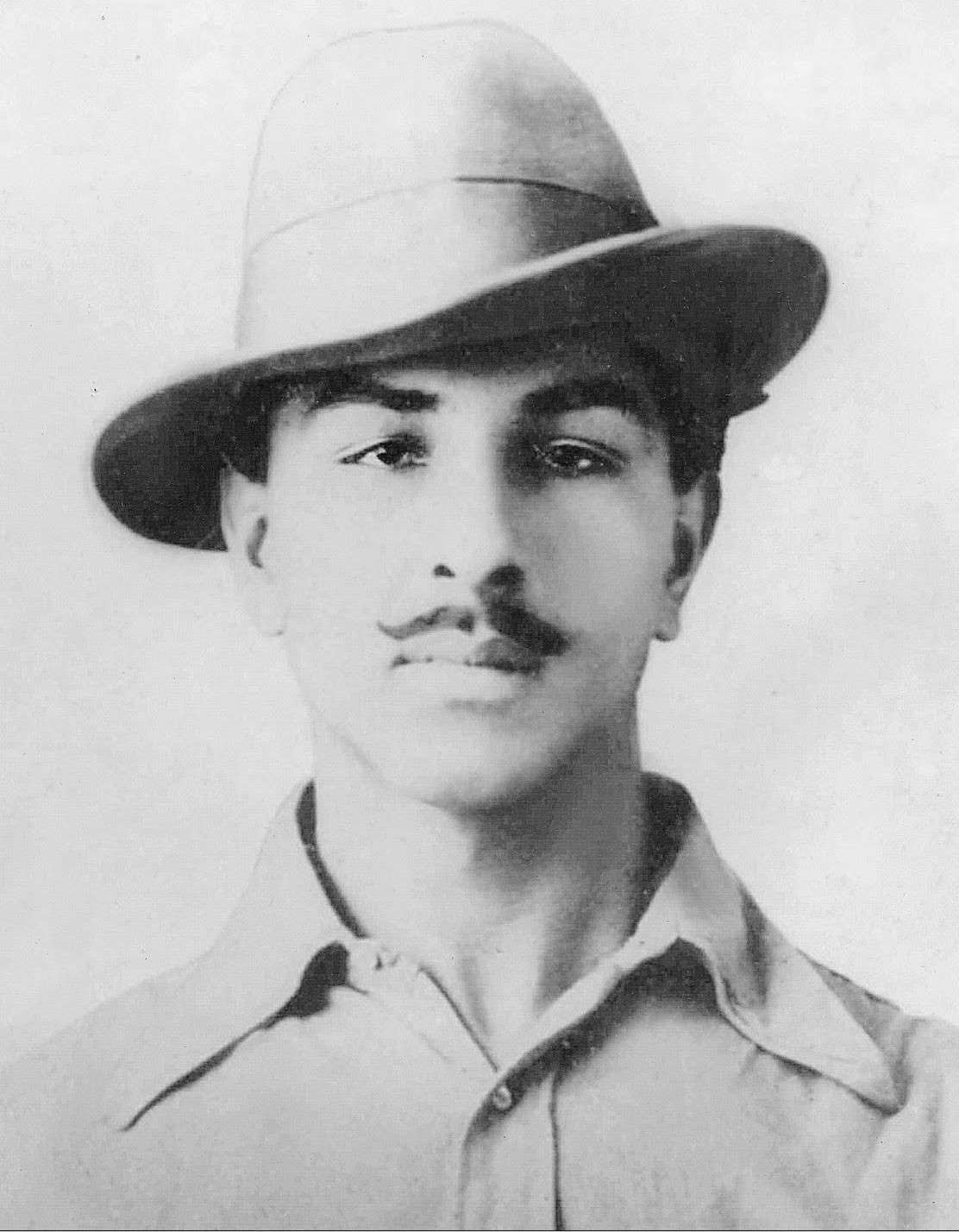
Bhagat Singh remains one of the most revered and inspiring figures in the history of India’s struggle for independence. A revolutionary, patriot, writer, and visionary, he dedicated his life to freeing India from British colonial rule. Although he lived only 23 years, his courage, sacrifice, and unwavering commitment to justice made him an immortal hero. His famous slogan, “Inquilab Zindabad” (Long Live the Revolution), continues to inspire generations of Indians.
Early Life
Bhagat Singh was born on September 28, 1907, in Banga village, Lyallpur district, Punjab (now in Pakistan). He was born into a patriotic Sikh family. His father, Kishan Singh, and his uncles, Ajit Singh and Swaran Singh, were actively involved in the freedom movement against British rule.
Growing up in such an environment, Bhagat Singh developed a deep love for his country from an early age. The stories of bravery, sacrifice, and resistance against British oppression shaped his thinking and inspired him to dedicate his life to India’s liberation.
The Impact of the Jallianwala Bagh Massacre
A turning point in Bhagat Singh’s life came with the Jallianwala Bagh Massacre of 1919. When hundreds of innocent Indians were killed by British troops under General Reginald Dyer in Amritsar, young Bhagat Singh was deeply affected.
Legend has it that he visited the site shortly after the massacre and collected blood-soaked soil in a bottle as a reminder of the sacrifices made by his fellow countrymen. This event strengthened his determination to fight against colonial oppression.
Education and Revolutionary Ideals
Bhagat Singh studied at the National College in Lahore, established by nationalist leader Lala Lajpat Rai. During his student years, he read extensively about world history, politics, socialism, revolution, and philosophy.
He admired revolutionaries from around the world and believed that true freedom involved not only political independence but also social and economic justice. He became a strong advocate for equality, secularism, and the rights of workers and peasants.
Joining the Revolutionary Movement
Bhagat Singh joined several revolutionary organizations, including the Hindustan Republican Association (HRA), which later became the Hindustan Socialist Republican Association (HSRA).
Along with fellow revolutionaries such as Chandrashekhar Azad, Sukhdev Thapar, Shivaram Rajguru, and Batukeshwar Dutt, he planned actions aimed at awakening the Indian masses and challenging British authority.
Unlike many revolutionaries who sought personal glory, Bhagat Singh believed that every act of resistance should inspire people to unite against oppression.
Revenge for Lala Lajpat Rai
In 1928, nationalist leader Lala Lajpat Rai was severely injured during a peaceful protest against the Simon Commission in Lahore. He later died from his injuries.
Bhagat Singh and his comrades held the British authorities responsible. They planned to assassinate Police Superintendent James A. Scott, who had ordered the brutal lathi charge. However, due to mistaken identity, Assistant Superintendent John Saunders was killed instead.
After the incident, Bhagat Singh escaped Lahore by disguising himself and successfully evaded the British police for several months.
The Central Legislative Assembly Bombing
One of Bhagat Singh’s most famous acts occurred on April 8, 1929, when he and Batukeshwar Dutt threw two low-intensity bombs into the Central Legislative Assembly in Delhi.
The bombs were deliberately designed not to kill anyone. Their objective was to “make the deaf hear” by drawing attention to British repression. After throwing the bombs, both revolutionaries remained at the scene, shouted revolutionary slogans, and distributed pamphlets explaining their motives before surrendering peacefully.
Their dramatic act gained nationwide attention and transformed Bhagat Singh into a household name.
Prison Life and Hunger Strike
While in prison, Bhagat Singh demanded equal treatment for Indian political prisoners. Along with fellow prisoners, he launched a historic hunger strike lasting more than two months.
The protesters demanded:
- Equal food and clothing with European prisoners.
- Access to books and newspapers.
- Better prison conditions.
- Recognition as political prisoners.
The hunger strike attracted widespread public sympathy and exposed the discriminatory practices of British prisons.
Even while imprisoned, Bhagat Singh continued to write essays and letters on freedom, revolution, socialism, religion, and human rights.
Trial and Martyrdom
Bhagat Singh, Rajguru, and Sukhdev were tried for the murder of John Saunders and other revolutionary activities.
Despite nationwide appeals for clemency, the British government sentenced all three to death.
On March 23, 1931, Bhagat Singh, Rajguru, and Sukhdev were executed in Lahore Central Jail. They embraced death with remarkable courage, reportedly shouting revolutionary slogans until their final moments.
The three revolutionaries became immortal martyrs in India’s struggle for independence.
Every year, March 23 is observed as Shaheed Diwas (Martyrs’ Day) in their memory.
Bhagat Singh’s Philosophy
Bhagat Singh was far more than a revolutionary fighter. He was a thoughtful intellectual who believed in reason, education, and social transformation.
His writings reveal his commitment to:
- National freedom.
- Social equality.
- Scientific thinking.
- Secularism.
- Justice for workers and peasants.
- Freedom from exploitation.
One of his most discussed essays is “Why I Am an Atheist,” in which he explains his beliefs with honesty and intellectual clarity.
Famous Quotes
Some of Bhagat Singh’s most memorable quotations include:
“They may kill me, but they cannot kill my ideas.”
“Revolution is an inalienable right of mankind.”
“Merciless criticism and independent thinking are the two necessary traits of revolutionary thinking.”
“The sword of revolution is sharpened on the whetting stone of ideas.”
These words continue to inspire young people to stand for justice, courage, and freedom.
Legacy
Bhagat Singh’s legacy extends far beyond India’s independence movement. He has become a universal symbol of youthful idealism, patriotism, and fearless resistance against injustice.
His life has inspired countless books, films, plays, songs, and scholarly works. Schools, universities, roads, parks, and public institutions across India bear his name.
Although his methods remain the subject of historical debate, there is no disagreement about his extraordinary courage, selflessness, and love for his country.
Conclusion
Bhagat Singh’s life demonstrates that greatness is measured not by the number of years one lives but by the impact one leaves on history. At just 23 years of age, he became one of India’s greatest national heroes. His sacrifice awakened millions and strengthened the resolve of a nation yearning for freedom.
Even today, Bhagat Singh stands as an enduring symbol of courage, sacrifice, and the unyielding pursuit of justice. His ideals continue to remind us that true patriotism is rooted in service, equality, and an unwavering commitment to the welfare of society.
:::
Leave a Reply