

Introduction
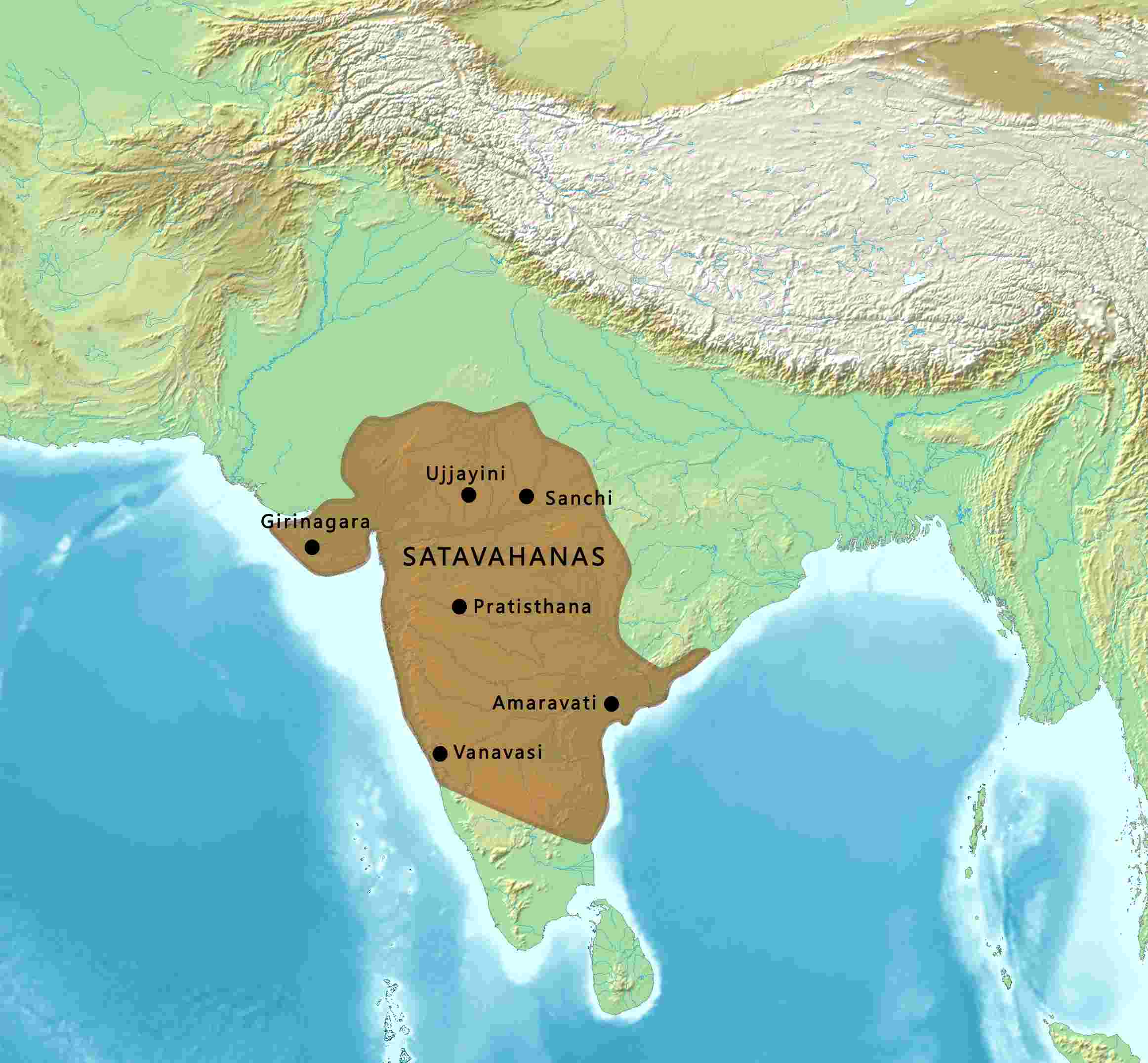
The Satavahana Dynasty (c. 230 BCE–220 CE) was one of the most influential and enduring dynasties in ancient Indian history. Emerging in the aftermath of the decline of the Mauryan Empire, the Satavahanas established a powerful kingdom in the Deccan Plateau, ruling large parts of present-day Maharashtra, Telangana, Andhra Pradesh, Madhya Pradesh, Karnataka, and Odisha.
Known as the Andhra Dynasty in many ancient texts, the Satavahanas played a vital role in unifying northern and southern India through trade, administration, religion, and culture. Their reign witnessed flourishing commerce with the Roman Empire, remarkable developments in Buddhist architecture, and the growth of regional languages and literature.
The Satavahana rulers left a lasting legacy by promoting religious harmony, strengthening inland and maritime trade, and laying the foundation for the political and cultural development of the Deccan.
Historical Background
The decline of the Mauryan Empire around 185 BCE led to the rise of several regional kingdoms across India. In the Deccan region, the Satavahanas gradually emerged as the dominant political power.
Although the exact origins of the dynasty remain debated, most historians agree that they belonged to the Deccan and established their authority in the Godavari River valley before expanding across central India.
The dynasty ruled for nearly 450 years, making it one of the longest-lasting royal houses in Indian history.
Foundation of the Dynasty
The founder of the Satavahana Dynasty is generally believed to be Simuka, who established the kingdom around 230 BCE.
Simuka consolidated various local chiefdoms and laid the foundation of a centralized state.
He was succeeded by his brother Krishna (Kanha), who further expanded the kingdom and strengthened its administration.
The dynasty’s early capital was likely Pratishthana (modern Paithan in Maharashtra), although other important cities later served as administrative centers.
Expansion of the Empire
Over the centuries, the Satavahana rulers expanded their kingdom across much of the Deccan.
At its greatest extent, the empire included territories covering:
- Maharashtra
- Telangana
- Andhra Pradesh
- Northern Karnataka
- Parts of Madhya Pradesh
- Gujarat
- Odisha
The Satavahanas controlled important inland trade routes as well as ports along India’s western and eastern coasts, making them a major commercial power.
Gautamiputra Satakarni: The Greatest Satavahana King
The most celebrated ruler of the dynasty was Gautamiputra Satakarni (c. 106–130 CE).
He is regarded as one of the greatest monarchs of ancient India.
His achievements included:
- Defeating the Western Kshatrapas (Shakas).
- Restoring Satavahana authority across western India.
- Expanding the empire to its greatest territorial extent.
- Strengthening central administration.
- Protecting important trade routes.
Much of what historians know about him comes from the famous Nashik Prashasti (Nashik Inscription), commissioned by his mother Gautami Balashri.
The inscription praises him as a just ruler who defended dharma and restored the prestige of the Satavahana dynasty.
Successors
After Gautamiputra Satakarni, his son Vashishthiputra Pulumavi continued to govern a prosperous kingdom.
Later rulers maintained the empire, though repeated conflicts with the Western Kshatrapas gradually weakened Satavahana authority.
Despite political challenges, trade and cultural development continued to flourish during much of the dynasty’s later period.
Administration
The Satavahana rulers developed an effective administrative system that combined centralized authority with local governance.
The King
The king served as:
- Supreme ruler.
- Commander of the army.
- Chief administrator.
- Protector of religion.
Royal authority was often hereditary, although capable leadership remained essential for maintaining control over the vast empire.
Provincial Administration
The empire was divided into provinces governed by royal officials.
Local administration relied upon:
- Provincial governors.
- District officers.
- Village headmen.
- Merchant guilds.
These institutions helped maintain law, collect taxes, and supervise public works.
Economy
Agriculture formed the foundation of the Satavahana economy.
Major crops included:
- Rice.
- Wheat.
- Millet.
- Cotton.
- Sugarcane.
- Pulses.
The fertile river valleys of the Godavari, Krishna, and Narmada supported prosperous farming communities.
Taxation on agriculture provided an important source of state revenue.
Trade and Commerce
One of the defining features of the Satavahana period was its thriving trade.
Inland Trade
The empire controlled important caravan routes connecting:
- Northern India.
- Southern India.
- Western coastal ports.
- Eastern coastal regions.
Merchants transported textiles, spices, precious stones, metals, and agricultural products across the subcontinent.
Overseas Trade
The Satavahanas maintained flourishing maritime trade with:
- The Roman Empire.
- Egypt.
- Arabia.
- Southeast Asia.
Major exports included:
- Cotton textiles.
- Pepper.
- Spices.
- Ivory.
- Beads.
- Precious stones.
- Pearls.
Imports included:
- Gold coins.
- Wine.
- Glassware.
- Coral.
- Luxury goods.
Large numbers of Roman gold coins discovered in the Deccan testify to the prosperity of Indo-Roman trade during this period.
Society
Satavahana society was diverse and multicultural.
Various social groups included:
- Farmers.
- Traders.
- Artisans.
- Priests.
- Soldiers.
- Merchants.
- Monks.
Merchant guilds became increasingly influential and often financed temples, monasteries, roads, and irrigation projects.
Women enjoyed relatively significant social status compared to many contemporary societies.
Several inscriptions identify rulers through their mothers, reflecting the importance of maternal lineage in royal identity.
Religion
The Satavahana rulers generally followed Brahmanical Hinduism, performing Vedic sacrifices and supporting Brahmin scholars.
At the same time, they generously patronized Buddhism.
This policy of religious tolerance allowed multiple traditions to flourish peacefully.
Royal donations supported:
- Buddhist monasteries.
- Stupas.
- Hindu temples.
- Religious scholars.
- Pilgrimage centers.
Jainism also continued to flourish in parts of the Deccan.
Art and Architecture
The Satavahana period witnessed remarkable artistic achievements.
Amaravati Stupa
One of the greatest monuments associated with the dynasty is the Amaravati Stupa in present-day Andhra Pradesh.
Known for its:
- Beautiful limestone sculptures.
- Detailed relief carvings.
- Buddhist narratives.
- Elegant artistic style.
It became one of the most important centers of Buddhist art in ancient India.
Rock-cut Caves
The Satavahana rulers and wealthy merchants sponsored many cave monasteries.
Famous examples include:
- Karla Caves.
- Bhaja Caves.
- Nashik Caves.
- Kanheri Caves.
These caves served as monasteries, prayer halls, and rest houses for monks and traders.
Literature and Language
The Satavahana age encouraged literary development.
One of the most famous literary works of the period is the Gatha Saptashati, a collection of lyrical poems traditionally attributed to King Hala, a Satavahana ruler.
The dynasty promoted:
- Prakrit literature.
- Sanskrit learning.
- Local languages.
Many inscriptions were written in Prakrit using the Brahmi script, providing valuable historical information.
Coinage
The Satavahanas issued coins made from:
- Lead.
- Copper.
- Bronze.
- Silver.
Their coins often depicted:
- Elephants.
- Ships.
- Lions.
- Horses.
- Religious symbols.
- Royal portraits.
These coins provide important evidence of the dynasty’s economy, trade, and political authority.
Decline of the Dynasty
By the late second century CE, the Satavahana Empire began to weaken.
Several factors contributed to its decline:
- Succession disputes.
- Frequent wars with the Western Kshatrapas.
- Rise of regional powers.
- Administrative decentralization.
- Economic pressures.
Around 220 CE, the dynasty came to an end, and several regional kingdoms emerged in the Deccan, including the Ikshvakus, Abhiras, and later the Vakatakas.
Legacy of the Satavahana Dynasty
The Satavahana Dynasty occupies a unique place in Indian history.
Its lasting contributions include:
- Political unification of much of the Deccan.
- Expansion of inland and overseas trade.
- Promotion of Buddhism and Hinduism.
- Development of Prakrit literature.
- Patronage of magnificent Buddhist architecture.
- Strengthening commercial guilds.
- Cultural integration between northern and southern India.
Their reign served as a bridge connecting the traditions of the Mauryan age with the later classical civilizations of the Gupta period.
Interesting Facts
- The Satavahanas ruled for nearly 450 years.
- They are often referred to as the Andhra Dynasty in ancient literary sources.
- Roman gold coins discovered in Satavahana territories reveal extensive international trade.
- The famous Amaravati School of Art flourished under their patronage.
- Several Satavahana rulers identified themselves using their mother’s name, an unusual feature among ancient Indian dynasties.
Lessons from the Satavahana Dynasty
The history of the Satavahanas teaches several enduring lessons:
- Strong trade networks contribute to national prosperity.
- Religious tolerance promotes social harmony.
- Investment in infrastructure encourages economic growth.
- Cultural exchange enriches civilization.
- Effective regional governance can unite diverse communities.
Conclusion
The Satavahana Dynasty stands as one of the foundational powers of ancient India, bridging the gap between the Mauryan and Gupta eras. Through wise administration, flourishing trade, religious tolerance, and patronage of art and literature, the Satavahanas transformed the Deccan into a vibrant center of political, economic, and cultural activity.
Their encouragement of commerce connected India with the wider world, while their support for Buddhism and Hinduism fostered a rich spiritual landscape. The magnificent stupas, rock-cut caves, literary works, and coins they left behind continue to testify to their achievements. More than two millennia later, the Satavahana Dynasty remains a shining example of how stability, cultural openness, and economic vision can shape the destiny of a civilization.
Leave a Reply