

Introduction
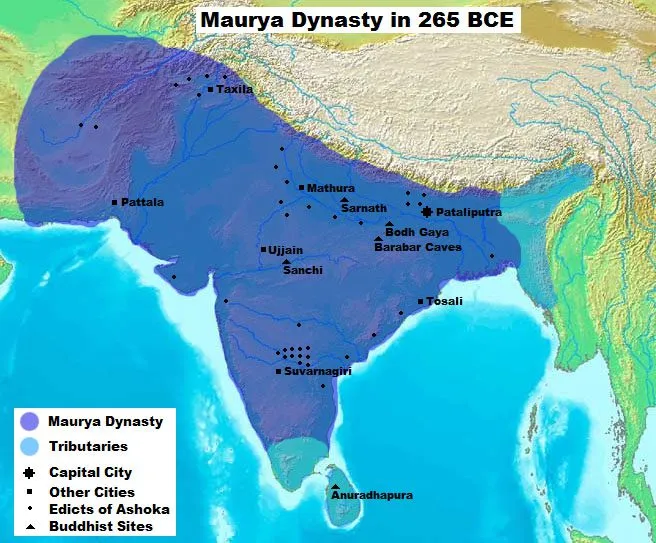
The Mauryan Empire (c. 322–185 BCE) was the first empire to unify most of the Indian subcontinent under a single centralized administration. Founded by Chandragupta Maurya, the empire marked the beginning of a new era in Indian political, economic, military, and cultural history. Stretching from present-day Afghanistan in the northwest to much of southern India, the Mauryan Empire became one of the largest and most powerful empires of the ancient world.
The empire reached its greatest extent under Emperor Ashoka the Great, whose embrace of Buddhism after the devastating Kalinga War transformed not only his reign but also the religious and moral landscape of Asia. Ashoka’s principles of nonviolence, compassion, and righteous governance left an enduring legacy that continues to inspire people around the world.
The Mauryan period also witnessed remarkable developments in administration, trade, architecture, literature, diplomacy, and governance, making it one of the foundational eras of Indian civilization.
Historical Background
Before the rise of the Mauryan Empire, northern India was divided into numerous kingdoms and republics known as the Mahajanapadas.
Among these, the Nanda Dynasty, ruling from Pataliputra (modern-day Patna), had established considerable power but was unpopular due to heavy taxation and centralized control.
At the same time, Alexander the Great invaded northwestern India in 326 BCE, defeating several local rulers before his army refused to advance further into the subcontinent. Although Alexander soon returned westward, his campaign weakened several regional powers and created political instability that paved the way for the rise of Chandragupta Maurya.
Foundation of the Empire
The Mauryan Empire was founded by Chandragupta Maurya around 322 BCE.
Guided by his brilliant adviser Chanakya (also known as Kautilya or Vishnugupta), Chandragupta overthrew the Nanda Dynasty and established a new imperial government.
Chanakya, a renowned scholar of politics and economics, played a crucial role in planning the empire’s administration. His famous treatise, the Arthashastra, provides valuable insights into governance, diplomacy, taxation, military organization, espionage, and statecraft.
Together, Chandragupta and Chanakya laid the foundation for one of history’s most efficient administrative systems.
Chandragupta Maurya (c. 322–297 BCE)
Chandragupta Maurya was one of India’s greatest empire builders.
His achievements included:
- Defeating the Nanda rulers.
- Unifying northern India.
- Expanding the empire into northwestern regions.
- Establishing a highly organized central administration.
- Building a powerful standing army.
Around 305 BCE, Chandragupta defeated Seleucus I Nicator, one of Alexander’s successors. A peace treaty followed, under which Seleucus ceded territories in present-day Afghanistan, Pakistan, and parts of Iran to the Mauryan Empire.
The agreement also strengthened diplomatic and trade relations between India and the Hellenistic world.
Greek ambassador Megasthenes visited Chandragupta’s court and later wrote Indica, one of the earliest foreign accounts of ancient India.
Toward the end of his life, Chandragupta is traditionally believed to have embraced Jainism and abdicated the throne in favor of his son, Bindusara. According to Jain tradition, he spent his final years at Shravanabelagola in present-day Karnataka.
Bindusara (c. 297–273 BCE)
Bindusara succeeded his father and continued expanding the empire.
Although less is known about his reign, historical records suggest that he extended Mauryan authority into much of peninsular India, leaving only the southernmost Tamil kingdoms independent.
Greek sources refer to Bindusara as Amitrochates, believed to derive from the Sanskrit title Amitraghata (“Slayer of Enemies”).
His reign maintained political stability and strengthened diplomatic ties with Hellenistic kingdoms, including those of Syria and Egypt.
Ashoka the Great (c. 268–232 BCE)
The most celebrated ruler of the Mauryan Empire was Emperor Ashoka, one of history’s greatest monarchs.
Initially known as a capable military commander, Ashoka expanded the empire further through conquest.
His most significant military campaign was the Kalinga War around 261 BCE.
Although victorious, the war caused enormous loss of life. According to Ashoka’s own inscriptions, more than 100,000 people were killed and many more suffered displacement.
Deeply moved by the devastation, Ashoka underwent a profound moral transformation.
Ashoka’s Conversion to Buddhism
Following the Kalinga War, Ashoka embraced the teachings of Buddhism.
Instead of pursuing military conquest, he adopted the policy of Dhamma (Dharma), emphasizing:
- Nonviolence.
- Compassion.
- Religious tolerance.
- Respect for all living beings.
- Justice.
- Moral self-discipline.
- Welfare of the people.
Ashoka did not impose Buddhism as the state religion but encouraged ethical conduct among all citizens regardless of their faith.
His reign became a model of moral kingship.
Ashoka’s Edicts
Ashoka communicated his principles through inscriptions carved on rocks and stone pillars throughout the empire.
These Ashokan Edicts remain among the earliest deciphered written records of ancient India.
The inscriptions discuss:
- Good governance.
- Kindness toward animals.
- Respect for parents and teachers.
- Religious harmony.
- Honesty.
- Compassion.
- Public welfare.
- Justice.
The famous Lion Capital of Sarnath, originally atop one of Ashoka’s pillars, was adopted as the National Emblem of India. The Ashoka Chakra, a 24-spoked wheel from another pillar, appears at the center of the Indian national flag.
Administration of the Mauryan Empire
The Mauryan Empire developed one of the most sophisticated administrative systems of the ancient world.
Central Government
The emperor exercised supreme authority but was assisted by ministers and advisers.
Key departments managed:
- Finance.
- Revenue.
- Justice.
- Agriculture.
- Trade.
- Defense.
- Public works.
- Foreign affairs.
Provincial Administration
The empire was divided into provinces governed by royal princes or trusted officials.
Important provincial capitals included:
- Taxila.
- Ujjain.
- Tosali.
- Suvarnagiri.
These provinces were further divided into districts and villages administered by local officers.
Intelligence System
The Mauryan government maintained an extensive network of spies and informants.
Chanakya regarded intelligence gathering as essential for maintaining security, preventing corruption, and ensuring efficient administration.
Economy
The Mauryan economy was prosperous and well organized.
Major sources of revenue included:
- Agriculture.
- Land taxes.
- Trade.
- Mining.
- Forestry.
- Customs duties.
- Craft production.
The state regulated weights, measures, markets, and prices to promote fairness and economic stability.
Trade and Commerce
The Mauryan Empire participated actively in both domestic and international trade.
Trade routes connected India with:
- Central Asia.
- Persia.
- Egypt.
- Greece.
- Sri Lanka.
- Southeast Asia.
Major exports included:
- Cotton textiles.
- Spices.
- Ivory.
- Precious stones.
- Metal goods.
Imports included horses, luxury items, and fine wines.
Society and Culture
Mauryan society was diverse and multicultural.
Different religious traditions flourished, including:
- Hinduism.
- Buddhism.
- Jainism.
- Local folk traditions.
Ashoka encouraged mutual respect among religious communities, making religious tolerance a hallmark of his reign.
Education, literature, philosophy, medicine, and the arts flourished during this period.
Architecture and Art
The Mauryan period witnessed remarkable achievements in architecture.
Notable examples include:
- Ashokan pillars.
- Rock edicts.
- Stupas.
- Monasteries.
- Palaces.
- Fortifications.
The polished sandstone pillars erected by Ashoka remain masterpieces of ancient Indian craftsmanship.
The Great Stupa at Sanchi, although enlarged in later centuries, traces its origins to Ashoka’s patronage and remains one of the finest examples of early Buddhist architecture.
Decline of the Mauryan Empire
After Ashoka’s death around 232 BCE, the empire gradually weakened.
Several factors contributed to its decline:
- Weak successors.
- Administrative difficulties.
- Financial strain.
- Provincial revolts.
- Reduced central authority.
In 185 BCE, the last Mauryan ruler, Brihadratha Maurya, was assassinated by his commander Pushyamitra Shunga, who founded the Shunga Dynasty.
This event marked the end of the Mauryan Empire.
Legacy of the Mauryan Empire
Despite its fall, the Mauryan Empire profoundly influenced Indian history.
Its enduring contributions include:
- The first political unification of much of the Indian subcontinent.
- A highly organized administrative system.
- Promotion of trade and economic development.
- Spread of Buddhism across Asia.
- Enduring ideals of ethical governance.
- Monumental architecture and inscriptions.
- Foundations for later Indian empires.
Ashoka’s emphasis on peace, justice, and compassion continues to inspire leaders and scholars worldwide.
Interesting Facts
- The Mauryan Empire covered nearly 5 million square kilometers at its greatest extent.
- Pataliputra was among the largest cities in the ancient world.
- The empire maintained one of history’s largest standing armies.
- The Arthashastra remains one of the world’s earliest and most comprehensive treatises on political science and economics.
- Ashoka sent Buddhist missionaries to Sri Lanka, Central Asia, and other regions, helping Buddhism become a major world religion.
Lessons from the Mauryan Empire
The history of the Mauryan Empire teaches several enduring lessons:
- Strong leadership can unite diverse peoples under effective governance.
- Good administration is essential for national stability and prosperity.
- Military success should be balanced by compassion and justice.
- Religious tolerance fosters social harmony.
- Ethical leadership leaves a legacy that outlasts military conquest.
- Education, diplomacy, and economic development are vital for lasting civilization.
Conclusion
The Mauryan Empire was one of the greatest civilizations of the ancient world and a defining chapter in Indian history. Through the leadership of Chandragupta Maurya, the wisdom of Chanakya, and the moral vision of Emperor Ashoka, the empire demonstrated that political strength could be combined with administrative excellence, cultural flourishing, and ethical governance.
Although the empire came to an end in 185 BCE, its legacy continues to shape India’s identity. The ideals of justice, tolerance, efficient administration, and compassionate leadership championed by the Mauryan rulers remain relevant even today. As India’s first great empire, the Mauryan dynasty stands as a lasting symbol of unity, statecraft, and the enduring pursuit of peace and human welfare.
Leave a Reply