

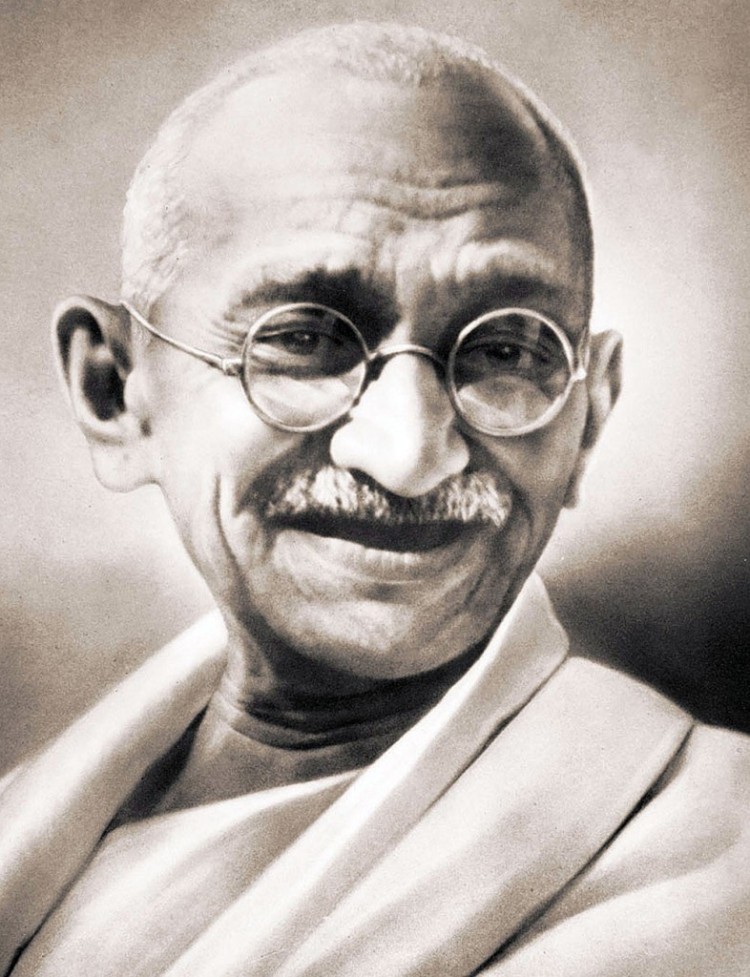
Few individuals in modern history have influenced the course of human civilization as profoundly as Mahatma Gandhi. Revered as the “Father of the Nation” in India, Gandhi transformed the struggle for Indian independence into a moral movement rooted in truth, nonviolence, and human dignity.
His life was a remarkable journey of courage, sacrifice, and unwavering commitment to justice. Through his philosophy of Satyagraha—the force of truth—and Ahimsa—the principle of nonviolence—he inspired millions in India and influenced civil rights movements across the world.
More than seven decades after his death, Gandhi remains a global symbol of peace, freedom, and moral leadership.
Early Life and Family
Mahatma Gandhi was born as Mohandas Karamchand Gandhi on October 2, 1869, in Porbandar, a coastal town in present-day Gujarat, India.
His father, Karamchand Gandhi, served as the chief minister of Porbandar, while his mother, Putlibai, was a deeply religious woman whose devotion greatly influenced Gandhi’s character.
From an early age, Gandhi was exposed to the values of honesty, self-discipline, compassion, and religious tolerance. These principles would later become the foundation of his philosophy and public life.
At the age of thirteen, he married Kasturba Gandhi, who would become his lifelong companion and partner in many of his social and political struggles.
Education in England
In 1888, Gandhi traveled to London to study law. While there, he enrolled at the Inner Temple and qualified as a barrister.
His years in England broadened his intellectual horizons. He studied various religious and philosophical traditions, including Christianity, Hinduism, Buddhism, and Islam. He was particularly influenced by texts such as the Bhagavad Gita, the Bible, and the writings of philosophers like Leo Tolstoy and John Ruskin.
These influences helped shape his understanding of morality, simplicity, and social responsibility.
The South African Experience
A defining chapter in Gandhi’s life began in 1893 when he traveled to South Africa to work as a lawyer.
There, he experienced racial discrimination firsthand. One famous incident occurred when he was thrown out of a first-class railway compartment despite holding a valid ticket because of his race.
This humiliation profoundly affected him and awakened his determination to fight injustice.
Over the next twenty-one years, Gandhi became a leader of the Indian community in South Africa. He organized campaigns against discriminatory laws and developed the philosophy of Satyagraha, which emphasized peaceful resistance, civil disobedience, and moral courage.
His success in South Africa prepared him for the larger struggle that awaited him in India.
Return to India
Gandhi returned to India in 1915 and soon became involved in public life.
Traveling extensively across the country, he witnessed widespread poverty, social inequality, and the hardships endured under British colonial rule.
Rather than leading from elite circles, Gandhi chose to identify with ordinary people. He adopted simple clothing, lived modestly, and sought to understand the struggles of farmers, laborers, and the poor.
This approach earned him immense respect and transformed him into a national leader.
The Indian Freedom Movement
Champaran Movement (1917)
One of Gandhi’s first major successes in India came in Champaran, Bihar, where he supported farmers who were being exploited by British indigo plantation owners.
His peaceful campaign resulted in significant reforms and demonstrated the effectiveness of nonviolent resistance.
Non-Cooperation Movement (1920–1922)
Gandhi called upon Indians to boycott British institutions, goods, and services. Millions participated, making it one of the largest mass movements in Indian history.
Although the movement was suspended after incidents of violence, it strengthened the demand for self-rule.
Salt March (1930)
The Salt March remains one of the most iconic events in world history.
To protest the British monopoly on salt production, Gandhi led a 240-mile march from Sabarmati Ashram to Dandi. Upon reaching the coast, he symbolically made salt, defying British law.
The event attracted worldwide attention and became a powerful symbol of resistance against oppression.
Quit India Movement (1942)
During World War II, Gandhi launched the Quit India Movement, demanding an immediate end to British rule.
His famous call, “Do or Die,” inspired millions. Although he and many leaders were imprisoned, the movement accelerated the process that ultimately led to independence.
Philosophy of Nonviolence
The cornerstone of Gandhi’s life and work was Ahimsa, or nonviolence.
For Gandhi, nonviolence was not merely the absence of physical violence. It was an active force based on love, compassion, truth, and respect for human dignity.
He believed that lasting change could never be achieved through hatred or revenge. Instead, he argued that moral persuasion and peaceful resistance were more powerful than weapons.
His philosophy later inspired leaders such as:
- Martin Luther King Jr.
- Nelson Mandela
- Desmond Tutu
- Cesar Chavez
Social Reform and Humanitarian Work
Gandhi’s concerns extended beyond political independence.
Fight Against Untouchability
He worked tirelessly to eradicate untouchability and discrimination against marginalized communities, whom he called “Harijans,” meaning “Children of God.”
Promotion of Village Industries
Gandhi encouraged self-reliance through local industries, especially hand-spinning and weaving. The spinning wheel, or charkha, became a symbol of economic independence.
Religious Harmony
Gandhi believed that all religions contained truth and should be respected. He promoted dialogue and unity among Hindus, Muslims, Christians, Sikhs, and people of other faiths.
Simplicity and Self-Discipline
His personal lifestyle reflected his ideals. He embraced simplicity, vegetarianism, fasting, and voluntary poverty as means of spiritual growth and service.
Independence and Partition
On August 15, 1947, India finally achieved independence from British rule.
However, independence was accompanied by the partition of British India into India and Pakistan, leading to widespread communal violence and displacement.
Gandhi was deeply saddened by the bloodshed. Rather than participating in official celebrations, he devoted himself to promoting peace and reconciliation among divided communities.
His efforts helped calm tensions and save countless lives.
Assassination
On January 30, 1948, Gandhi was assassinated in New Delhi by Nathuram Godse while on his way to a prayer meeting.
His death shocked India and the world.
According to many eyewitness accounts, his final words were:
“Hey Ram” (“O God”).
Millions mourned his passing, recognizing the loss of one of humanity’s greatest moral leaders.
Legacy and Global Influence
Mahatma Gandhi’s influence extends far beyond India.
His ideas continue to inspire movements for:
- Civil rights
- Human rights
- Social justice
- Peacebuilding
- Environmental responsibility
- Conflict resolution
The United Nations observes October 2, Gandhi’s birthday, as the International Day of Non-Violence, recognizing his enduring contribution to humanity.
Today, statues, memorials, schools, roads, and institutions around the world bear his name, reflecting his universal significance.
Famous Quotes by Mahatma Gandhi
- “Be the change that you wish to see in the world.”
- “An eye for an eye makes the whole world blind.”
- “The best way to find yourself is to lose yourself in the service of others.”
- “Strength does not come from physical capacity. It comes from an indomitable will.”
- “Where there is love there is life.”
Conclusion
Mahatma Gandhi was more than a political leader; he was a moral visionary who transformed the struggle for freedom into a movement based on truth, justice, and nonviolence. His life demonstrated that courage does not require weapons, and that the power of conscience can overcome even the mightiest empires.
Though he lived in a turbulent age, his message remains timeless. In a world often marked by conflict and division, Gandhi’s commitment to truth, peace, and human dignity continues to offer hope and inspiration.
His life reminds us that one individual, armed only with conviction and moral courage, can change the course of history.
“My life is my message.” — Mahatma Gandhi
Leave a Reply