

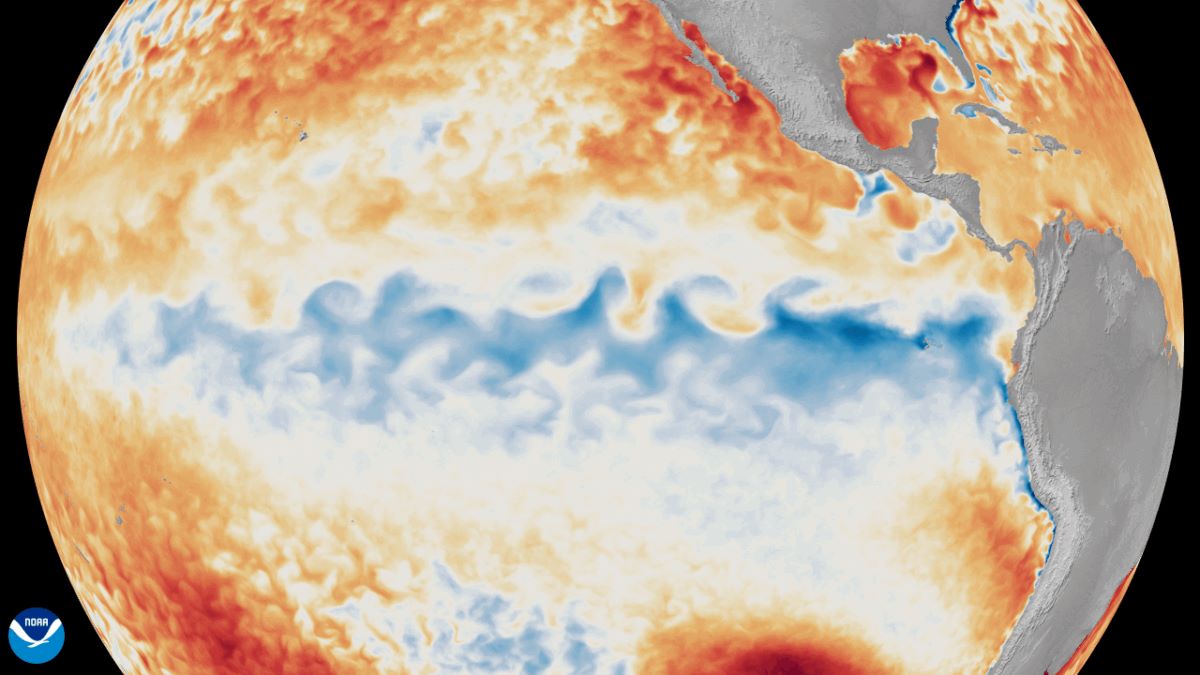
El Niño is a natural climate phenomenon that occurs in the tropical Pacific Ocean when sea surface temperatures become unusually warm in the central and eastern Pacific. It is part of a larger climate pattern known as the El Niño–Southern Oscillation (ENSO), which influences weather patterns around the world.
The term El Niño is Spanish for “The Little Boy” or “Christ Child,” a name given by South American fishermen because the warming of ocean waters was often noticed around Christmas.
Understanding Normal Pacific Ocean Conditions
Under normal conditions:
- Strong trade winds blow from east to west across the tropical Pacific Ocean.
- These winds push warm surface water toward Indonesia and Australia.
- Along the western coast of South America, cold, nutrient-rich water rises from deeper layers of the ocean in a process called upwelling.
- This pattern supports marine life and helps maintain normal weather conditions.
How Does El Niño Occur?
El Niño develops when the trade winds weaken or even reverse direction.
Step 1: Weakening of Trade Winds
For reasons related to interactions between the ocean and atmosphere, the normally strong trade winds become weaker.
Step 2: Eastward Movement of Warm Water
As the winds weaken, warm water that had accumulated in the western Pacific begins to move eastward toward the coast of South America.
Step 3: Reduced Upwelling
The movement of warm water suppresses the upwelling of cold, nutrient-rich water from the deep ocean.
Step 4: Rise in Ocean Temperatures
Sea surface temperatures in the central and eastern Pacific become significantly warmer than average.
Step 5: Changes in Global Weather
The warmer ocean transfers more heat and moisture into the atmosphere, altering wind patterns and affecting weather across many regions of the world.
Effects of El Niño
1. Heavy Rainfall and Flooding
Some regions experience unusually heavy rains and flooding.
Examples:
- Western coast of South America
- Parts of the southern United States
2. Droughts
Other regions may suffer severe drought conditions.
Examples:
- Australia
- Indonesia
- Parts of India
3. Impact on Agriculture
Changes in rainfall and temperature can reduce crop yields and affect food production.
4. Marine Ecosystem Disruptions
Reduced upwelling means fewer nutrients reach the surface waters, affecting fish populations and marine biodiversity.
5. Increased Global Temperatures
El Niño years are often among the warmest years on record because of the extra heat released from the Pacific Ocean into the atmosphere.
El Niño and India
India is particularly sensitive to El Niño because it can weaken the Southwest Monsoon, which provides most of the country’s annual rainfall.
Possible impacts include:
- Reduced monsoon rainfall
- Water shortages
- Lower agricultural productivity
- Increased risk of heat waves
However, El Niño does not always cause drought in India, as other climate factors can also influence the monsoon.
La Niña: The Opposite of El Niño
The opposite phase of ENSO is called La Niña (“The Little Girl”).
During La Niña:
- Trade winds become stronger than normal.
- More warm water is pushed toward the western Pacific.
- Cold-water upwelling increases along South America.
- Global weather patterns shift in the opposite direction of El Niño.
Conclusion
El Niño is a recurring climate phenomenon caused by the warming of surface waters in the central and eastern Pacific Ocean. It develops when the trade winds weaken, allowing warm water to spread eastward and disrupt normal ocean-atmosphere interactions. Although it begins in the Pacific Ocean, El Niño influences weather, agriculture, ecosystems, and economies across the globe, making it one of the most important climate patterns on Earth.
Leave a Reply